





SINN FÉIN made a big mistake in 2020.
The party had been on a journey away from revolutionary politics towards being a viable choice to lead Ireland: but it did not recognise its best chance.
Normally adept at strategising for elections to maximise the number of seats it might get, it slipped up in the general election in the Irish Republic that year.
It didn’t run enough candidates. As a consequence, it led the field in percentage share of the first-preference votes (24.5%) but came in behind Fianna Fáil.
This was an enormous breakthrough for a party which had had problems winning over an electorate wary of its past associations with the Provisional IRA.
There were now three major parties of roughly equal representation in the Dáil and, while two of them, Fianna Fáil and Fine Gael, could block Sinn Féin from entering a coalition by teaming up with the Greens, it seemed unlikely they would be able to repeat that stunt at the next election.
Sinn Féin under Mary Lou McDonald started preparing for government.
One of those hired for the job of making the party attractive was journalist Siobhán Fenton. She was not a party activist but she had been spotted as someone young and energetic and concerned with liberal issues.
They asked her if she would like to work on their media campaign.
For almost five years, Fenton worked closely with Mary Lou McDonald, Pearse Doherty and other leading party figures, honing their speeches and the answers they would give at press conferences.
She has written about this period and the catastrophic collapse of Sinn Féin’s support in her new book Ourselves Alone (Penguin).
Sinn Féin’s support rose sharply to 36% then slid rapidly back down to the low twenties, its hopes thwarted in three successive electoral contests: local government, the European Parliament and Dáil Éireann.
So what went wrong?
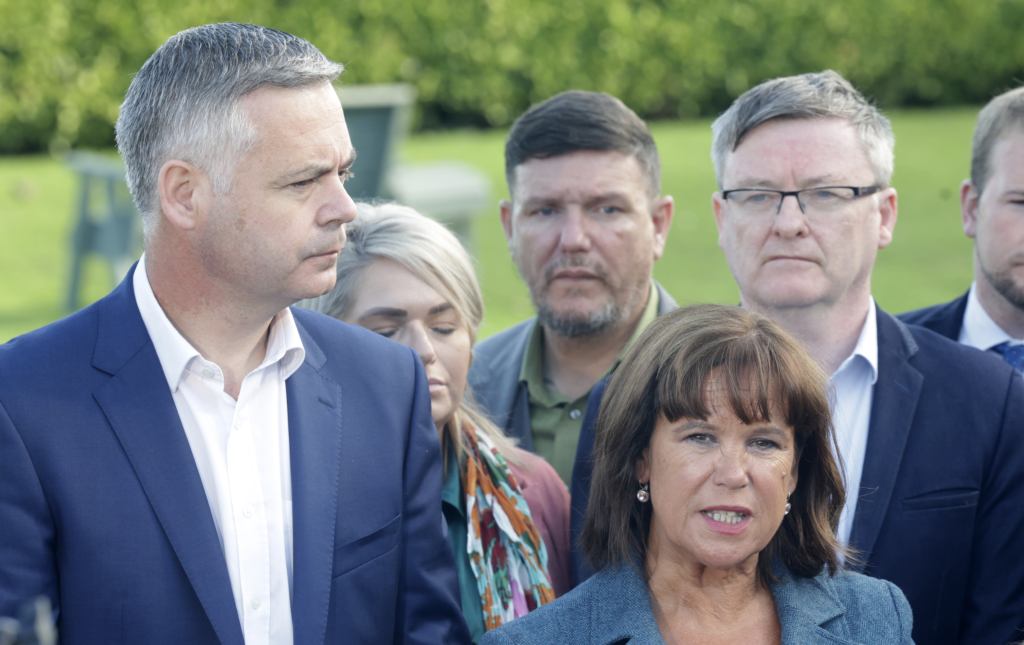 Sinn Féin leader Mary Lou McDonald
Siobhán Fenton tells the inside story of deliberations within the party through successive challenges. In the end, she quite unfairly considers that she might have been part of the problem herself, might not have advised Mary Lou McDonald well enough.
Readers will be more likely to conclude that the problem was McDonald herself, creating the biggest difficulties when acting on her own initiative.
For example, after the Dublin riots in 2023, which followed a knife attack in which three children and a care worker were injured, she went against popular sentiment by criticising the gardaí. Public sympathy was with the police, given what they had suffered in the rioting.
Siobhán Fenton says that she feared that some people might interpret McDonald’s comments “in the context of Sinn Féin’s historic links to the IRA”. An astute press officer, concerned to present an image of Sinn Féin as a modern party fit for government, would not have risked inviting that cynical reading of McDonald’s intention.
The Garda Commissioner, Drew Harris, had been deputy chief constable of the Police Service of Northern Ireland when then Sinn Féin president Gerry Adams was arrested in 2014 and later released without charge.
Then McDonald winged it on another issue, though with Fenton close by. The big issue for Sinn Féin was the housing crisis. Irish Times political correspondent Pat Leahy asked McDonald what she saw as the appropriate price for a house in Dublin and she offered up the figure of €300,000. This caused alarm among householders afraid that, if Sinn Féin came to power, the value of their houses would drop and they might get stuck owing more on them than they could be sold for.
In Ireland, houses are often not just homes, they are investments.
And while Fenton cringes at not having saved McDonald from that trap, perhaps by having rehearsed the question in advance, it’s hard to see how she could have sidestepped it.
Houses are as much subject to the laws of supply and demand as mobile phones, jewellery or package holidays.
Any political party ambitious to build, build, build will threaten the market price of a house. What’s to be done about that? You either lose the middle classes who have mortgages or you betray the poor who need homes, but you need both to vote for you if you are to win an election.
The third crisis for Sinn Féin was the rising protests against migrants coming into the country. Fenton says that the party had cut itself off from attitudes on the street and misread the intensity of feeling against migrants until Fenton herself was pelted with coins while canvassing in a poor housing area where they had expected strong support.
This was another issue which divided people so deeply that Sinn Féin could not take a position on it without losing support.
And then, Fenton asks herself, what if we’d got it wrong all along? What if the surge in support for Sinn Féin had been more a rejection of the other parties than an endorsement of the newcomers? How much did people really understand the party and its policies?
Very little, it seems, for people on the doorsteps had seen so much of Mary Lou McDonald that they assumed she was in government, that she too was to be blamed for the problems for which she was struggling to articulate a solution.
Everything from irishpost.com and the print edition is available on the Irish Post App — plus more! Download it for Android or Apple IOS devices today.
See More: Mary Lou Mcdonald, Sinn Féin
