





THERE is a remarkable young Irish woman from Limerick called Natasha O’Brien.
She came to public prominence when she campaigned against the unfairness of the suspended sentence given to the man who had brutally attacked her.
Following an appeal by the Director of Public Prosecutions, he was sent to prison. After the attack, he had boasted on Snapchat: “Two to put her down, two to put her out.”
Her bravery in standing up and refusing to accept the injustice she saw in that sentence brought her media attention across Ireland.
She has spoken both of the horror of the attack and of the strength she drew from the support she received. Her subsequent campaigning brought to light some very uncomfortable truths about our country.
The charity Women’s Aid, for instance, reported that its national and regional services were contacted 32,144 times in 2024 by people seeking help. It is an astonishingly bleak figure.
You’d have to worry about men, wouldn’t you? You’d have to ask why and how. You’d have to ask what can be done.
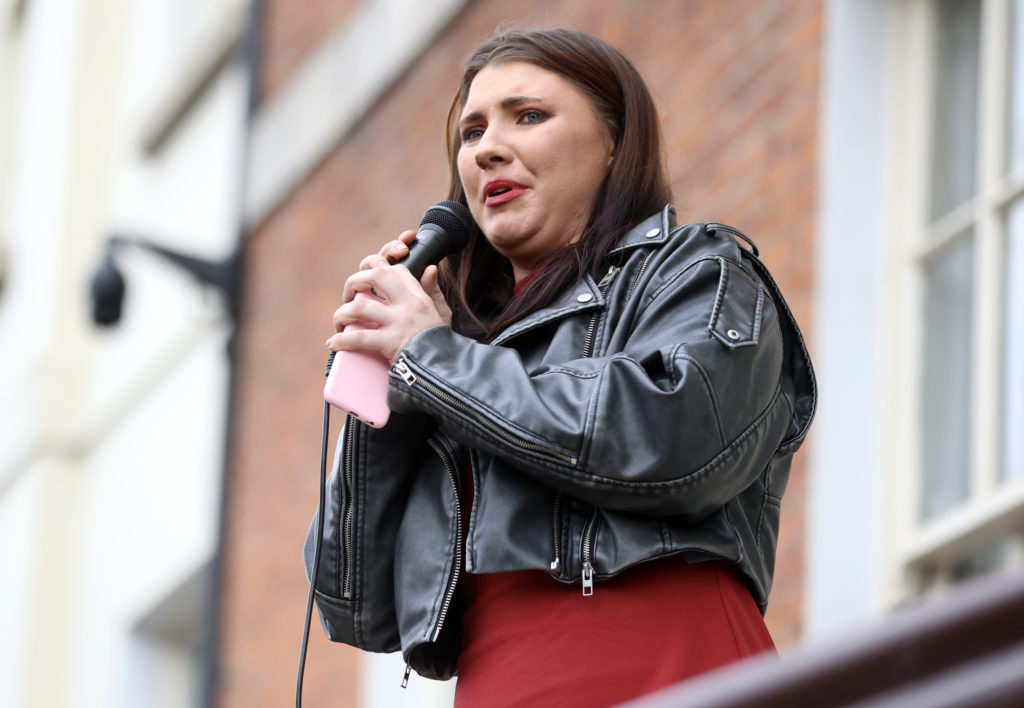 Campaigner Natasha O'Brien
Natasha O’Brien, though, has pushed past her terrible ordeal and is now involved in another campaign. Called Our Flag, it is about reclaiming the tricolour from those who have used it as a symbol of resentment and prejudice.
O’Brien has described the campaign as an effort to restore the flag’s meaning as a symbol of unity and inclusion.
This use of the Irish national flag came into view during Covid, when conspiracy theorists, anti-vaxxers and far-right activists protested with the tricolour flying in their midst.
A flag born of the revolutionary tradition and a struggle against imperialism was suddenly being flown by people motivated by prejudice.
Interestingly, some in these groups reserve a special hatred for another party we might historically have associated with the tricolour: Sinn Féin.
Its members are, in their eyes, traitors and rats and swine, and all the other loving language of social media.
We have seen members of Sinn Féin, or people closely associated with it, buried over the years in coffins draped in that tricolour. The people in those coffins fought what they saw as a war against an occupying power. Whatever your view of that campaign, you would have to acknowledge that this is what they believed.
Yet, to those who now fly the flag in anger, Sinn Féin should apparently no longer have it. Fianna Fáil shouldn’t have it. Fine Gael shouldn’t have it. Presumably Irish football fans cheering on a team that might include players of African descent shouldn’t have it either.
What is a wonder is how this has happened. There was no sign of it twenty years ago. No sign of it ten years ago. But now, when I see a parade of tricolours on a street, I find myself wondering what it means.
During the centenary celebrations for 1916, I remember seeing streets festooned with the national flag. I can’t say it didn’t look just a little uncomfortable, simply because of the sheer number of them blowing in the wind. It might have been the tricolour, but it didn’t look very Irish. It looked too martial, too militaristic. It didn’t, though, speak of bigotry or prejudice. That was still to come.
Natasha O’Brien is one of those seeking to counteract that, and we can only once again admire her sense of justice and fairness. Is this use of the flag just a blip? Is its appropriation a temporary moment?
When I was a kid in England, I distinctly remember watching a controversial National Front party political broadcast on television.
It was festooned with union jacks. Coming from an Irish family and an Irish community, I was already uncomfortable with that flag: uncomfortable walking past pubs that had little pennants of union jacks across a window.
How ironic it would be if, back in Ireland, the tricolour started to do the same.
See More: Natasha O'Brien
