




JOHN O’Donoghue is an author across several disciplines — poetry, short stories, novels.
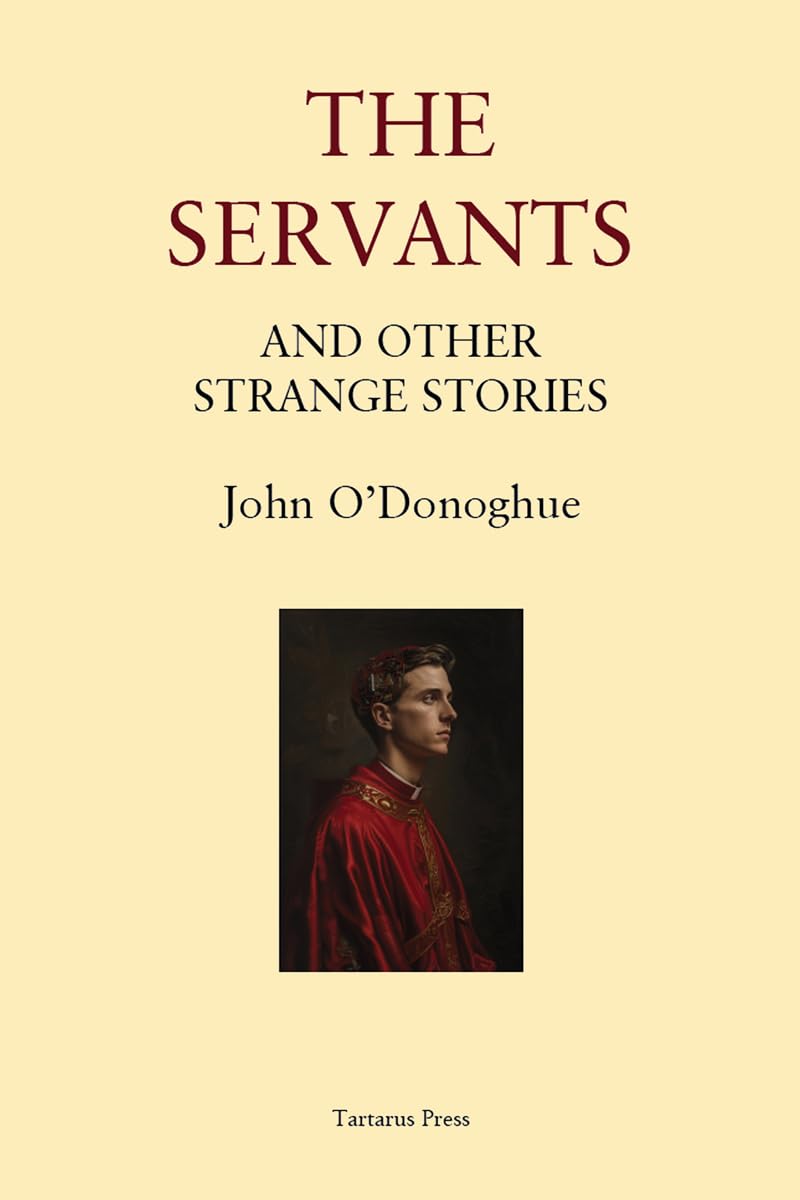
His latest collection The Servants and Other Strange Stories was published on March 19.
Ms O'Donoghue has a PhD in Creative Writing from Bath Spa and lives in Brighton.
This week he took some time out to talk to the Irish Post...
 Author John O'Donoghue
What are you up to?
I’m publicising my collection of short stories and novellas, The Servants.
The Servants of the title tells the story of Seamus, a cybernetic handyman who works at a convent in Greater Dublin about 50 years into the future.
After accessing the convent’s databases he conceives a vocation to the priesthood. When the bishop is summoned and tells him he can’t be a priest as he isn’t a human being, Seamus points out some of the advantages of ordaining him – he finishes by saying that priestly celibacy would of course not be a problem for him.
The Servants – ten linked stories at the heart of the book - are heavily influenced by Asimov’s robot stories, with a large dollop of Flann O’Brien thrown in to the gubbins.
What are you reading at the minute?
I’ve just finished reading Manchan Magan’s Thirty-Two Words for Field.
It’s a book about the Irish language. My father was a native speaker from the Kerry Gaeltacht, but only left me bainne agus siúcra, his way of telling me we’d come to a land of milk and sugar.
I love the way Irish makes great play of the Otherworld, and the Fairies – I draw on this tradition for several of my stories, including one about ten ‘little people’ seeking asylum in an unnamed Irish midlands town; one about a secret Dublin Metropolitan Police unit tasked with keeping an eye on the fairy folk; and one about an island where a shipwrecked sailor encounters some very strange and secretive people.
Which piece of music always sends a shiver down your spine?
Sinead O’Connor singing He Moved Through The Fair. OK, she transposes the traditional pronoun from She to He, but that’s a mere incidental.
Sinead’s voice is ethereal here, a voice that truly does come from another world, another time.
Can you give us your top three great Irish books?
Gosh! So many to choose from! But I love Ulysses, At Swim Two Birds by Flann O’Brien, and Frank O’Connor’s Collected Short Stories.
I made a particular study of the Irish short story, and James Joyce, Sean O’Faolain, Edna O’Brien, Bridget O’Connor, and Kevin Barry are all great exponents of this perennial form.
Barry’s The Fjord of Killary is terrifically funny – you can read it for free on the New Yorker website.
 John O'Donoghue's book is now available to buy
When did you take up writing?
I was given ‘headlines’ by my mother to copy aged four.
She told me stories when I was very small about a family of cats. The father would raid the cat’s meat man’s shop and steal the cat’s meat.
When my mother used to end the story by telling me that the mammy cat would say ‘Top off, half gone, whole gone’ I got a real frisson, the first time a story entranced me. Later when I was seven I used to retell stories from the English comics I’d read to my six cousins in Ballinode, Co. Monaghan.
Then my teachers used to read my stories out to my classmates when I was in secondary school. However, it was poetry I turned to after my father died when I was 14, setting out to deliberately apprentice myself like Dylan Thomas – I too had four Silvine notebooks of poems, and during my 20s won a little competition, the City of London Festival’s poetry competition, and had my first poems published in Green Ink 5, the London Irish writers’ group anthology.
Books Ireland said mine were the best poems in the anthology, and I never looked back. Well, not much!
How would you describe your work?
The hardest thing to do as a writer with just these odd-looking squiggles on a page is to make the reader laugh or make them cry. I’ve been told my memoir Sectioned: A Life Interrupted (John Murray, 2009) does both.
The Servants is mainly a series of humorous stories, although a few have serious subtexts. Basically, I write simply, with the odd poetic grace note, and have only one thought in my mind as a writer – to move the reader.
If I can persuade them to actually buy a book, or borrow it from the library, I’m very happy.
Who will you thank when you’re awarded the Nobel Prize for Literature?
My mother and that family of cats that I loved so much as a small child. My aunt and uncle for hosting us every summer when I was a boy. And my cousins for letting me tell them a few old yarns.
Who would narrate a film of your life? Graham Norton or David Attenborough — or is there someone else?
My life has been quite surreal – I think Professor Stanley Unwin, the inventor of Unwinese, would make a great job of this.
Younger readers who may have never heard of Professor Unwin might want to check out a brilliantly funny film on You Tube of the good professor talking to the man who did the Bill and Ben voices. Deep joy!
What are your Irish roots?
My father was from Killorglin, Co. Kerry, and my mother from Ballinode, Co. Monaghan. Coming from opposite ends of Ireland they could only have met in Camden Town.
What is your favourite place in Ireland?
My aunt and uncle’s house in Ballinode, Co. Monaghan. It was sold after their deaths, and a whole host of memories went with it. I tried to recapture these memories in The King From Over The Water (The Wild Geese Press, 2019).
I’ve been told by other second-generation Irish people that this was their childhoods as well – anyone who spent their summer holidays in Ireland as a child invariably I think had very happy times.
The book comprises 26 linked short stories, and ends just as the shadow of the Troubles starts to loom over Ulster.
Opera or pantomime?
I like operamime.
Has any book influenced you greatly?
All of ’em to some extent, but Frank O’Connor’s stories and his study of the form, The Lonely Voice, essentially a series of lectures, shaped my work greatly.
Which living person do you most admire?
My wife, Bernadette. We’ve been married for 35 years. I don’t know how she’s stood it!
Which person from the past do you most admire?
Jesus Christ. A great teller of stories Himself!
I often wonder whether they were drawn from first-hand experience or did He actually make them up. Such great characters – The Prodigal son, The Good Samaritan, The Wise and the Foolish Virgins…
What would be your motto?
The O’Donoghue Family Motto: Numquam Non Paratus. Never Unprepared.
Why has Ireland produced so many great writers?
Irish people are brought up to relish conversation, repartee, the craic.
The love of story, of song, of getting together, is very much the Irish way of life. Often it beats the TV!
What do you believe in?
The holiness of the heart’s infections.
Who (or what) is the greatest love of your life?
Mrs O’Donoghue – she has given me four wonderful children, and a whole host of very happy memories.
I expect we have a few more adventures to come.
See More: John O'Donoghue
