





A MAJOR new festival celebrating the life, work and legacy of George Bernard Shaw is set to make its debut in London this summer, bringing together theatre, film, discussion and scholarship in honour of one of Ireland’s greatest literary figures.
The inaugural Shaw Festival London will take place at the Irish Cultural Centre in Hammersmith from July 10 to 12, marking the centenary of Shaw’s receipt of the Nobel Prize for Literature in 1926.
Organised in partnership with The Shaw Society, the three-day event aims to shine a fresh light on the playwright, critic, essayist and social commentator whose influence continues to be felt more than 75 years after his death.
Although best known internationally as the author of Pygmalion – the play that later inspired the musical My Fair Lady – Shaw’s extraordinary career encompassed far more than the theatre. He was a political thinker, journalist, campaigner and public intellectual whose views often provoked controversy and debate.
Born in Dublin in 1856, Shaw left Ireland for London as a young man but never lost sight of his Irish roots. Throughout his long life he remained deeply engaged with questions of politics, class, religion and social reform, using humour and satire to challenge accepted wisdom and conventional thinking.
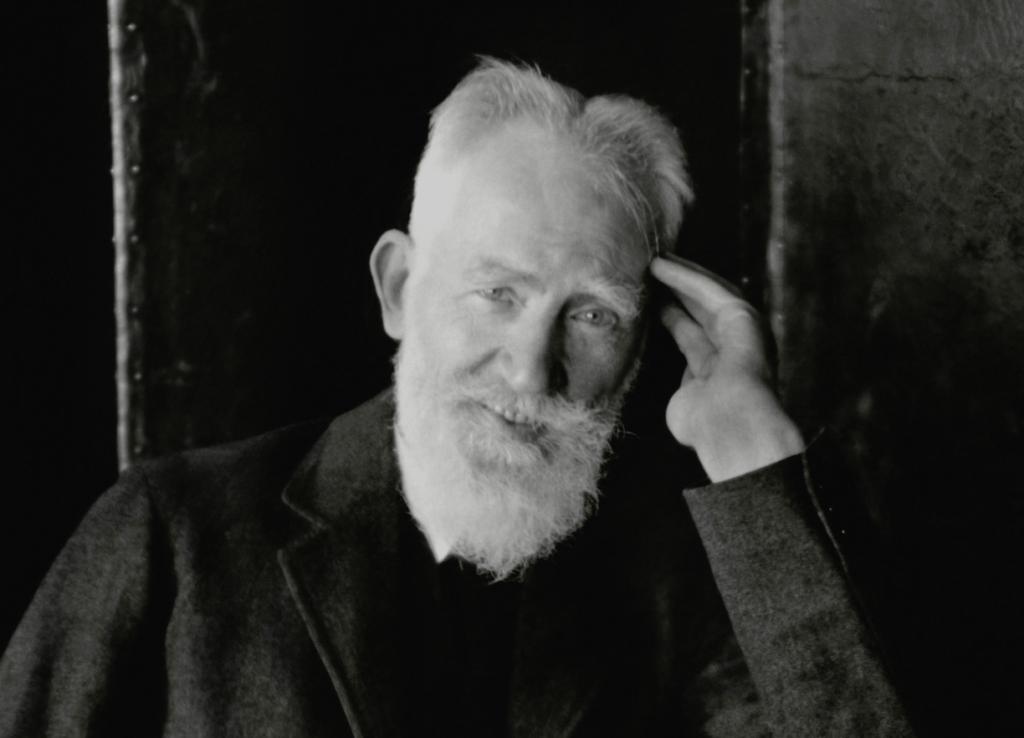 Playwright George Bernard Shaw
The festival’s organisers believe his work remains remarkably relevant in the modern world.
Rosalind Scanlon, Cultural Director of the Irish Cultural Centre, said the event would celebrate not only Shaw’s writing but also the enduring power of his ideas.
The festival programme has been designed to showcase the breadth of Shaw’s achievements, combining stage performances with film screenings, lectures and audience discussions.
Among those supporting the initiative is acclaimed actress Dame Siân Phillips, who described Shaw as one of her favourite writers both to perform and to watch.
For lovers of theatre, the centrepiece of the weekend will be a full production of Shaw’s celebrated comedy-drama Candida, presented by Rumpus Theatre Company under the direction of John Goodrum.
First performed in 1894, the play remains one of Shaw’s most admired works. It centres on Candida Morell, the intelligent and self-possessed wife of a Christian Socialist clergyman, who finds herself at the heart of a complicated emotional triangle involving her husband and a young poet.
What begins as a seemingly conventional domestic drama develops into a sophisticated examination of love, power, marriage and personal independence. Like many of Shaw’s plays, it overturns audience expectations and challenges traditional assumptions about relationships and gender.
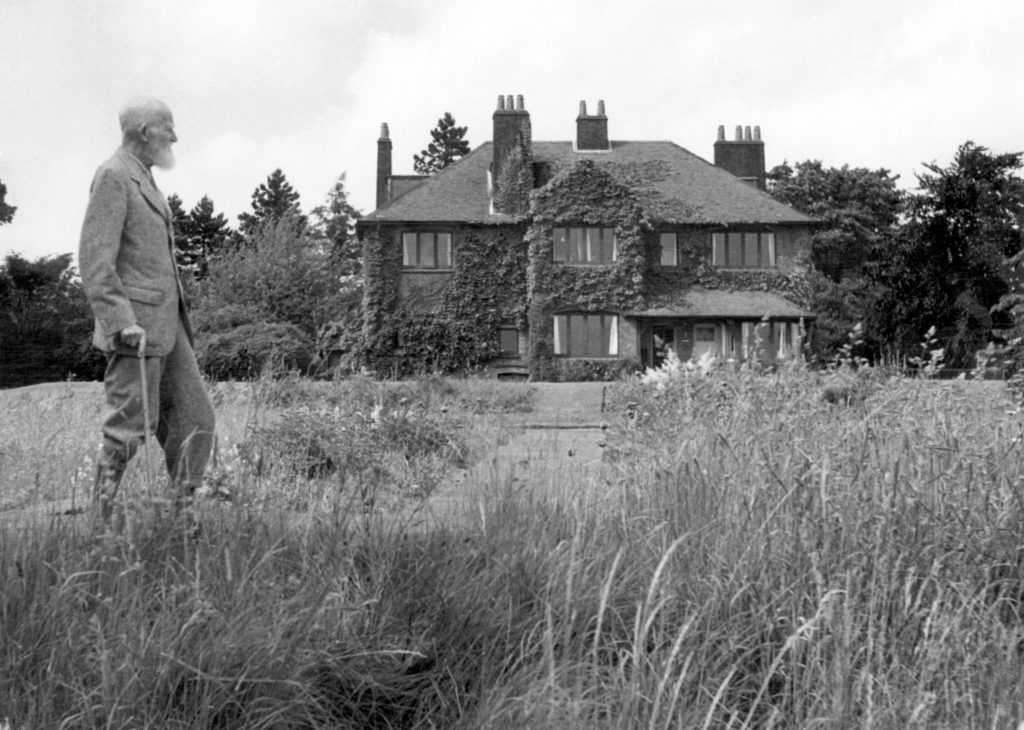 Shaw pictured in front of his house in Ayot St Lawrence in July 1947
The production will be staged on both Saturday evening and Sunday afternoon, giving audiences two opportunities to experience the work.
The performance will be complemented by a lecture from Dr Audrey McNamara of University College Dublin, who will explore the play’s themes and examine Shaw’s treatment of gender, power and social convention.
Her talk, titled Candida: An Oedipal Crisis, will consider the playwright’s willingness to tackle subjects that many Victorian writers preferred to avoid.
Shaw frequently addressed issues such as poverty, inequality, prostitution, marriage and class conflict, using drama as a vehicle for social criticism. His willingness to challenge prevailing attitudes made him both admired and controversial during his lifetime.
The lecture promises to offer fresh insights into how Shaw used Candida to question accepted ideas about romance and the roles expected of women and men in late Victorian society.
The festival’s exploration of Shaw’s thinking continues on Sunday with a lecture devoted to his views on feminism.
Presented by Shaw Society Vice-Chair Murray Rosenthal, the talk will examine the development of Shaw’s ideas about women’s rights and gender equality, tracing the influences that helped shape his outlook.
Long before feminism became a mainstream political movement, Shaw was arguing for greater independence and opportunities for women. Many of his female characters display an intelligence, confidence and agency that were unusual for the period in which they were written.
Rosenthal’s lecture will also consider Shaw’s correspondence with the celebrated actress Mrs Patrick Campbell, whose relationship with the playwright remains one of the most fascinating literary friendships of the early twentieth century.
Film also plays an important role in the festival programme.
The opening evening features two productions exploring Shaw’s life and work.
The first is an interview with the distinguished biographer Sir Michael Holroyd, whose multi-volume study of Shaw is widely regarded as the definitive account of the playwright’s life.
 Writer Michael Holroyd
Filmed in 1988, the interview sees Holroyd discussing Shaw’s character, beliefs and achievements, drawing upon decades of research into one of the most complex literary figures of modern times.
The second screening, Shaw’s Corner, offers a more dramatic approach.
Adapted from Shaw’s own writings by Neil Titley and performed by the acclaimed Irish actor Dermot Walsh, the production imagines Shaw reflecting on his life in old age.
Walsh, who appeared in the original production of Shaw’s final play Buoyant Billions under the playwright’s supervision, brings a particular authenticity to the role.
Following the screenings, audiences will have an opportunity to hear directly from Neil Titley in a discussion hosted by Murray Rosenthal.
The festival concludes on Sunday evening with one of the most unusual events of the weekend.
Shakes Versus Shav, a short film based on Shaw’s final published play, reimagines an imaginary meeting between George Bernard Shaw and William Shakespeare.
The production combines puppetry, comedy and literary debate to explore Shaw’s famously complicated relationship with England’s most celebrated playwright.
Throughout his career Shaw frequently challenged what he saw as the excessive reverence accorded to Shakespeare, arguing that modern audiences should judge writers on merit rather than reputation.
Yet his criticism was never entirely hostile. Beneath the jokes and provocations lay a genuine admiration for Shakespeare’s achievements.
The film captures this mixture of respect, rivalry and humour in a playful and inventive way.
Directed by Damian Farrell and Gerry Hoban, it features the voices of Irish actor Colm Meaney as Shaw and Sir Derek Jacobi as Shakespeare.
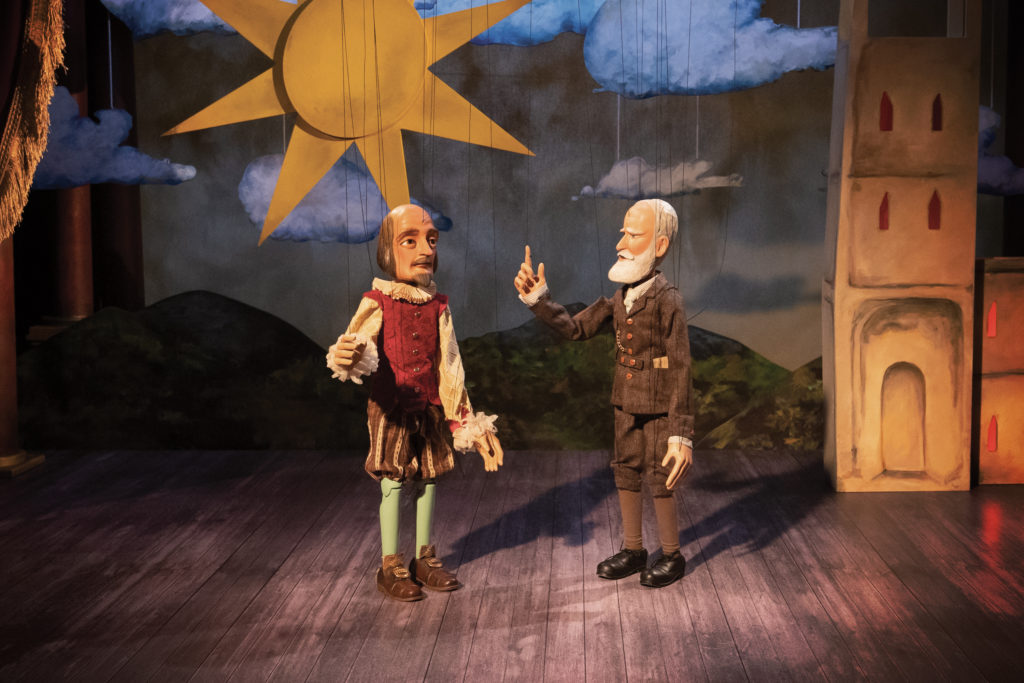 Puppets Shakespeare versus Shaw
The production enjoyed considerable success on the festival circuit, winning awards including Best Comedy at the Bloomsday Film Festival in Dublin.
A question-and-answer session with the directors will follow the screening, and audiences will even have an opportunity to meet the puppet versions of “Shakes” and “Shav” used in the film.
For the organisers, the festival is intended not merely as a one-off celebration but as the beginning of an annual tradition.
The Shaw Society, which was founded in 1941, has spent more than eight decades promoting appreciation of the playwright’s life and work through lectures, performances and publications.
Over the years it has helped ensure that Shaw’s legacy remains visible despite changing literary fashions and shifting public tastes.
That legacy extends far beyond the theatre.
In addition to writing more than sixty plays, Shaw played a role in the founding of institutions including the London School of Economics and the Royal Academy of Dramatic Art. He was also associated with the Fabian Society and contributed extensively to journalism and public debate.
His achievements remain unique in literary history.
Shaw is still the only person to have been awarded both the Nobel Prize for Literature and an Academy Award. The Oscar came in 1939 for his screenplay adaptation of Pygmalion.
Such distinctions underline the extraordinary range of a career that stretched across literature, politics, theatre and film.
For Irish audiences in particular, Shaw occupies a distinctive place in the nation’s cultural history.
Although he spent most of his life in England, he never ceased to engage with Ireland and Irish identity. His writings frequently reflected an outsider’s perspective on both British and Irish society, allowing him to challenge assumptions on all sides.
His sharp wit, sceptical intelligence and refusal to accept conventional wisdom remain among the qualities that continue to attract new generations of readers and theatre-goers.
As the centenary year of his Nobel Prize is marked, organisers hope the new festival will encourage audiences to rediscover a writer whose ideas continue to resonate in the twenty-first century.
With a programme that ranges from scholarly lectures and historical documentaries to live theatre and award-winning film, the inaugural Shaw Festival London promises to demonstrate that George Bernard Shaw is far more than a figure from literary history.
He remains, as ever, a provocative, entertaining and deeply relevant voice.
Everything from irishpost.com and the print edition is available on the Irish Post App — plus more! Download it for Android or Apple IOS devices today.
