





A TEAM of Irish and Italian scientists will study this week’s solar eclipse from a flying observatory.
The eclipse is set to be visible across Ireland tomorrow (August 12), with up to 98 per cent of the sun expected to be covered during the celestial event.
Scientists will take to the skies to observe that rare moment - where the earth, moon and sun align – which they will use to study the sun’s atmosphere during the eclipse.
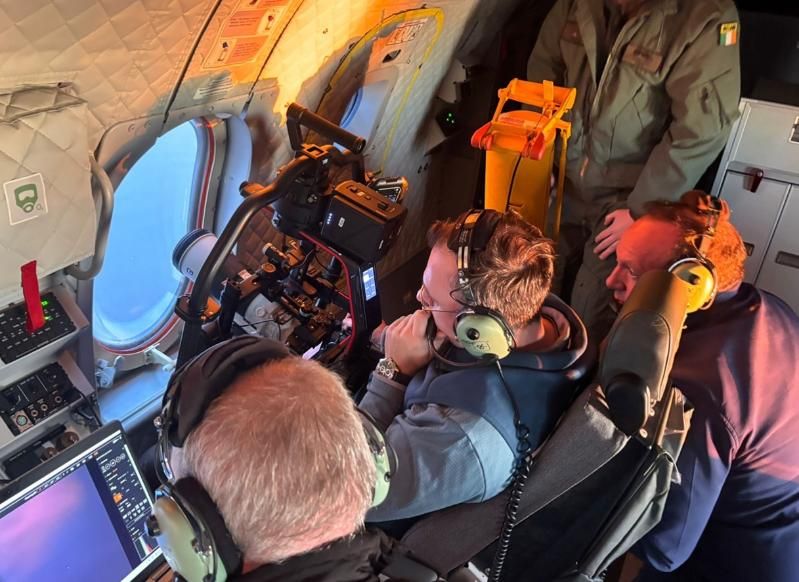 Members of the research team aboard the Irish Air Corps aircraft (Pic: TCD)
Researchers from the Dublin Institute for Advanced Studies (DIAS), Technological University Dublin (TU Dublin), the Irish Air Corps, and Italy’s National Institute for Astrophysics (INAF) will fly an advanced solar telescope aboard an Irish Air Corps Airbus C295 aircraft to undertake the study.
“The total solar eclipse gives us a unique opportunity to observe the sun’s atmosphere, called the corona,” Joe McCauley, Senior Experimental Officer in Trinity’s School of Physics, explained.
“Trinity is taking the lead on setting up and running the solar telescope that will be used to image the corona from an open window at 13,000 feet.”
Their telescope, which has been developed by INAF, has been built using spare flight components from two European Space Agency solar missions – Proba-3 and Solar Orbiter.
While sits far above the visible surface of the sun, the corona can reach temperatures of around two million degrees Celsius - hundreds of times hotter than the surface below.
The telescope has been designed to help scientists understand why this happens, by measuring the magnetic field of the corona.
“These magnetic fields are thought to play a major role in shaping the Sun’s atmosphere and releasing huge amounts of energy into space,” a Trinity spokesperson said.
“During a total solar eclipse, the moon blocks out the sun’s bright disc, briefly revealing the faint, glowing corona around it,” they explain.
“So for just a few precious minutes, scientists get a natural window into a part of the Sun that is usually hidden from view.”
During the observation, a small ‘bubble window’ on the aircraft will be opened to allow the telescope a clear view of the eclipsed sun.
“This means the instrument can observe without looking through standard aircraft windows, which can blur or distort the images,” the spokesperson added.
“Flying also gives the science team a major advantage: the aircraft can be positioned to spend as much time as possible in the Moon’s shadow, while also reducing the risk of clouds blocking the view from the ground.”
Along with Trinity’s Joe McCauley, the Irish-Italian eclipse team includes Lucia Abbo, Gerardo Capobianco, Hervé Haudem (INAF); Ciarán O’Callaghan (TU Dublin); and Prof. Peter Gallagher (Director of DIAS Dunsink Observatory and Adjunct Professor at Trinity) and Dr Laura Hayes (DIAS, and Trinity alumna).
Everything from irishpost.com and the print edition is available on the Irish Post App — plus more! Download it for Android or Apple IOS devices today.
