



THERE is an old saying that nobody really understands the GAA unless they have stood on a touchline in the rain waiting for a match that may never start.
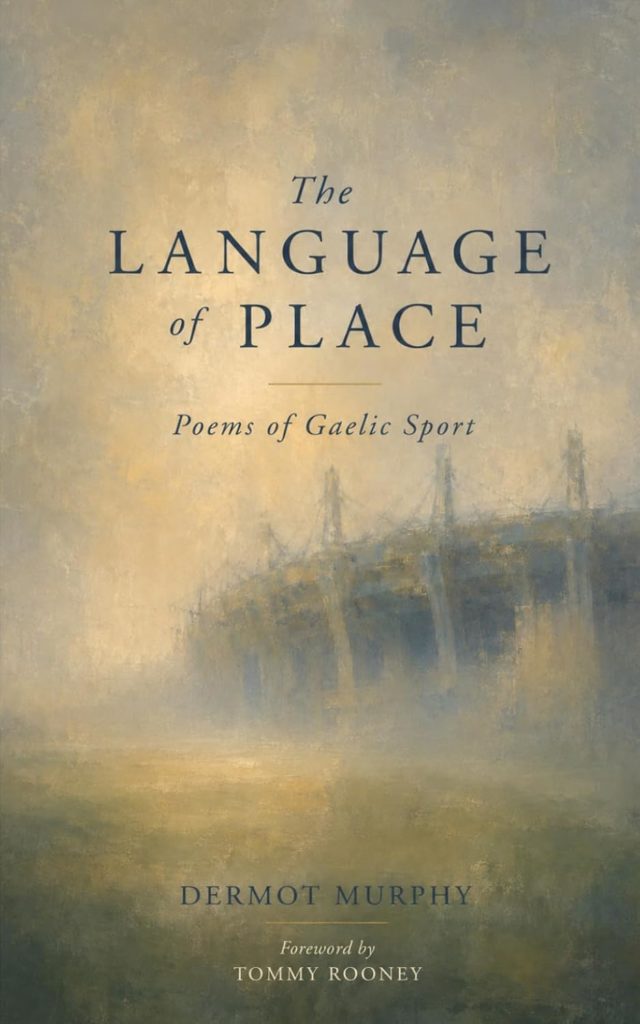
Dermot Murphy's The Language of Place understands exactly that.
This is not a book about winning All-Irelands or celebrating sporting heroes, although famous victories and legendary figures make their appearances. Instead, it is a meditation on what Gaelic games mean to Ireland itself: to villages, parishes, families, emigrants and memory.
Organised around Ireland's 32 counties, with a series of reflective poems linking the sections, Murphy attempts something surprisingly ambitious.
Each county becomes less a sporting history than an emotional landscape. The poems rarely concern themselves with scores or statistics.
Rather, they explore belonging, resilience, disappointment, identity and continuity — the invisible threads that bind communities together long after the final whistle.
That approach gives the collection its distinctive character. Readers expecting page after page of nostalgic sporting verse may initially be surprised by how restrained many of the poems are.
Murphy is less interested in dramatic match reports than in the quieter moments: the volunteer repainting pitch markings, the parent washing jerseys, the long drive home after defeat, or the child picking up a hurley for the first time. It is in these ordinary rituals that he locates the true soul of Gaelic games.
His background perhaps explains this sensitivity. Having worked as a social worker, management consultant and now within hospice care supporting young adults with life-limiting conditions, Murphy writes with an awareness of human vulnerability that frequently elevates these poems beyond sport.
Loss, endurance and shared memory recur throughout the collection without ever becoming sentimental.
Some of the strongest pieces are the poems that step away from individual counties altogether. Ash, which traces the transformation of the ash tree into the making of a hurley, is among the book's finest achievements.
It becomes both an ode to craftsmanship and a meditation on time, patience and tradition, suggesting that every strike of ash upon ash carries centuries of history.
Similarly effective is The Weight of the Jersey, which looks beneath the mythology of county colours to the private doubts carried by players.
Murphy reminds readers that behind every celebrated performance lies anxiety, pressure and vulnerability — emotions seldom acknowledged in sporting culture.
Perhaps the collection's most moving poem is We Were Always There, a tribute to generations of women whose contributions to Gaelic games were overlooked or marginalised.
Rather than delivering an overt polemic, Murphy lets remembered voices speak for themselves, charting the slow emergence of women's sport from the margins to its rightful place at the centre of Irish sporting life. It is one of the book's emotional high points.
Murphy also wisely avoids treating the GAA as an exclusively nostalgic institution.
The Big Field acknowledges emigration while recognising that Gaelic games have travelled with Irish communities to Britain, America and Australia.
More importantly, it embraces the newcomers now joining clubs throughout Ireland, arguing that a game founded upon belonging should never become exclusive. It is a quietly contemporary note that broadens the book's horizons considerably.
The county poems inevitably vary in impact. Some, particularly Clare, Mayo, Donegal and Limerick, capture both sporting history and local identity with impressive economy.
Others occasionally rely a little too heavily on familiar county characteristics or celebrated moments that seasoned GAA followers will immediately recognise.
Yet even where individual poems feel less distinctive, the overall structure succeeds remarkably well. Moving steadily from county to county creates the impression of travelling around the island itself, discovering not differences alone but the remarkable similarities that unite communities from Antrim to Cork, Kerry to Wicklow.
Murphy writes in accessible free verse, favouring clarity over complexity. Literary purists looking for formal experimentation or dense metaphor may find the language deliberately straightforward. However, that accessibility feels entirely appropriate for the subject matter.
These poems are written to be read aloud, shared in clubhouses, remembered after matches and perhaps quoted during speeches or presentations. Indeed, the afterword explicitly suggests that these are poems to be recited rather than merely read.
If the collection has one limitation, it is that its consistently reflective tone can occasionally flatten emotional variety.
More moments of humour in the vein of the delightful A Schmozzle in the Parallelogram would have provided greater contrast.
That said, the prevailing seriousness reflects Murphy's central argument that Gaelic games are about much more than entertainment. They are repositories of culture, memory and identity.
Ultimately, The Language of Place is not simply a poetry collection for GAA enthusiasts.
It is a book about Ireland itself, viewed through the lens of its indigenous games. In celebrating volunteers as much as champions, communities as much as counties, and continuity as much as victory, Dermot Murphy has produced an affectionate, thoughtful and quietly moving collection that understands why Gaelic games occupy such a unique place in Irish life.
Whether your memories are of Croke Park on All-Ireland final day or a windswept parish pitch on a wet Sunday afternoon, there is likely to be something here that feels deeply familiar.
The Language of Place: Poems of Gaelic Sport is available in hardback (16.99) and paperback (£9.99) at all good bookshops and online booksellers. Find out more at: https://dermotmurphyauthor.com/
About the author
Dermot Murphy began his career as a social worker before moving into senior leadership roles and working for many years as a management consultant.
He currently works within a hospice setting, supporting the care of young adults with life-limiting conditions, a commitment that continues to shape his understanding of resilience, vulnerability and presence.
His poetry is shaped by his experience of how lives unfold within families, institutions and historical currents.
Dermot Murphy’s previous poetry collections are Not Yet Ash, The Drift of Memory and In the Quiet Light.
Everything from irishpost.com and the print edition is available on the Irish Post App — plus more! Download it for Android or Apple IOS devices today.
See More: Dermot Murphy, GAA, Poetry, The Language Of Place
