





A RECENT article in The Irish Times by Stephen Collins (August 7, 2026) argued that Ireland should give up on honouring the heroes of the Easter Rising.
This was the insurgency in Dublin in 1916 in which Patrick Pearse and his fellow revolutionaries declared Ireland to be a republic independent of Britain.
That insurgency was put down and the British firing squads executed fifteen leaders but the idea of the republic was taken up by Sinn Féin and two years later when they entered government they established that republic.
The Irish Republican Army then fought a war against Britain. There were dirty tactics on both sides. This war ended in a treaty which acknowledged the partition of Ireland and the establishment in 26 counties of a free state.
We know all this.
The leaders of the Easter Rising are honoured every year by the Irish president and the armed forces at a ceremony in Dublin.
But what of those who held fast to the idea of a republic and did not accept the treaty? In the first instance they were defeated in the civil war which followed.
But there were resurgences throughout the following century, most notably in the 1950s when the IRA attacked police stations along the border and in the decades after 1970 when various republican movements but primarily the Provisional IRA, through murder and sabotage, protested against the Union with Britain and the right of the British army and the police to patrol the streets of Northern Ireland and enforce British law.
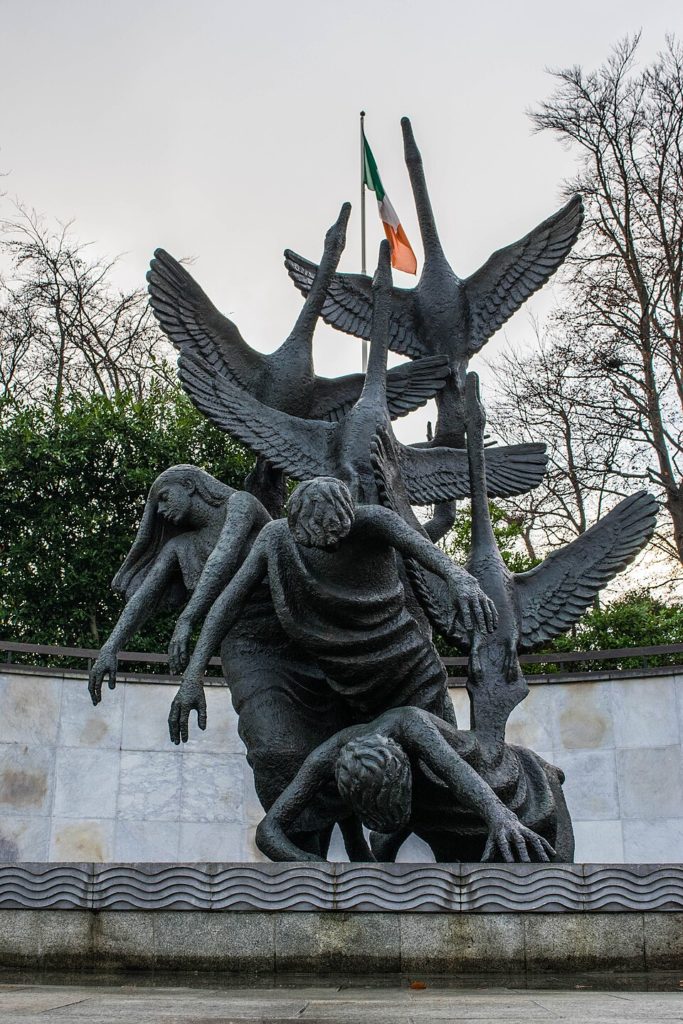 The Garden of Remembrance in Dublin (Picture Oliver Gargan:CC BY SA 4.0)
At the same time similar pro-British or loyalist paramilitaries advanced their campaigns largely by killing members of the IRA, when they could get them, and, more often, random Catholics when they couldn't.
Stephen Collins, in his Irish Times article, argued that honouring the revolutionaries of 1916 is problematic because successive iterations of the Republican campaign have drawn legitimacy from the example set by the Rising and the honouring of its leaders.
He wrote, “…the State has continued to foster the dangerous myth that independence came about only through violence. This distorted version of history has provided ideological cover for the minority in succeeding generations who have tried to destroy it”.
He was moved to make this point because a bomb had just recently been intercepted on its way to Derry, no doubt to kill someone there.
Then the president Catherine Connolly caused outrage among some, indifference among others, when she was photographed in Belfast smiling in the company of a convicted member of the IRA, Mary McArdle, who had delivered guns to IRA men for an attack on a magistrate, Tom Travers and his family, wounding him and killing his daughter Mary, a teacher in a Catholic primary school.
Ann Travers, a surviving sister has complained to the president and the president has offered to meet her. But Ann was abused by many republican sympathisers on social media for airing her grief and grievance.
This was often cruelly worded by insensitive IRA sympathisers using pseudonyms. Sinn Féin has recently called on its members not to troll people on social media, perhaps conscious of how such venom disgraces the cause.
Today there is still an armed republican campaign run by old diehards calling themselves the New IRA. The media tends to call them dissident republicans but they are not dissidents.
They are purists who did not go along with the Provisional movement when it switched from the armed militant tradition to the democratic constitutional tradition which also has its heroes in the likes of Daniel O'Connell, Charles Stewart Parnell and John Hume.
Few countries emerging from the colonial experience have been as stable as Ireland. Pakistan and India, which like Ireland were partitioned to facilitate sectarian majorities on each side of the line, have both had problems with democracy. Ireland has never had martial law or a suspension of democratic rule, though it has had corruption and emergency powers.
This must surely in part be because within the Union with Britain through the 19th century, and even before it, the country’s politicians had deep experience of parliamentary practice and principles.
The main street in Dublin is rightly named in honour of Daniel O’Connell who fought democratically for Catholic Emancipation, though he failed in his efforts to repeal the Union by legal challenge. He had argued that the parliament in Dublin in 1800 had had no power to vote itself out of existence.
The main railway station is named after James Connolly who, undoubtedly a brave and principled socialist has made little actual difference to the character of modern Ireland.
But modern Sinn Féin, like successive governments in Dublin, continues to honour the armed militants as if they were the ones who had actually shaped the country. Many did indeed die for Ireland, but none of them produced the actual Ireland they aspired to.
And they include the most awful thugs and bigots, like Bik McFarlane who was convicted for his part in the IRA attack on the Bayardo Bar and who, as the IRA prisoners’ officer commanding in the Maze, helped maintain the hunger strike even as some prisoners began to question whether they should continue.
But strangely in Ireland, unlike elsewhere, it tends to be the losers not the victors who write history.
Everything from irishpost.com and the print edition is available on the Irish Post App — plus more! Download it for Android or Apple IOS devices today.
See More: Easter Rising, Ireland, Revolutionaries
