





THREE of Ireland’s inhabited islands are in Roaringwater Bay in West Cork: Heir, Sherkin and Cape Clear.
For some, the islands are where they were born and brought up. For others, they are an escape. And then there are those who move to an island to do something they have always dreamed about.
One such person is John Desmond. He was born in Dublin and trained to be a chef at the Ritz Hotel in Paris.
Having worked for several top French restaurants, he eventually became a Professor de Cuisine at the Ecole de Cuisine La Varenne.
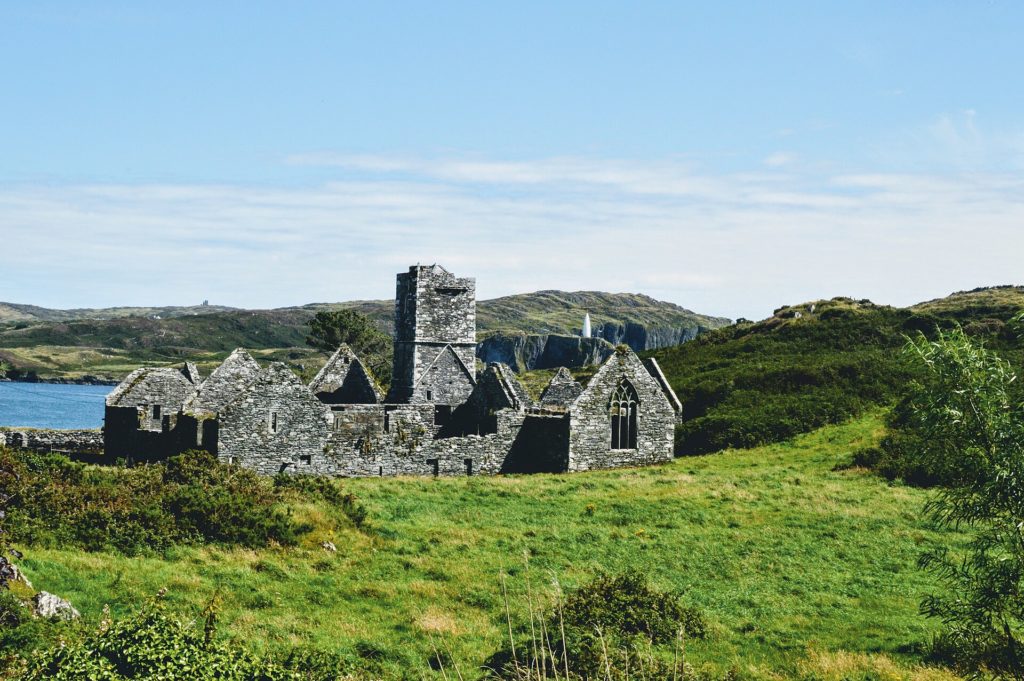 Sherkin Island
But his long-term plan was to have his own restaurant in Ireland. Only, he didn’t return to Dublin; he chose somewhere quieter, somewhere more remote. In the late 1980s, he found it on Heir Island.
Along with his Cork-born wife, Ellmary, he set up Island Cottage: a restaurant, cookery school, art gallery and, most recently, a retreat for artists and writers.
Over the years, the restaurant has made the island a popular destination point, especially for foodies eager to explore this unique setting and experience Desmond’s aim to put the best produce from local farmers and fishermen at the heart of every meal.
The restaurant is housed in a beautiful, white-washed cottage looking out over the bay.
It seats 22 people and lunch is a set menu. This summer, it’s fillet of beef with garnish and potatoes; a hot lemon souffle and coffee, and it costs €25. I went in early September and still have this memory of succulent beef juices and fluffy, crisp roast potatoes.
For dessert, he had collected blackberries from the island’s hedgerows to make a superb blackberry sorbet.
The Atlantic’s Gulf Stream means that Heir tends to have mild temperatures, so foraging has always been a big tradition. The simple goodness of the land around us was on our plate.
There are about 20 permanent residents on Heir Island, and like Desmond, many of them have their own boat. It’s another tradition that goes way back.
In the 19th century, most of the men spent the summer fishing for lobster, which was particularly in demand by the transatlantic liners coming into Cork Harbour. In the winter, they would spend their days making the lobster pots to catch them.
Some are still fishermen today and some are farmers. Other islanders have holiday homes and there are two well-known sailing schools.
Heir can be reached from Cunnamore Pier, not far from Skibbereen, and it’s just a five-minute ferry ride.
The island is a mile and a half long and a mile wide, so it’s a great place to go for the day.
But there is no pub or shop. If you are tempted to stay on this beautiful island, a supermarket in Skibbereen takes grocery orders and delivers them to the island. Just don’t expect Deliveroo!
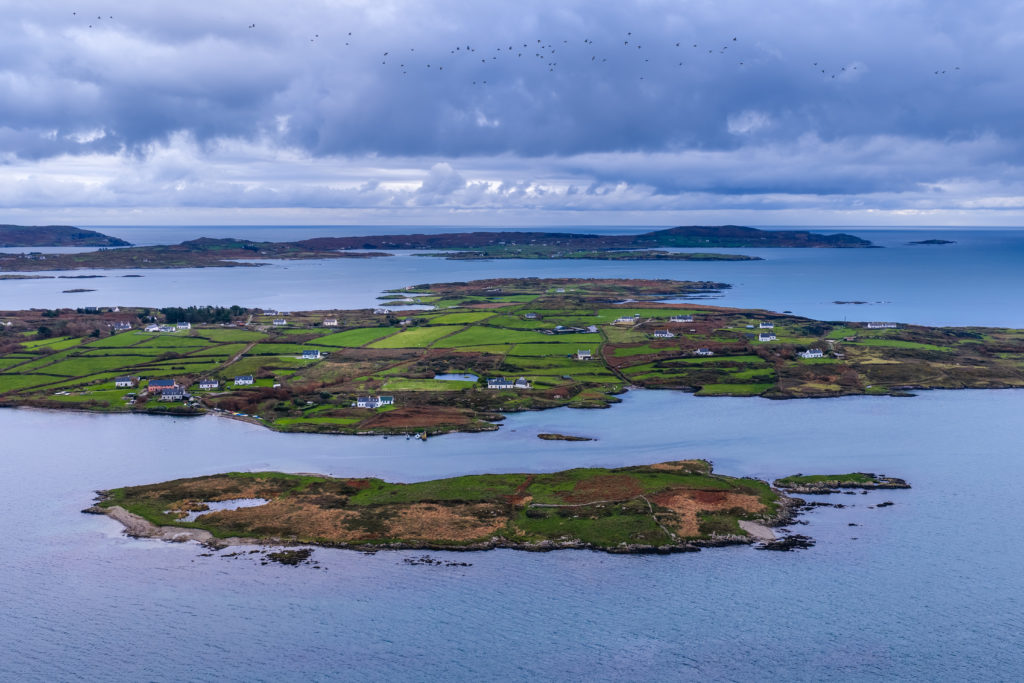 Illaungawna Isalnd and Heir Island, and in the background, Sherkin Island (Picture Podstawko / CC BY 4.0)
Sherkin Island
Neighbouring Sherkin Island is just a ten-minute boat ride from the fishing port of Baltimore. Similar in size and pace to Heir, it has several sandy beaches, an old lighthouse, a pub called The Jolly Roger and glamping for those who want a bit more comfort with their camping experience.
About a mile from the pier is a small 19th-century Catholic church dedicated to St Mona, the patron saint of the island. A few years ago, I was lucky to attend a cousin’s wedding there. All the guests – heels, hats and fancy bags – walked the distance from the harbour along a country lane decked with nature’s floral displays of honeysuckle and fuchsia. I hasten to add that the bride didn’t walk – she got a lift.
It was while I was on the island that I found out about the community of artists and photographers who live on the island. One of them is Robbie Murphy, who was 10 months old when his parents moved from Cork City to Sherkin. He would never live anywhere else and for over 30 years, he and one of his brothers, Michael, have made a living farming oysters on the island’s mudflats. In his spare time, however, he takes photographs of spectacular sunsets and starry skies.
Roaringwater Bay’s rich marine life is one of the reasons why the late Matt Murphy and his wife Eileen set up the Sherkin Island Marine Station in 1975. For over 50 years, botanists did award-winning research. In one of its publications on the wider environment, it concluded that “these islands remain the botanically richest 10-kilometre square in Ireland.”
Not far from St Mona are the ruins of a Franciscan friary (also called the Abbey) which dates back to 1460. The island was then owned by the Chieftain Fineen O’Driscoll, who ruled large parts of South Cork. He gave his blessing to the church, but when members of the O’Driscoll clan stole a cargo of wine from some Waterford merchants, so the story goes, the merchants retaliated by destroying the Abbey and two of the O’Driscolls’ castles on the mainland.
The O’Driscolls also have roots on Cape Clear, the biggest of the three islands – three miles by one mile. The ruins of one of their castles from the 14th century are a reminder of just how extensive their power was and, with the annual gathering of O’Driscolls in Baltimore every year, it’s a history they are determined not to forget.
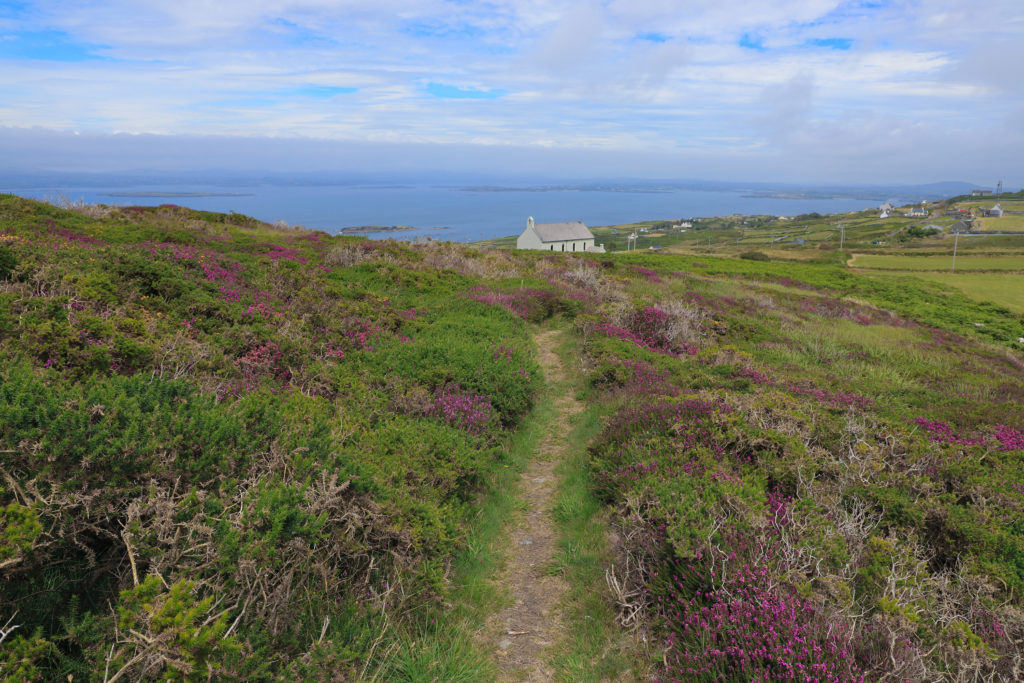 Cape Clear Island, Co Cork
Cape Clear
Cape Clear is eight miles from the mainland, 45 minutes from Baltimore Harbour. As you head out, the calmer waters of the bay become that bit more unruly, and as it is the southernmost part of Ireland, it is here that passengers leaving for America would get one last glimpse of Irish soil.
Equally, ships coming around this corner of Ireland have been very unlucky. There had been a lighthouse at the highest point of Cape Clear since 1818. But in 1847, an American passenger ship called Stephen Whitney was sailing from New York to Liverpool. It was due to call into Cork Harbour, but as it approached Ireland, what may have looked like a harmless haze soon turned into a thick blanket of fog.
Charles W. Popham was the ship’s captain, a man originally from Cork, so he must have known how treacherous it could be. But as the fog got thicker, there was confusion as to where they were, and they mistook a lighthouse at the end of the Kinsale Peninsula for one then at Crookhaven. They failed to see the lighthouse at Cape Clear and, as a result, the ship struck the tip of a tiny island – West Calf Island – in Roaringwater Bay.
Tragically, of the 110 on board, 92 died. It was this, however, which led to the building of the 54-metre-high lighthouse on Fastnet Rock, five miles from Cape Clear and 13 miles from the mainland. The Fastnet Rock lighthouse is now the tallest and widest rock lighthouse tower in Ireland and the UK. You can’t go inside it, but you can take a boat tour around it from Baltimore or Schull.
There are about 100 permanent residents on Cape Clear, many Irish-speaking and many with smallholdings where they keep sheep, pigs, cows and goats. One such place is Cleire Goat Farm, which is owned by Ed Harper, who is blind. Originally from Liverpool, he visited the island in the late 1970s, fell in love with it and stayed. He still milks the goats and uses the milk to make ice-cream – possibly Ireland’s most famous goat ice-cream!
I went in the spring, deciding to volunteer on two of the farms in exchange for meals and accommodation. One of them was Cleire Goat Farm and the other was Mara Farm run by Fiona MacLachlann. Fiona has a fantastic small heritage farm which includes Kerry-bog ponies and Tamworth pigs – said to be the closest breed to Ireland’s now extinct native pigs.
I certainly got a feel of what it would be like to live on the island and had the added joy of helping with all the new arrivals – piglets, calves, goats and lambs. I also found out that several of the other neighbouring farms were choosing to rear rare and more traditional breeds to help promote the island’s agricultural heritage, which was in danger of disappearing.
From where I was staying, I could see the loom of the light on Fastnet every night, slightly mesmerising, slightly haunting, but thankfully guiding ships to safety. For centuries, brave fishermen, ghostly shipwrecks and lost souls have been the subjects of great stories that get passed down orally through the generations. And the island’s International Storytelling Festival is an annual event which is dedicated to keeping the Irish tradition of storytelling alive.
This festival has been going for over 30 years now and takes place from 4-6 September, luring visitors far and wide with many funny, as well as tragic, tales. Some come for the day, others stay for the whole event and, luckily, there are various options on the island, including a hostel, a guesthouse, Airbnb and a campsite.
As the island’s museum reveals, people have been living on Cape Clear for 5,000 years, and farming and fishing have been a way of life here for centuries. It was one of the reasons why the population grew. Before the famine, the island had over 1,000 people. It has never recovered from that.
In 2023, however, the Irish government launched a 10-year strategy to support its island communities and in August last year the local community organisation for Cape Clear was making two houses available for long-term rental, especially for new families with children of primary school age who want to start a new life on the island.
The government strategy also includes a scheme to offer people grants to renovate vacant homes (up to €60,000) or derelict homes (up to €84,000). There are conditions: the property must become a primary residence or a long-term rental.
Maybe like John Desmond and Ed Harper you have dreamed about moving to a small island. It isn’t for everyone. But these are exceptional islands and perhaps you might be the exception.
For details about Island Cottage visit www.islandcottage.com
For the International Storytelling Festival, Sept 4-6, visit capeclearstorytelling.com.
For details about Robbie Murphy’s latest exhibition: www.robbiemurphyphotos.ie.
For details about the government scheme visit www.gov.ie.
Everything from irishpost.com and the print edition is available on the Irish Post App — plus more! Download it for Android or Apple IOS devices today.
See More: Cape Clear, Heir Island, Sherkin Island
