



I STARED at the Giant’s Causeway for a long time. No matter how many times I’ve seen this rock formation I’m astounded by its sheer audacity.
OK, I know the official explanation — that a giant called Finn Mac Cumhaill (pronounced McCool) built the causeway to walk to Scotland in order to do battle with another giant. But surely that can’t really account for the sheer oddity of thousands of dark, spectacular columns rising out of the sea? Maybe there’s a geological explanation for it all. I can ask when I get back to Carnlough. Somebody in the pub is sure to know.
Ah, Carnlough. This village itself could be reason enough to visit this part of Ireland. I imagine it once supported an entire postcard industry; selfies will have cut down on that trade, but Costcutter still had a fine selection.
As I wandered round the harbour, I looked back across the old stone piers towards the village. Small pastel-washed houses vied for space with neat little shops, cafes and ancient, cosy pubs. The Glencloy Inn has been serving the thirsty people of the town since 1837, according to Joe the barman.
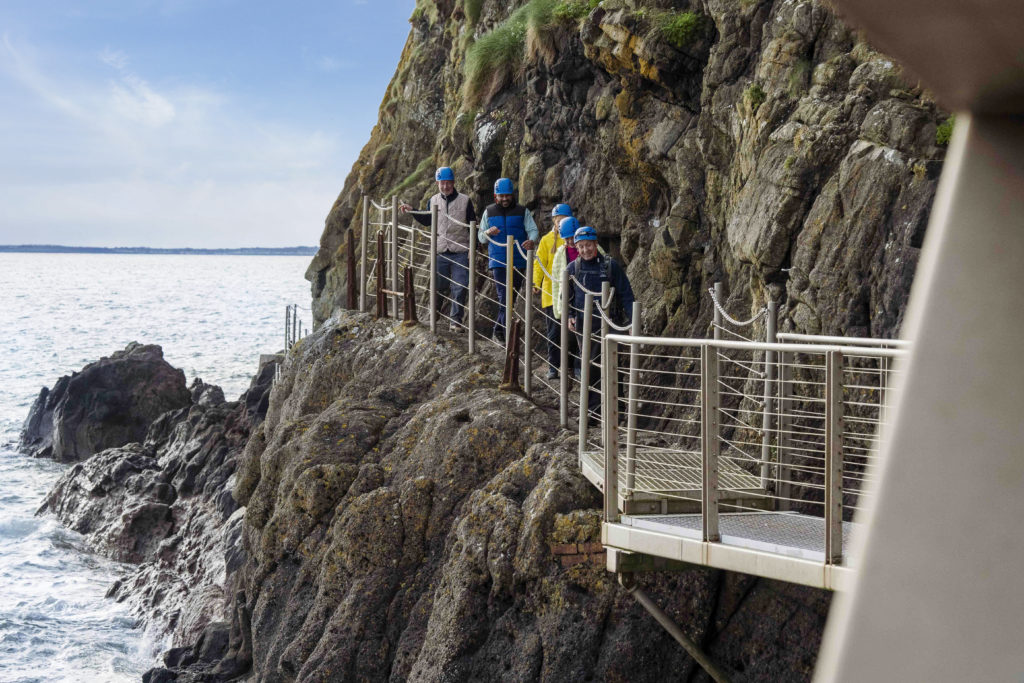 The Gobbins Cliff Path in a unique and dreamlike experience
Carnlough is just one of many star turns on the Causeway Coastal Route. The fishing harbour of Ballintoy is another A-lister. The harbour and surrounding beach have been widely featured in Game of Thrones, as have nearby caves acting the part of The Stormlands. It’s not difficult to see why the area is such a cinematic star. Mighty cliffs enclose the bay, gaunt black rocky stacks emerge from the sea, and the old stone harbour seems tailor-made for adventure and intrigue.
Before the coming of the Game of Thrones, this part of the country already had its fair share of legend. St Patrick tended pigs here, on the slopes of Mount Slemish; I’m always slightly surprised that legend hasn’t bestowed Patrick with the occupation of looking after sheep rather than pigs. I mean, ‘shepherd’ always sounds much better than ‘pigherd’. Nobody’s going to sing a psalm called The Lord is My Pigherd. Or While Pigherds Watched Their Flocks By Night.
Before Patrick came to Antrim, the Wee Folk and the odd giant inhabited the nine Glens of Antrim. All long gone now (probably), but the atmosphere, and the landscape, remains ethereal and magic.
Castles and coastal wonders
MADMAN'S Window looks out over the Irish Sea. No-one quite knows why he went mad, or what his fate was – but the gaunt sentinel, in reality a curious rock formation, watches over the spectacular road which snakes from just beyond the seaport of Larne to the old walled city of Derry.
Music is a strong tradition in these parts, not least Limavady, the home of Danny Boy. Today that song, as well as a host of local characters including fairies, serpents, highwaymen and ancient sea dogs are remembered at the Limavady Sculpture Trail.
The Mull of Kintyre rises just a dozen miles away across the Irish Sea. Inland the nine Glens of Antrim snake their way up to the Antrim Plateau.
The Causeway Coastal Route winds through postcard-grade villages and glens with names that read like a poem: Cushendun, Cushendall, Glenballyeamon, Glenarm, Waterfoot.
It’s ideal topography for castle-building. Should you wish to deter unwelcome visitors, there can be few better locations than on a gaunt rocky outcrop high above the crashing waves of the Atlantic. Dunluce Castle fits the bill admirably — built by the Normans, this is the House of Greyjoy in Game of Thrones. It’s no stranger to drama — both real and imaginary. Mediaeval forces mustered here, Sorley Boy McDonnell grabbed ownership of the castle. CS Lewis braved the stiff north-westerlies to imagine the craggy towers of Cair Paravel in the Chronicles of Narnia, while Led Zeppelin used an image of the castle on the cover of their album Houses of the Holy.
Nearby, Benone, a seven-mile strip of sand on Derry's Atlantic coast, looks across Donegal's Inishowen Peninsula. Washed by huge breakers, it’s one of the finest surfing beaches in Ireland, and comes with a beguiling dune system attached.
To the westerly end of the strand stands a Martello Tower, built to help see off Napoleon on the unlikely event he’d decided to march on the village of Castlerock. Mussenden Temple, a building for which the word folly could have been invented, stands high above the strand.
The waypoints include many adrenalin-producing moments. The Carrick-a-Rede rope bridge is every bit as precarious as it sounds — swaying between Co. Antrim and the tiny Carrick Island some 24 metres away, it will probably be the most terrifying trans-Atlantic journey you’re likely to take.
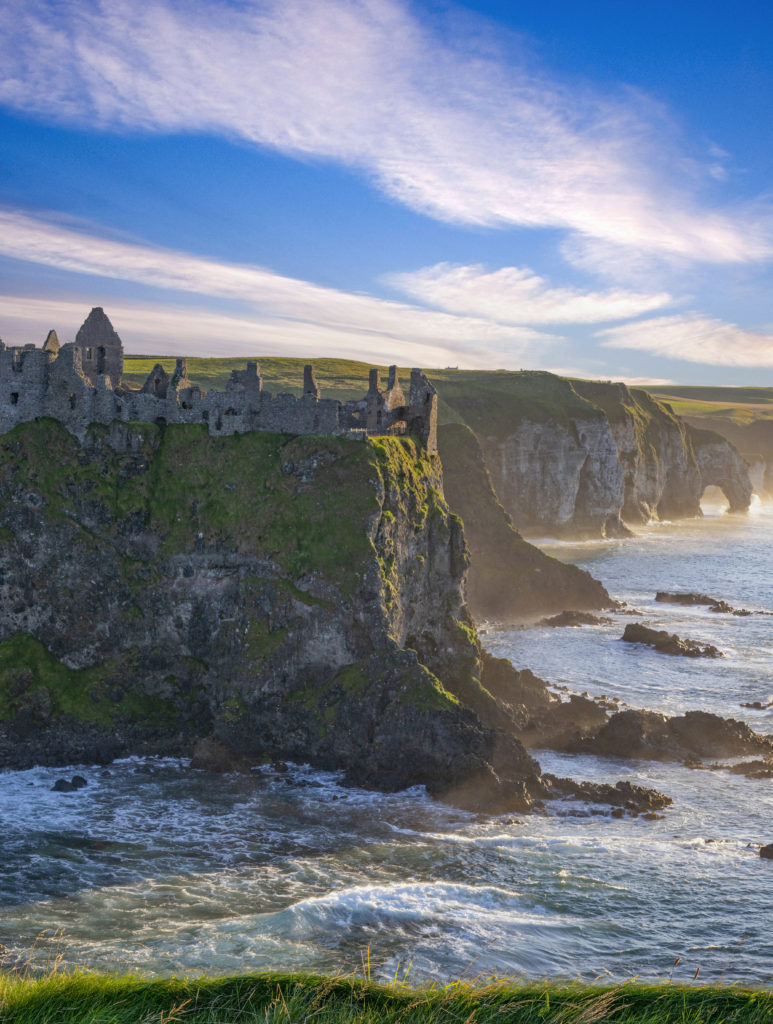 View of Dunluce Castle and White Rocks Cliffs near Portrush
Before heading down the coast road and through the nine Glens of Antrim, there’s time for a quick detour to the Bregagh Road near Stranocum. Better known as The Dark Hedges, aka The King’s Road, Game of Thrones, this beautiful avenue of beech trees was planted in the 18th century. Because of its starring role on screen, cars are today barred from entry — and it’s all the better for that.
Back on the coast, and Fair Head, the north-east extremity of Ireland, stands the crumbling ruins of Bonamargy Friary. Founded by the Franciscans in the 15th century, battles have raged outside its walls, hidden treasure has been buried inside. Needless to say, it’s haunted — so mind how you go.
Alongside the ancient stands the newly-furbished. The Gobbins was an Edwardian tourist attraction, now given a complete makeover allowing visitors to do a spot of cliff-climbing by means of via ferrata contraptions, in relative safety.
Distilleries and disappearing lakes are not connected, even though they’re both part of the Causeway Coast. Bushmills Distillery is the oldest licensed whiskey manufacturer in the world, with more than 400 years of experience in the artform.
Loughareema, some two miles from Torr Head (impressive views guaranteed) is possessed of a highly unusual topography – a chalk "plug hole" bunged up with peat. Which means you can bring a picnic and watch the entire lake vanish before your very eyes.
Along the route you can wander round mediaeval Carrickfergus Castle, look out for puffins, Manx shearwaters and other avian celebrities on Rathlin Island, or stop for tea in the lovely old village of Glenarm.
To reach the fishing harbour of Ballintoy you head down a steep, winding narrow road, with plunging cliffs either side. The harbour and surrounding beach have also been widely featured in Game of Thrones, as have the nearby Cushendun Caves — which acted the part of The Stormlands. It’s not difficult to see why this whole area is such a star of screen. Mighty cliffs enclose the bay, gaunt black rocky stacks emerge from the sea, and the old stone harbour seems tailor-made for adventure and intrigue.
Seaside luxury and sunsets
IN AMERICA people assume Red Sails in the Sunset is focused on some sunswept beach in Hawaii; in Britain it’s usually presumed to be about the Mediterranean. But the song was inspired by a scene on the north coast of Ireland.
Tyrone man Jimmy Kennedy watched one evening as a Portstewart boat The Kitty of Coleraine put out to sea and headed for Portrush. The sails were white — the sunset coloured them red, etching them out in silhouette against the Inishowen Hills of Donegal. The lyrics were born.
The melody for Red Sails was written by a long time collaborator of Kennedy’s, Wilhelm Grosz. Forced to flee his native Vienna to escape the Holocaust when the Nazis moved in, he had teamed up with the Tyrone man in a very successful songwriting duo. Whether he ever made it to Portrush or Portstewart, I couldn’t say. But I really hope so.
Visit the north coast of Antrim or Derry of an evening and you’ll realise that the light here is so ethereal you’ll see what Jimmy Kennedy was getting at. I hadn’t been there in a while, and had forgotten the mix of colouring — sand, sky, sun — would look perfectly at home in a Raphael painting, never mind a Jimmy Kennedy song. As I rounded a corner en route to my destination the Elephant Rock hotel, the streets along the seafront were bathed in gold and orange. I genuinely thought a film production company had set up shop, with all spotlights turned on.
But of course not. It just is that quality of light you get at 55 degrees north. There are few better places to experience this phenomenon than the most northerly boutique hotel in Ireland.
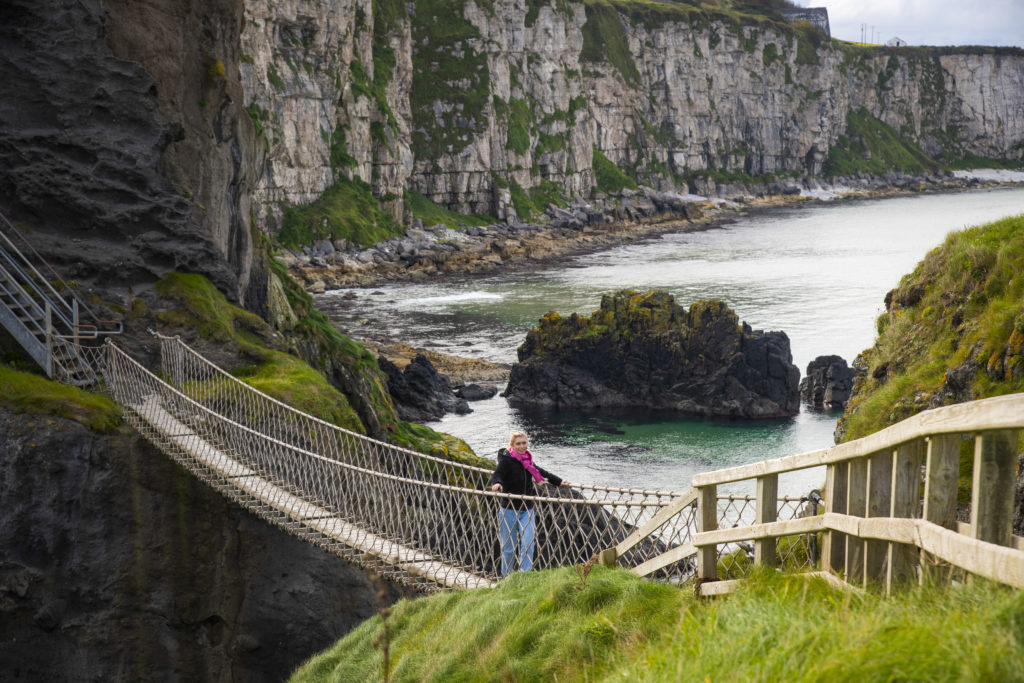 View of Carrick a Rede
You get to Elephant Rock hotel, an oasis of luxury, by driving along the Causeway Coastal Route to Portrush.
Real drama has been re-enacted here many times. A Spanish warship Girona foundered just to the east of Dunluce at Lacada Point in November 1588. The panicky English garrison in Dublin were spooked by the Spanish Armada which had lost many ships along the Irish coast. They accordingly gave orders to execute all Spaniards not important enough to be ransomed. Life for these unfortunate men on the lam became a dangerous game of hiding from English soldiers and sheltering from the weather.
A commander of one ship, Don Alonso de Leiva, had already survived two wrecks when he came across the deserted Girona in Killybegs harbour. With other fleeing Spanish sailors and soldiers — and with the help of some locals — the ship was repaired. It set sail for Scotland, but foundered in a storm off Lacada Point.
Elephant Rock, on Ramore Head, is within easy reach of all of these grade A sights.
Ramore Head is a spit of land looking out towards Scotland. On a clear day you can make out the isle of Islay shimmering in the distance — you can just about see the people waving.
This rocky Co. Antrim headland is somewhat incongruously called Lansdowne Crescent — which sounds as if it should be in Georgian Dublin or perhaps Mayfair in London. But no, here it is with the Atlantic almost lapping the houses.
The hotel is even more oddly called Elephant Rock. Turns out this is actually a rock formation at nearby Ballintoy Harbour.
The hotel oozes boutiquerie and lack of restraint in equal measure. Done out in pink and black, it’s independently owned by Portstewart woman Charlotte Dixon. From the moment you check in, the utterly charming staff look after you; there’s an easy nonchalance about the place that makes you wish you were booked in for a fortnight.
Set among a terrace of sea-facing Victorian townhouses overlooking Lansdowne Harbour and Whiterocks Beach, Elephant Rock was converted from a British Legion convalescent home. Today it's an 18-bedroom hotel with a wonderful mix of over-the-top styles. The food is excellent: salmon fillet, scallops, black pudding, monkfish scampi; unsurprisingly seafood features prominently on the menu. The cocktail bar, art deco in style and with views over the Atlantic, pays homage to the Roaring Twenties, mixing marble, metal and verre eglomise mirrors. It more or less demands that you get up to no good.
Make sure to get a room with sea view. Sulk if you don't. Create a scene. Because you really don’t want to miss the sun coming up over the Causeway Coast. Leave the curtains open to wake to the tang of the sea air — the only way you’ll better this is if you sleep on the beach.
The Glens and their myths
THE GLENS of Antrim are nine, or maybe ten in number, running from the Antrim Plateau to the coast.
The glens are: Glentaisie, Glenshesk, Glendun, Glencorp, Glenaan, Glenballyeamon, Glenariff(e), Glencloy and Glenarm. Glenravel is often considered a tenth glen, although it fails on one crucial, unticked box - it doesn’t open directly onto the sea.
Few places in Britain or Ireland hold more interest for geologists than the 100 miles of coastline which hug the North Channel and Atlantic. At Fair Head, the north-east extremity of Ireland, geology takes on a dizzying dimension with a 600 ft plunge into the sea. Should you happen to fall off, you’ll pass sixteen different rock strata en route to the bottom.
Glenariff, the queen of the glens, has gushing waterfalls and a scenic path skirting the sheer sides of the plunging gorge. Three cascades, Ess na Crub, Ess na Laragh and Tears of the Mountain have viewpoints where you can sit and contemplate – and see if you can come up with something better than Thackeray’s: ‘Switzerland in miniature’. It’s OK, but you feel he might have tried a little harder.
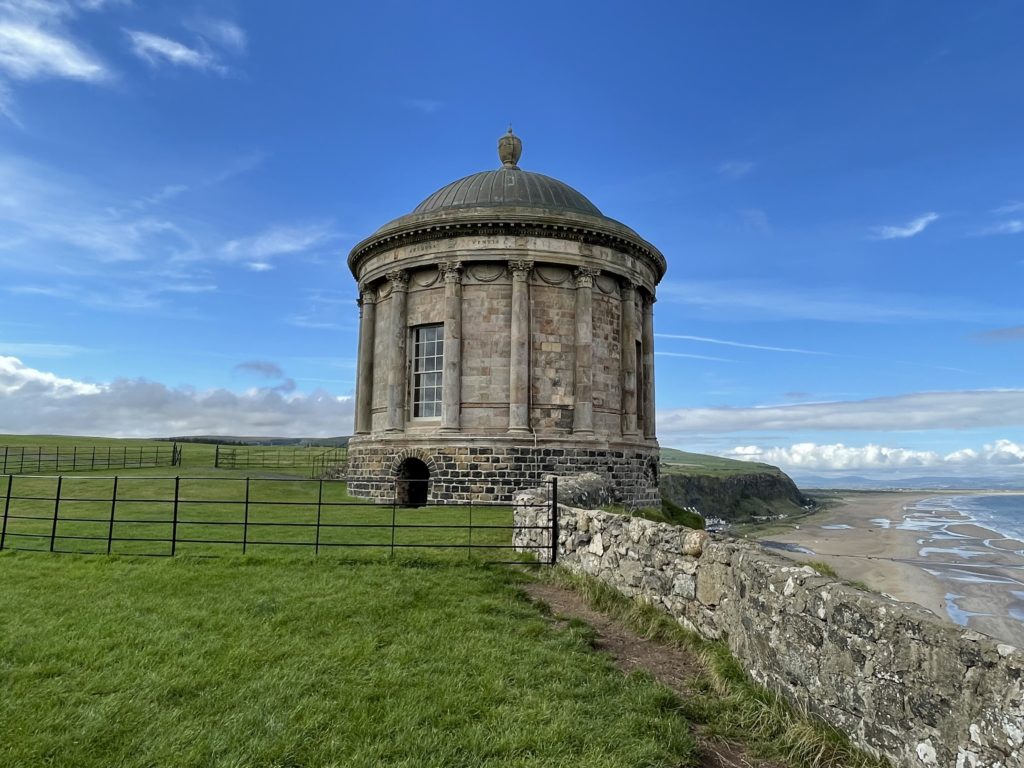 Mussenden Temple and Benone Strand copy
Ancient Gaelic influences in Antrim (both native Irish and Hebridean Scots Gaelic)– the Glens have bequeathed to us more than their fair share of legends and folklore. The sheer effrontery of the landscape has probably helped as well – steep-sided valleys, surreal rock shapes and swirling mountain mists all contribute to a rich store of magic mythology.
Lurigethan Mountain, which begins in Glenarriff, is one of the main settlements of the Wee People - or Wee Folk (not leprechauns in these parts). BBC Northern Ireland has an early photograph of small Glens boys dressed in petticoats to look like girls while travelling through this area – the fairies were famous for capturing boys.
A local, traditional poem, The Little Son, refers to the avarice of the fairies and the wisdom of steering clear of green fertile glens where the Wee Folk might gather:
In a green an' tremblin' shadow there I'll hush my tender laddo,
An' the flittin' birds 'ill quet their songs as if they understood.
When my pretty son's awake, och, the care o' him I'll take!
An' we'll never pass a gentle place between the dark an' day;
If he's lovely in his sleep on his face a veil I'll keep,
Or the Wee Folk an' the Good Folk might be wantin' him away.
The Watershee is also believed to inhabit the Glens. She usually appears as either a female fairy or a beautiful woman who lures weary travellers into bogs and loughs with her sweet singing, only to drown them and devour their unfortunate souls. Only the wearing of a cross or saying a prayer will protect you from her dark and evil ways.
The banshees are slightly more benevolent, although a visit from them is equally unwelcome. They appear and begin wailing when a death is imminent.
Mind you, the Christians – Johnny-come-latelys in this part of the world – saw all this strangeness in another way. Hugh Shearman in his book ‘Ulster’ wrote: “A powerful astringent presence seems to brood over a great area of north Antrim . . . when I read that a certain individual, a bishop, claimed to have seen great angels in north Antrim, I did not feel at all inclined to question it.”
For further details visit ireland.com
Everything from irishpost.com and the print edition is available on the Irish Post App — plus more! Download it for Android or Apple IOS devices today.
See More: Antrim, Derry, Giant's Causeway
