





WHAT is the point, you might wonder, of a stone beehive?
I have seen them in the ashram in Rishikesh where the Beatles learned to meditate and on the bleak and beautiful south-west coast of Ireland. I have seen them on Slea Head in Kerry, on the edge of the Atlantic, where it is often stormy and cold.
They were shelters for monastic drop-outs, serious ascetics who wanted to be alone with their contemplation of the divine.
There was a monastic tradition in Ireland going back a very long way, and those who engaged in it were a hardy lot or they didn’t survive.
And if they weren’t mad to go there, they would probably have passed as mad after a spell at the heart of the howling wind.
If they wanted an even more distant retreat, they went out to Skellig Michael, a scarred and blasted rock, and suffered even greater danger and discomfort.
Nowadays, meditation is often sold as a means to relaxation and clarity, freedom from stress and amenability to inspiration.
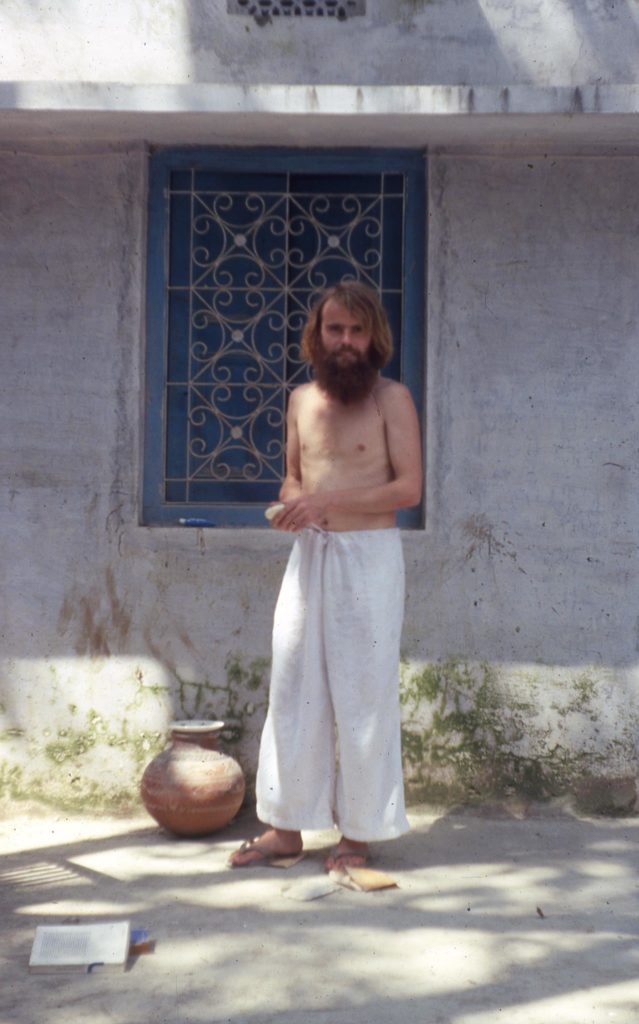 Malachi pictured in the ashram in 1977 (Pic: Richard Elwood)
But a recent article in The Atlantic reports the discovery by researchers that many of those who meditate sleep uneasily and suffer mental and spiritual discomfort arising from their practice.
And why wouldn’t they, when they are taking on the spiritual exercises of the mystics who accepted that a life of dedicated reflection on the spirit within brought enormous challenges?
They believed that they had to cut themselves off as hermits and trained themselves to be wary of the temptations that come with social intercourse. Out of that tradition, we have not developed a system of Irish meditation distinct from Christian religious tradition.
More practising Catholics simply prefer the rosary, as more Hindus prefer japa, counting out recitations of a holy name on beads.
There may still be hermits we haven’t heard of because such people don’t give media interviews. None have come forward to commend their practices as systems for an enhanced sense of well-being because that is not what they were meditating for in the first place.
The beehives in Rishikesh intrigue me. Were they modelled on the Irish beehives or was it simply a coincidence that a teacher of yoga meditation in India arrived at the same design for a private shelter?
Actually, the beehives in Rishikesh are bigger than the Irish ones. I have been in one of them and it even had its own toilet.
I doubt there were en suite facilities on Skellig Michael or Slea Head.
The ashram in Rishikesh is now a tourist attraction because those who meditated there include the Beatles, Mia Farrow, Donovan and others.
That toilet I saw may have been used by John Lennon. That wouldn’t impress me. I have one downstairs that was used by Brad Pitt (another story).
The genius of the Maharishi Mahesh Yogi, who brought Transcendental Meditation to the West, was to take an ascetic system of religious devotion and package it as a relaxation technique. The mantras which he taught are, in fact, invocations to Hindu deities.
Meditation, as it was traditionally practised by the yogis in their caves, was probably a lot more like the dedicated prayer lives of the Irish monks.
And the yogis suffered for their devotion. Indeed, they imposed suffering on themselves under the guidance of their gurus.
I have a simple theory about yoga asanas, the physical contortions the yogis practised. Most of us in the West can’t manage a simple lotus posture anyway.
This involves crossing the legs in a sitting position so that each foot rests, sole up, on the opposite thigh. That way they wouldn’t fall over when they went into a trance.
They used the other contortions, asanas and mudras, to unstiffen themselves after hours of sitting in the one position. And the meditation that is taught in the West now is probably as far removed from the entrancement of the yogis as the system taught in leisure centres is from the travails of the naked ascetics, who were stretching to relieve the inevitable constipation from hours of sitting still.
(You know what it’s like yourself after a long drive.)
The point of meditation for the yogi was to experience the soul and, further, to discover that the individual soul is the soul of the universe. The Christian contemplatives in the remote monastic settlements of the west of Ireland were as serious about their objective and as willing to suffer for it. You would expect some hardship along the way if that is what you were after.
But if you were after a period of peace and reflection, would you not prefer a long bath?
I should declare an interest now. In my twenties, I lived for four years in an ashram in India with a Hindu guru, meditating morning and night and stretching myself in the prescribed manner to loosen up afterwards.
I believed that what I was doing was a pursuit of the mystical vision. I came away from that with a sense that I had a different vocation.
The ashram teaching, which is contained in the holy books of the Hindus, like the Bhagavad Gita, is that one progresses in meditation by detaching oneself from the world and giving up hope of reward for one’s work. That wasn’t for me.
Furthermore, the tradition, like that of the monks in Kerry, required celibacy. That wasn’t for me either.
The pic shows me in the ashram in India in 1977. Credit: Richard Elwood.
Everything from irishpost.com and the print edition is available on the Irish Post App — plus more! Download it for Android or Apple IOS devices today.
See More: Inner Peace, Meditation
