





THIS year, 2026, marks the 150th anniversary of the opening of the Settle–Carlisle railway line to passenger traffic.
The Midland Railway Company needed its own independent route to Scotland after disputes over access rights with rival companies, and there was only one option — straight through the Yorkshire Pennines.
So I took a trip over its 72 miles of track. The day of my journey was wet and, at the line’s highest points, there was fog, with swirling mist rolling down through the dales and valleys. I got off the train at Ribblehead, a very remote spot in the middle of nowhere, where I was greeted by 40mph winds and lashing rain. I was getting a real sense of what it must have been like for the navvies who worked on the railway.
The scenery is among the finest in the country — when it can be seen!
I made my way to Settle to meet Sarah Lister, who has written an excellent book detailing her research into the line.
Sarah told me that she had found that only 2.4 per cent of the navvies were Irish. At first, I was disappointed, but checking the figure showed that more than 100 of the 6,000 workers who built the Settle–Carlisle Railway between 1869 and 1878 were Irish. They laboured in remote and difficult conditions, enduring freezing winds, deep snowdrifts and heavy rain.
Sarah said there were Irish graves at several locations along the line.
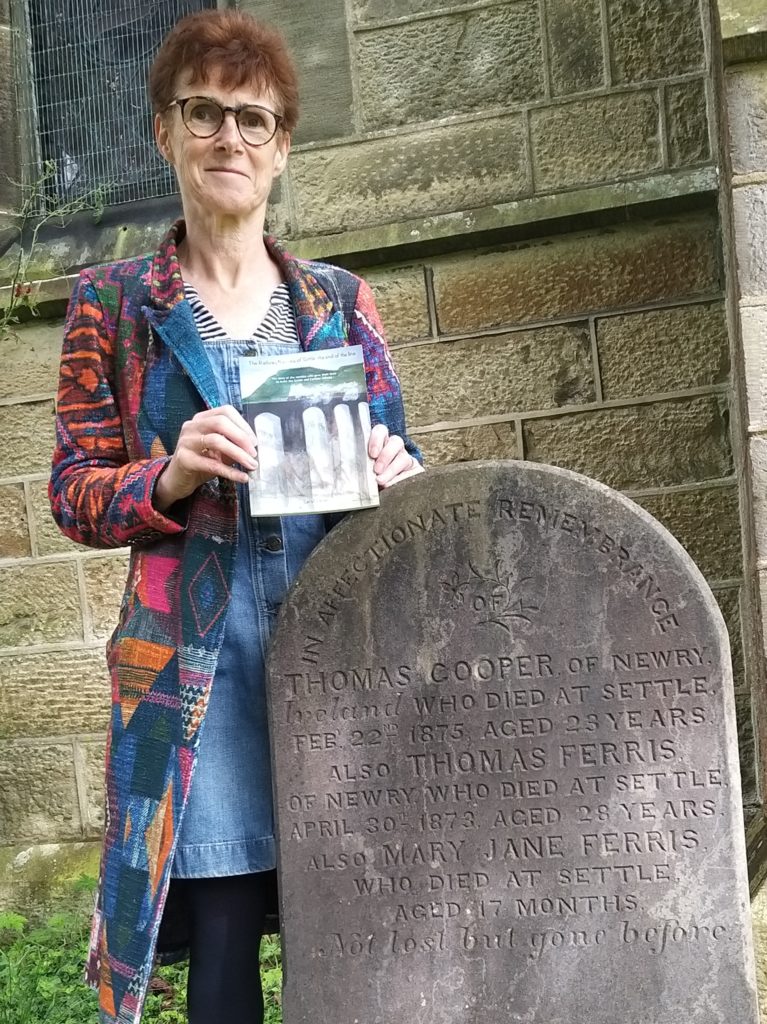 Historian Sarah Lister of Settle (Pics: Peter Fawcett)
In the churchyard of the Church of the Holy Ascension in Settle are the graves of 20 workers and members of their families. They include Samuel Henry, of Commons, Newry, Ireland, who died in Settle, Yorkshire, on October 15, 1874, aged 25.
There is also the grave of Thomas Cooper, of Newry, Co. Down, who died from pneumonia on February 22, 1875, aged 23. Thomas was buried in the same grave as Thomas Ferris, also of Newry, who died on April 30, 1873, aged 23, and Mary Jane Ferris, who died aged 17 months.
The main thing that struck me was the length of the tunnels, hacked out of solid Yorkshire millstone grit. There are 14 of them. The longest, Blea Moor Tunnel, stretches for 2,629 yards — 2,404 metres, or about 1.5 miles — between Ribblehead and Dent.
The waiting room at Ribblehead station was used for Catholic Mass and other church services during the construction of the Settle–Carlisle line.
Along its 72 miles, the railway has 14 tunnels and 22 viaducts. The largest is Ribblehead Viaduct, which has 24 arches and rises 104ft — 32 metres — above the ground.
One point worth mentioning is that the line was hewn entirely by hand, without modern machinery. In the Victorian tunnels, known as “hell holes”, dynamite was favoured in places such as Blea Moor because it was considered safer than gunpowder, the use of which killed more than 100 people in the tunnels.
By comparison, the tunnels for London’s Crossrail project were excavated using giant tunnel-boring machines measuring approximately 150 metres (492ft) in length.
The navvies laboured with sledgehammers to drill holes deep into hard gritstone and limestone, pack them with dynamite and clear away the rubble, all while breathing thick, toxic smoke. No wonder there were frequent fatal accidents, which were treated as necessary casualties of the work.
It has been estimated that three men lost their lives for every mile of track built, although we may never know the true number of casualties.
Rockfalls inside the tunnels were another reason why many did not survive. But good pay encouraged men to take the chance.
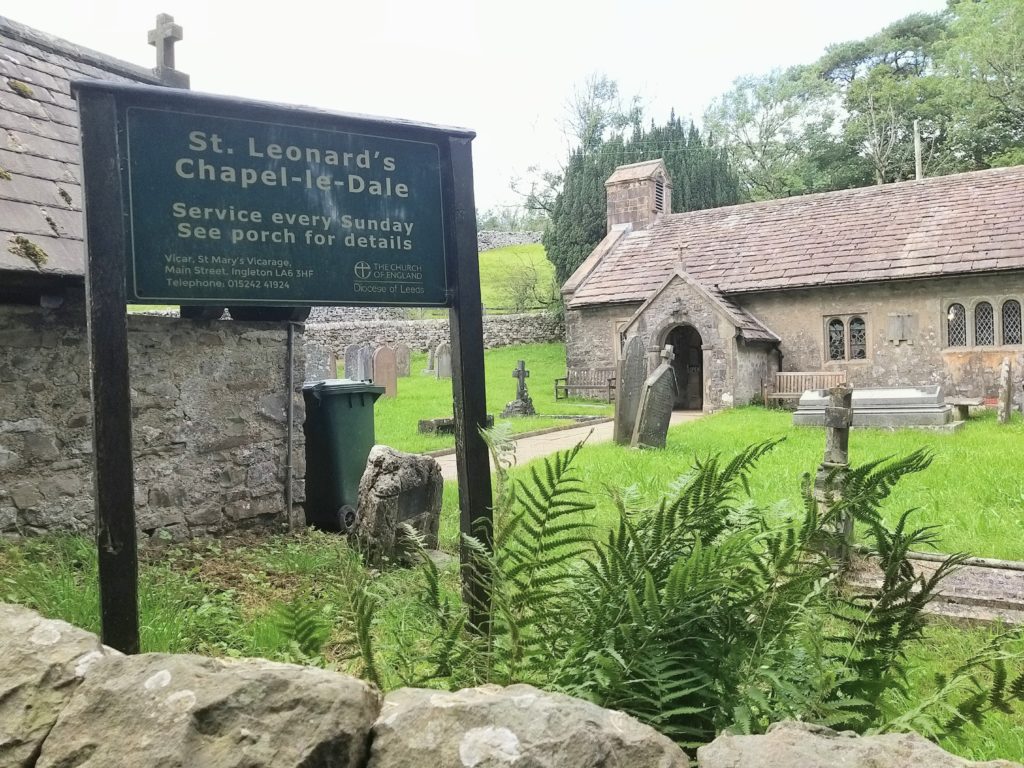 Chapel-le-Dale church where unmarked graves lie
Sarah Lister says that more workers died from diseases such as smallpox and cholera than from industrial accidents.
Large camps of wooden buildings were erected to house the workers. Inevitably, there were disputes and fights among the navvies, while the Irish experienced hostility from some of the non-Irish workers.
The Midland Railway Company employed missionaries to provide education. A Mr Tiplady was put in charge of a mission intended to draw men away from “pursuits and places of a corrupting character”. A reading room was opened for “mental improvement and social engagement”.
A concert was held in the reading room at Dent Head in December 1871, at the expense of the Midland Railway Company. Even today, Dent Head is a wild and bleak place, seemingly in the middle of nowhere.
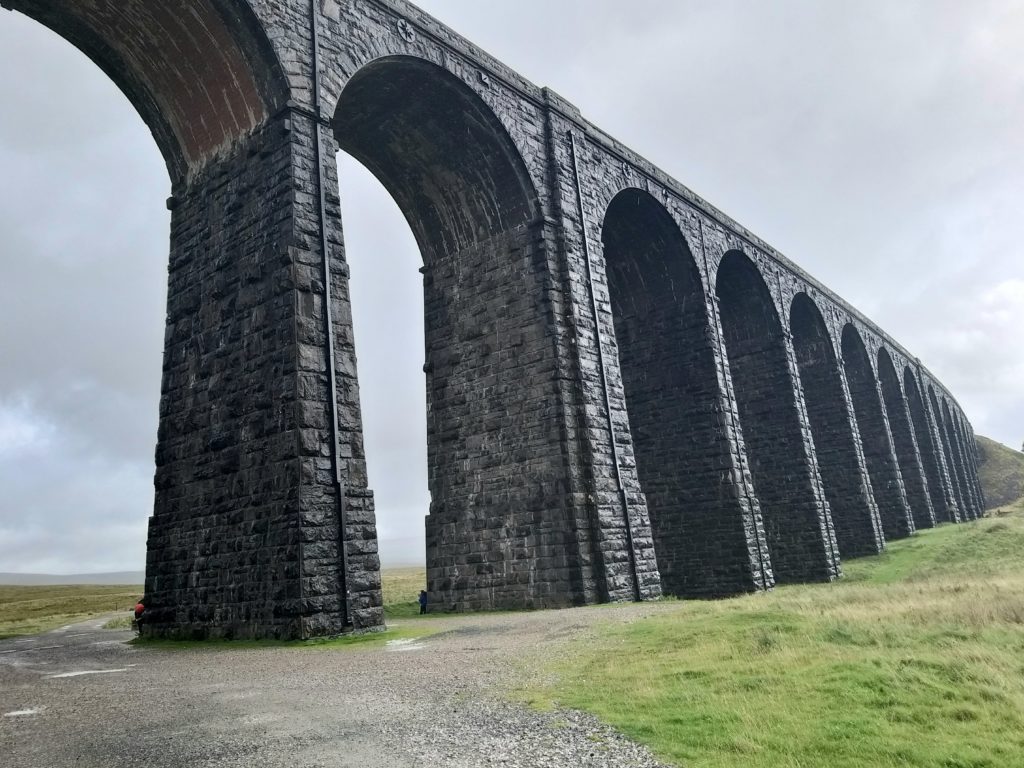 Ribblehead Viaduct
The camps lacked clean water and proper sanitation, causing deadly outbreaks of smallpox and other illnesses. This was in addition to the dangers posed by work on the tunnels and viaducts.
A horse and cart constantly transported bodies from Batty Green — the navvy camp beside Ribblehead Viaduct — to the church at Chapel-le-Dale, where the dead were buried in unmarked graves three miles away. Such was the loss of life that the railway company paid for the graveyard to be extended. The site can still be visited in this very remote spot.
We know the names of only a few of the Irish people who worked on the line.
A review of church records suggests that another 15 navvies may lie in unmarked graves somewhere in the churchyard at Chapel-le-Dale. There are more graves at Dent, while other navvies are believed to have been buried in unmarked graves across the moor.
I cannot help wondering whether, in those far-off days, their families back in Ireland ever received news of their deaths — or whether they were simply left wondering what had become of them.
One point to verify before publication: the railway opened in 1876, so the statement that it was built “between 1869 and 1878” may need adjusting. The estimates concerning deaths from gunpowder and the figure of three fatalities per mile should also ideally be attributed to a source.
Everything from irishpost.com and the print edition is available on the Irish Post App — plus more! Download it for Android or Apple IOS devices today.
