





IRISH sport is seldom just about the field of play.
It’s often tangled up with history, migration, religion, class, politics, pride, heartbreak (inevitably) and occasionally unfettered joy — such as Troy Parrot’s goals that have kept Ireland in the World Cup.
A clutch of recent literary releases reminds us why the games we play matter far beyond the scoreboard.
Brendan Murphy rewrites the origin story of football itself; Mike Hennessy remembers a priest who gave Edinburgh its Hibs; Brendan Fanning charts Irish rugby’s pursuit of greatness; and Chris Lee follows football across an island split but still singing.
And Johnny Sexton relates how it can all combine into a hero admired the world over.
The Game That Would Be King — Brendan Murphy
Published by Meyer & Meyer Sport
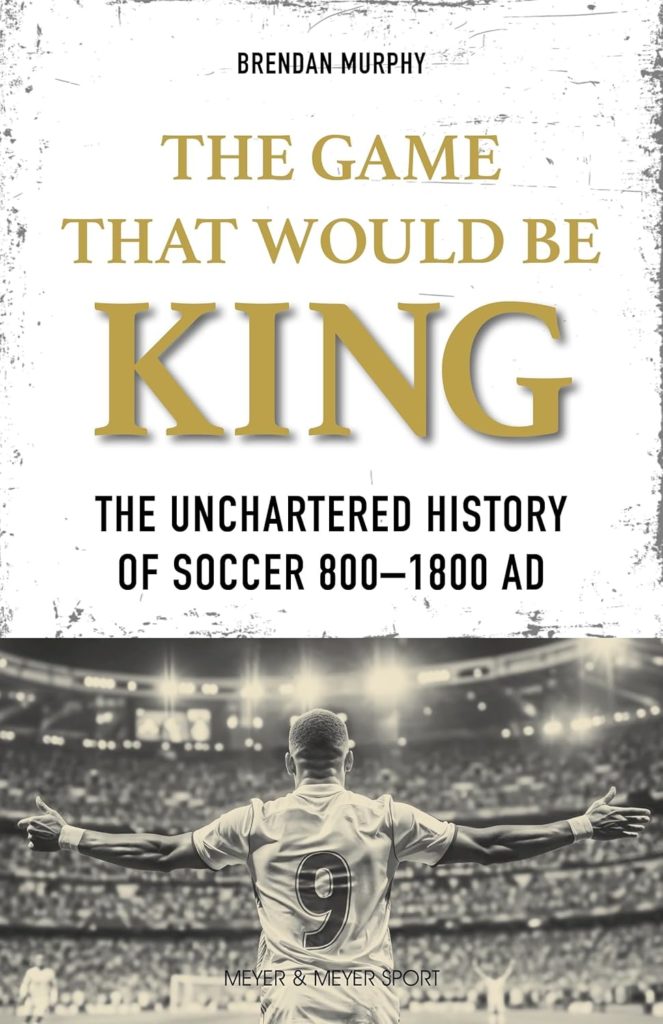
The Game That Would Be King sets out to do something audacious: rewrite what we think we know about the origins of soccer. Brendan Murphy’s new work, published by Meyer & Meyer Sport earlier this month, is part scholarly odyssey, part time-traveller’s guide, charting the evolution of ball games over five millennia. The journey stretches from ancient Egypt to Mesoamerica, through the Greeks, the Chinese dynasties, and the Roman Empire, before arriving in medieval Britain and, crucially, Ireland, where much of the real action begins. Kicking a ball, it seems, was a ubiquitous pastime.
Murphy traces a family tree of games long forgotten: trapball, stoolball, the wonderfully named “camping” and “knappan”, with hockey, hurling, baseball, bowling, tennis and golf stepping into view along the way. Exotic cousins — baggataway, knattleikur, soule, calcio — are part of the story too, although possibly not in evolutionary terms; just evidence that playing ball seems to have been with us, in most areas of the world, for a long time.
Soccer remains centre stage, but the wider cast gives the book its colour, strangeness and charm.
For Irish readers there is particular interest. Large portions of the research delve into hurling’s antiquity and its role as arguably Europe’s earliest post-Roman field sport. Murphy mines political and literary sources to show how, over centuries, an Irishman striking a ball could, in the wrong company, be seen as subversion. Newspapers bristle with official suspicion, and the author threads these social and political echoes through the narrative with care.
There are fascinating digressions too, not least Murphy’s reiteration of evidence that elements of Norse mythology may have sprung from Irish oral tradition, supported by the striking statistic that 43 per cent of Iceland’s first settlers came from Ireland and Scotland. This, of course, is not new research, and has been attested to before. “The Irish brought to Iceland their literature and their learning – of which the Scandinavians had nothing,” said Halldór Laxness, Iceland’s Nobel Laureate in Literature. “Without the sagas we would just be another Danish island.”
Packed with oddities, anecdotes and ephemera, The Game That Would Be King is a dense but engaging work — likely the most comprehensive history of early ball games yet assembled, described in the publisher’s words as “a revolutionary text”.
Edinburgh’s First Hibernian by Mike Hennessy
Published by Thirsty Books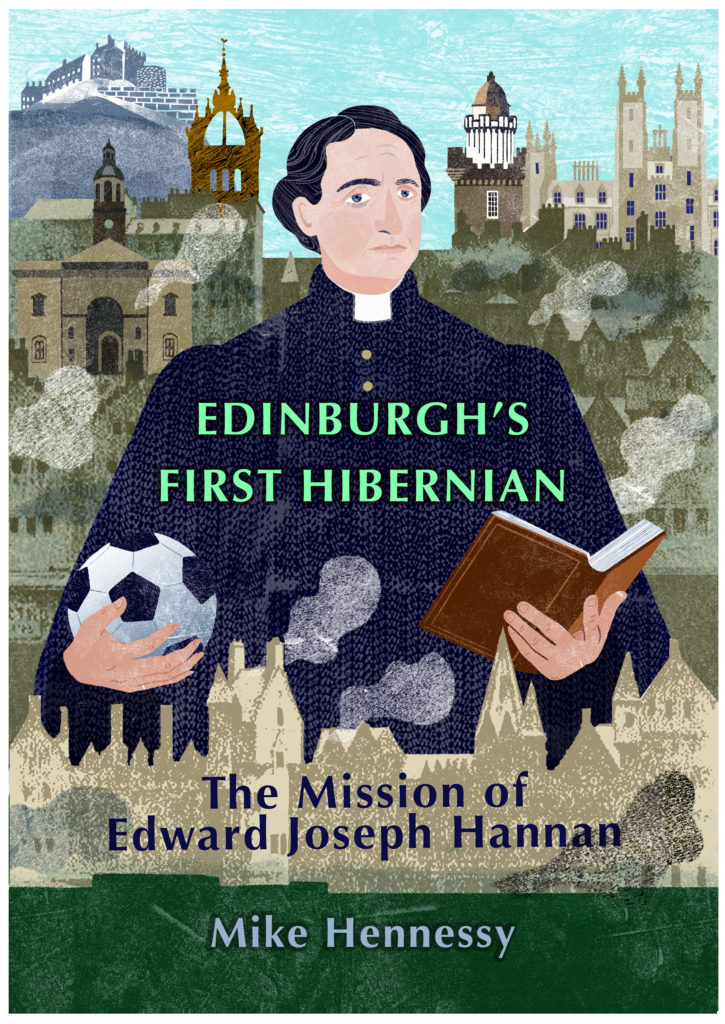
WE HAVE many Irish emigration stories, some glorious, some tragic, many forgotten, some inspirational. Edinburgh’s First Hibernian, a biography of Canon Edward Hannan, reminds us why some deserve to be pulled sharply back into the spotlight.
Born in 1836 on a small farm in Ballingarry, Co. Limerick, Hannan survived the Famine years, trained at All Hallows in Dublin, and sailed for Scotland in 1861, part of the great clerical outflow sent to serve destitute Irish communities abroad. What followed was not just ministry, but institution-building on a remarkable scale.
In the Cowgate area of Edinburgh, “Little Ireland” as it was often called, Hannan found squalor, prejudice and poverty in equal measure. The Irish population in Scotland at that time was very much put upon — and that’s describing it mildly. His response was not despair but organisation: night schools, savings schemes, reading rooms, temperance halls and the Catholic Young Men’s Society, which, in time, became a hub not only for faith but also politics, education and social uplift.
It was in that same St Mary’s Street Hall that, in August 1875, 150 years ago, Father Hannan announced the creation of a football club for young Irish members excluded elsewhere because of their nationality and religion. Its name was Hibernian, its motto Erin go Bragh, and its early players were sons of famine emigrants determined to belong.
The book tells this story with clarity, affection and research that feels lived rather than compiled. It folds in the wider sweep of Irish Presbyterian landlords, evicted Highlanders, and the shaping of early Scottish football. James Connolly — himself an Edinburgh Irishman — flickers at the edge of the narrative as another son of that same immigrant soil.
Hibs’ birth sits perfectly in the long tale of Irish endurance abroad: faith, football, identity — and the stubborn belief that the poor deserve dignity and joy. It is a fine book, rich in detail and heart, and a welcome reminder that Irish footprints in Britain run deep, and often lead to goals.
Touching Distance by Brendan Fanning
Published by Gill Books
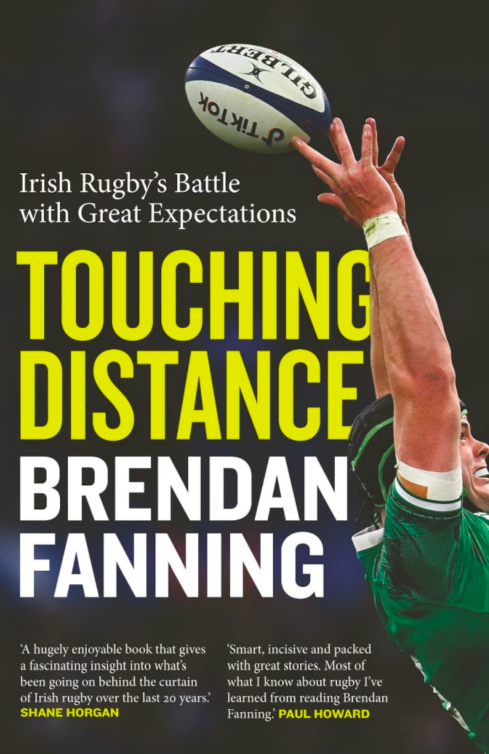
IRISH rugby has spent the better part of two decades chasing a place among the world’s elite. World Cup semi-finals have become the great unfinished business — a target that has shaped performance analysis, player development and public expectation. Having exited the World Cup at the quarter-final stage on eight occasions has become a weight round the neck of the Ireland squad.
In Touching Distance, Brendan Fanning attempts to answer a question that has hovered around the sport for years: has that single goal come to define Irish rugby too narrowly, and what does success really look like?
Fanning is well placed to make the assessment. A former player and coach who became one of Ireland’s longest-serving rugby correspondents, he covered the sport for the Sunday Independent for nearly thirty years and has reported on rugby since the 1980s. His earlier book, From There to Here, chronicled the shift from amateurism to professionalism. This new volume picks up where that work logically continues: beginning around the time of the 2007 World Cup and running forward into the present era.
Over the course of the book, Fanning moves through schools rugby, provincial systems and the national side, examining how Ireland built a winning culture and how, in some areas, the structures that work in Leinster have not translated with the same ease elsewhere.
Coaches such as Eddie O’Sullivan, Joe Schmidt and Stuart Lancaster appear throughout, as figures examined with the benefit of distance. David Nucifora’s tenure as performance director — a role often compared to a chief executive of rugby operations — is explored in terms of influence, decision-making and controversy.
The interviews, drawn from Fanning’s years of contact within the game, allow him to challenge assumptions while also acknowledging the scale of the transformation professional rugby brought. Before professionalism arrived, the Irish squad could have been characterised as being made up of a handful of Ulster doctors, a large tranche of Dublin and Cork public school products, and a bunch of hardnecks from Limerick. All changed now, of course.
Much of the strength of Touching Distance lies in tone. Fanning’s writing has always carried a plain-spoken quality: experienced, occasionally blunt, and uninterested in myth-making. The book promises to be valuable both for dedicated followers of the game and readers who want to understand how Ireland arrived at the modern high-performance era. It is not a sentimental history; rather it reads as a guided walk through the machinery behind Irish rugby — its progress, its limitations, and the persistent question of what comes next.
For supporters still wondering why a semi-final remains elusive, this book offers context instead of easy answers — and that is its real achievement.
Shades of Green: A Journey into Irish Football
Published by Merrion Press
 Irish football is often overshadowed by the dominance of GAA codes and rugby in public discourse, yet beneath the noise lies a rich, complex and evolving story that few outsiders fully appreciate. Soccer in Ireland is a complex story, bound up with sport, community — and sectarianism and politics.
In Shades of Green: A Journey into Irish Football, author and football-culture writer Chris Lee seeks to bring that story into the light, and manages to do so with stylish clarity.
Published in March 2025 by Pitch Publishing, the book takes the reader on a physical and historical journey across Ireland — the whole island.
Lee criss-crosses from Dublin derbies to old Northern stadiums, from the backstreets of Belfast to suburban grounds in the Republic, unearthing untold stories.
What makes Shades of Green stand out for an Irish sports-loving audience is Lee’s refusal to treat the subject as just another addition to the “foreign-sport” archive, the “garrison-games” narrative. Instead, he positions football in Ireland as a lens on identity, politics, migration, sectarian history, community and finally a degree of hope.
The book explores how the 1921 split — which fractured the domestic game along the same lines as national politics, but in fact beat partition to it — reverberates to this day in league structures and fan allegiances.
Cross-border sensitivities are examined, and Lee unpacks how the game once denounced as “foreign” became a battleground for identities, yet ultimately a space for reconciliation and shared culture (think “Big” Pat Jennings, a Catholic from Newry becoming an icon for Northern Ireland fans across the politico-religious divide).
Lee’s strength lies not just in the breadth of his geography — north and south, city and small town — but in the human voices he draws in: fans, historians, former players, local club organisers. It’s a grassroots, bottom-up portrait rather than a top-down institutional history.
The book also captures the contemporary moment. As League of Ireland and Northern Irish football gain renewed attention — with rising attendance, growing women’s football, and shifting loyalties in a post-Brexit, post-pandemic Celtic cultural landscape — Lee argues we may be witnessing something akin to a renaissance. He treats these changes with steady optimism, but avoids hyperbole: the revival, he suggests, is fragile, shaped by economics, identity and the ever-present shadow of more glamorous foreign leagues.
This is a nuanced, compelling and often moving exploration of an under-explored sporting culture — the definitive modern portrait of football in Ireland, north and south.
Obsessed: The Autobiography – Johnny Sexton
Sandycove / Penguin Books
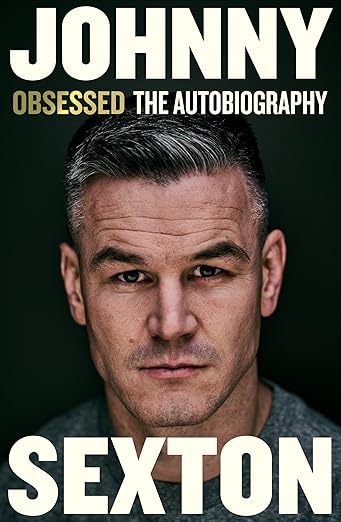 Johnny Sexton’s memoir Obsessed is a raw, driven and remarkably honest look inside the mind of one of Ireland’s greatest ever rugby players. Published by Sandycove, an imprint of Penguin Books, it charts the arc of Sexton’s career from his early days at Leinster to becoming a figurehead for Irish rugby on the world stage. The title is fitting: this is a book about the power and price of obsession, and Sexton writes with a candour that goes beyond the usual sporting triumphs.
He begins with a portrait of himself as a young player fighting for recognition, far from the certainty and authority he later came to embody. He describes setbacks, self-doubt and an almost compulsive need to prove himself. Throughout, there is a clear theme: high performance is exhilarating, but it can also be bruising. His rise to becoming one of the most influential fly-halves of his generation is set against the mental and physical toll required to stay there. The fly-half, sometimes called the out-half, is the pivotal position in any rugby team.
The book moves through his most significant moments with Ireland and Leinster — European titles, Grand Slams, famous wins over top nations, two stints at world number one, and the pride of representing the Lions. Where the memoir shines is in its willingness to dwell not only on medals and celebrations, but also on the fear of failure, the loneliness of injury rehab, and the strain relentless standards place on family life. Sexton is unsparing about his own temperament: competitive to a fault, sometimes intense to be around, always demanding more of himself than anyone else could.
Relationships form another strong thread. There are thoughtful reflections on team-mates and rivals, on coaches who challenged him, and on how leadership developed over time — not as a birthright of great players, but as something earned through mistakes and reflection. The emotional core lands in the later chapters, where retirement looms and he reckons with what remains when the roar fades.
Obsessed stands out because it feels truthful. It isn’t just a trophy cabinet in print — it's a study of what success costs and why driven people keep going back for more. The book offers an inside account of a golden era for the national team — although it certainly had steep disappointments; but the story is told by the man who wore the weight of expectation on his back and often thrived on it.
