





IRELAND'S Hidden Heartlands is a region in the midlands of Ireland known for its tranquil, unspoiled landscapes, waterways, and rural charm.
This tranquil area specialisines in unhurried holidays featuring "slow travel" — experiences such as cycling, horseback trails, walking trails and cruising down the maze of waterways.
Longford
To the south of Longford’s bogland lies rich grassland, while in the north the land gets more hilly as it blends with the drumlins of south Ulster. But everywhere you can be sure of one thing – a peaceful, unchanging landscape, probably a bit closer to the idyll of Ireland as she used to be.
And any county which can nurture Oliver Goldsmith, in many people's opinion the author of the finest novel, poem and play in the English language (The Vicar of Wakefield, She Stoops To Conquer and The Deserted Village, since you ask), must be accorded huge consideration.
Longford is situated where the provinces of Connacht, Leinster and Ulster converge. Accordingly, Lough Gowna is the Longford boundary of the Black Pig’s Dyke, and most ancient, prehistoric boundary. The Black Pig, by the way, is explained in local legend as a wicked schoolmaster who was transformed into a pig. Presumably some prehistoric form of Ofsted took on the task of improving educational standards by turning teachers into hogs.
Inchmore Island, in the south western corner of Lough Gowna, are the remains of a 6th century church on the site of a monastery founded by St Colmcille himself. (You’ll be further intrigued to hear that the actor Mel Gibson’s middle name is Colmcille.)
At Kenagh the visitor's centre will take you back in time to a construction project over 2,000 years old. The oak road over the boglands of Longford is believed to have been the largest of its kind discovered in Europe. The whole history is related in the Corlea Trackway Visitor Centre.
Some 30km away, the Mote of Granard standing some 600 ft high (180m) offers a wide-screen view of the Midlands.
Next to the Shannon, the most famous expanse of water round these parts is of course Lough Ree, lauded in song and story. Here a wide choice of transport is available, the better to tour around — including bicycle, watercraft and horseback.
Westmeath
Walter Raleigh — pirate, adventurer, land-grabber, plant-importer — stayed in Westmeath for a while, at Killua Castle. Fresh from the Americas, it’s believed he planted, in the grounds of the castle, the very first potatoes ever to make the journey to Ireland. An obelisk, erected in 1810, marks the spot, although sadly it’s not in the shape of a potato, or even a chip. In fact, it looks pretty much like an obelisk.
So, plenty of history hereabouts, and unlike the more traditional destinations for tourists - the Lakes of Killarney, the Cliffs of Moher, the clubs of Temple Bar - Westmeath is largely untouched by anything even resembling over-tourism.
Modern Ireland of course has encroached into the area, nowhere more so than the county town Mullingar. Muileeann Cearr (Wry Mill) was originally in the centre of the ancient Kingdom of Meath, but then along came the Normans with their penchant for dividing the country up and Mullingar soon found itself the proud capital of the 22nd biggest county in Ireland.
This oldish town, dating back to the 13th century, was in former times home to both a Dominican Friary and a Augustinian Priory, and today the wide streets still bear testament to the fact that Mullingar is a thriving market.
From it’s a handy enough schlep to the peaceful tranquility of Lough Ennell, hard by the great silence of the Bog of Allen.
By the way, if you've already visited the various other exact centres of Ireland, including Birr in Offaly, plus a few optimistic claimants in Co. Longford, then you should check out the Hill of Uisneach to the north of the edge of the Bog of Allen, a place with excellent credentials for being Erin's bull's eye.
Traditionally known as Ail na Míreann, the Stone of Divisions, this point on the map once marked the convergence of Ireland's ancient provinces - Ulster, Leinster, Connacht, Munster and Meath (modern Meath with a few added parcels of land).
The Hill of Uisneach is easy enough to find, although not sign-posted in any extravagant fashion. All six hundred feet of the hillock lie about ten miles to the west of Mullingar, just beyond the village of Loughanavallay. A board helpfully erected by the local council proclaims the importance of the hill - Seat of the High Kings, site of the Druidic Fire Cult, centre of Ancient Ireland, site of the Bealtaine Festival. There are historians who are on record as proclaiming that here is the very source of Halloween, the place where the first festival began, and the source of all other Bealtaine bonfires round Ireland.
Offaly
Here in the stronghold of the O’Carroll clan are more than 400 castles, haunted houses, the sites of bloody battles, Neolithic stones, great wooded valleys, monasteries, friaries, pagan wishing wells and bullaun stones with ancient magical significance.
Charleville Castle was finished exactly 200 years ago, snagging and all, in 2012 for the Bury family. Built by Francis Johnston, this is the largest Gothic-style castle in Ireland, with the finest Gothic interiors in the country. The castle played host to Lord Byron, who held many parties here during the 19th century. And he was a man who knew how to party on down.
Despite this evocation of merriment, I need hardly tell you that the place is haunted, severally, but most notably by Charles Bury’s 8-year-old daughter who met an untimely death here. The castle hosts many events, including "fright nights” for ghost fanciers. Charleville has been investigated by many paranormal investigation groups from around the world, and has appeared on Living TV's Most Haunted and Fox's Scariest
Birr Castle abounds with curios. Its main claim to fame is the huge telescope in the castle grounds. Built in 1845 by Lord Rosse, this huge Heath Robinson contraption was until 1917 the biggest telescope in the world. This huge engineering feat truly makes one marvel at the range of human curiosity.
Just up the Camcor River from the telescope, and still within the castle grounds, is Ireland’s oldest suspension bridge. Built around 1820, it’s a pedestrian bridge from which you can appreciate the wonderful trees and shrubs lining the river.
If you have even a passing interest in botany it is an essential visit to see one of the greatest displays of magnolia in Ireland, and of course the oldest box hedge in the world — as all you box hedge fanciers out there will already know.
If it’s ghosts you want, Offaly has plenty of them. Leap Castle, hard by Clareen in County Offaly, has guarded the pass from Slieve Bloom into Munster since the 13th century. Visit this place when a tarpaulin of drizzle blots out the mountains, and the grey granite walls of Leap create a foreboding appearance which fits well with its dark reputation: the most haunted castle in Ireland.
Uninvited guests - of which you can be sure there have been many - were treated to boiling water, tar, arrows, rocks, and other early weapons of mass destruction, rained down on them from overhead murder-holes.
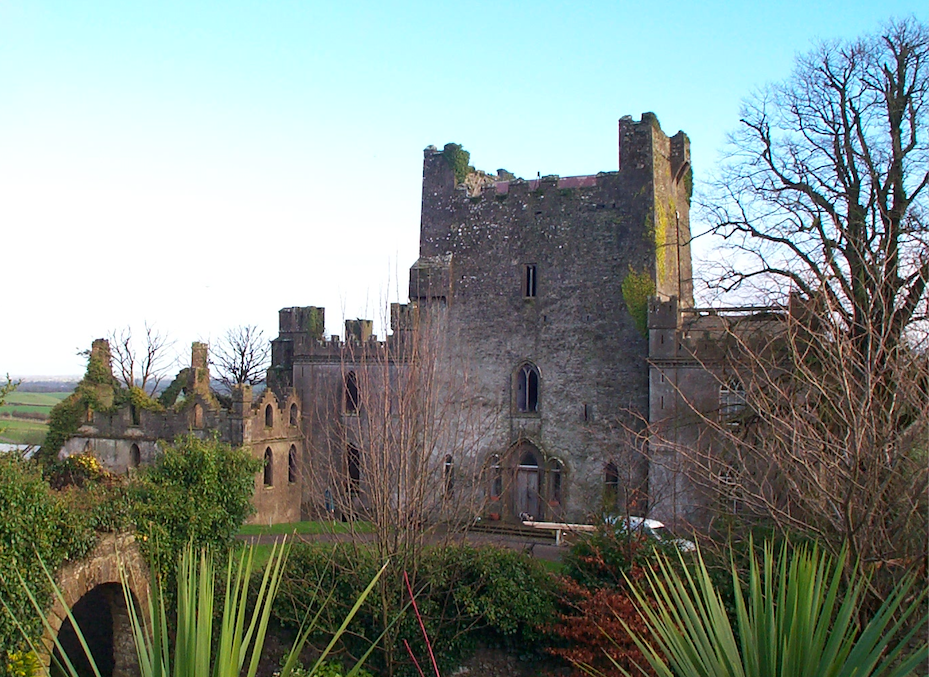 Leap Castle in Co. Offaly
Leap Castle has always had a reputation as a charnel house. Current owner of Leap Castle, Sean Ryan, has lived here - along with his wife and daughter - since 1994. He takes the bloody aspect of Leap Castle in his stride and insists it isn't all doom and gloom. "Most of the spirits we see are good-natured," says the Master of Leap, quite matter-of-factly. "We've had no problems - but there's definitely a presence here, no doubt about that. Some visitors find there's actually a physical barrier to entering. Some people have described a stranglehold round their neck."
Sean will give you a conducted tour of the place. If you think you’re hard enough.
At the happier end of the spiritual spectrum stands Clonmacnoise. Here at the crossroads of ancient Ireland, nearly 1500 years ago, St Ciaran founded a monastery which helped shape Christianity. On a natural gravel ridge overlooking the Shannon sits this magnificent ecclesiastical site. Several high crosses remain, plus assorted churches and gravestones.
Look out especially for the little Nun’s Church, a short walk away from the main buildings. This is home to what is surely the most beautiful doorway in Ireland. The small, one-room church was built by Devorgilla in the 12th century, and the Romanesque western doorway exquisitely frames the bucolic Offaly countryside.
Leitrim
Leitrim's watery landscape is one of its major attractions. More than forty loughs lie within just 10 km of Ballinamore alone. You can bag one all to yourself, and the angling is of seriously world-class quality.
But it’s equally a place where you can sit indolently on the loughside and watch a cast of characters that includes swans, herons, jumping brown trout and the odd kingfisher. And remember: as the old fisherman’s proverb has it, the gods never deduct from your lifespan the days you spend fishing.
The Shannon–Erne Waterway snakes through and along the county, with villages to moor at along the way. From Carrick-on-Shannon or Ballinamore you can rent a boat — even a multiple-berth luxury cruiser — and get lost in the maze of loughs and rivers.
Lough Allen, splits the county in two, joining up with the Shannon-Erne waterway, a historical link between Lough Erne the Leitrim lakes — Lough Melvin Lough Allen and Lough Gill — and the Shannon. The waterway snakes along a slow-flowing river, with villages to dock in along the way. Rent a boat from Carrick-on-Shannon or Ballinamore and get lost in the maze of loughs and rivers.
Lough Melvin is internationally renowned for its unique range of plants and fish – with three types of trout, this is ichthyology central, as a zoologist might put it. Covering an area of 2000 hectares, it is famous for its early “run” of Atlantic salmon – which basically means if you’re into boasting to your friends about your catch (and which angler isn’t?), you can have one of the first tall tales of the season here.
On Lough Gill’s shores stands the beautiful Parke’s Castle, built on the grounds of on the site of an O’Rourke chieftain’s residence. Restored by Dúchas, the beautiful 17th century fortified manor house is built round a courtyard and contains the foundations and feature from earlier defensive structures. The epitome of 'Planter's gothic' the house is set in ancient oakland, ts courtyards and towers framed by the quiet shoreline of Lough Gill. Guided tours are available
https://heritageireland.ie/places-to-visit/parkes-castle
For refuelling, the prize-winning gastro-pub, The Oarsman, in the centre of Carrick Sautéed scallops, venison stuffed with wild mushrooms and baby vegetables served with sweet potatoes type of thing. (www.theoarsman.com)
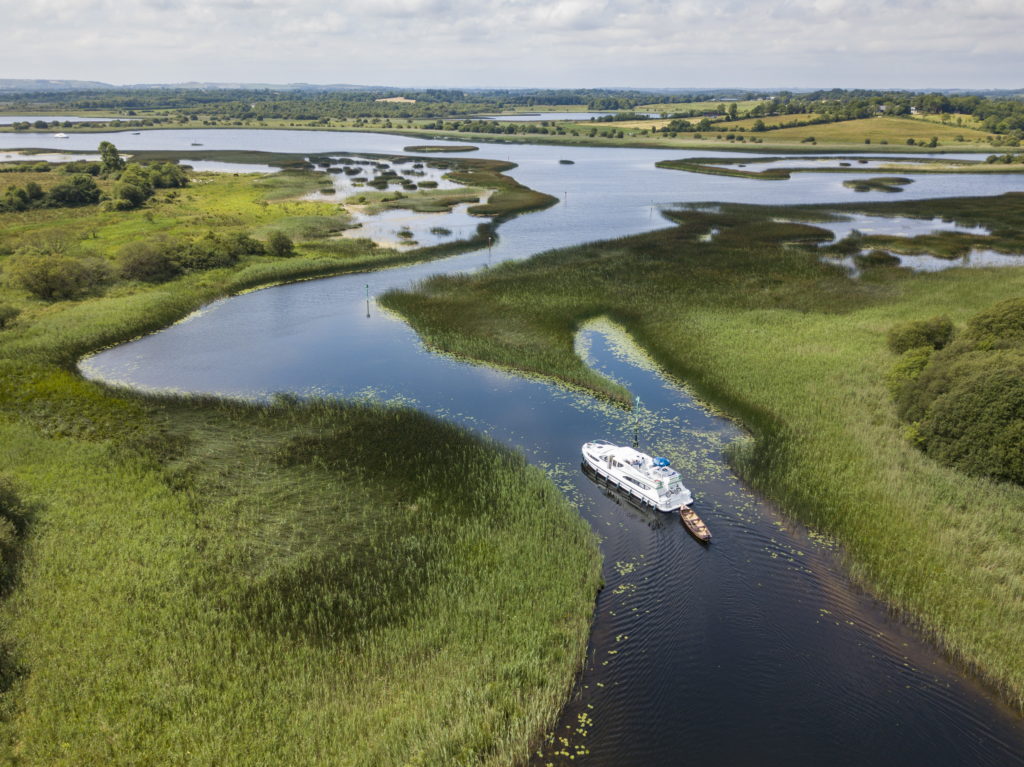 Lough Boderg in County Roscommon
Roscommon
Roscommon is one of those counties people think they know until they actually go there. It’s the heart of the country, with the River Shannon curling along Roscommon’s borders. Lough Key’s forest park is an arboreal marvel: a tangle of woodland trails, canopy walks, hidden follies, and lakeshore benches.
Half a dozen miles south of Frenchpark (the birthplace of Ireland’s first president Douglas Hyde) lies Rathcrogan. The area boasts some fifty archaeological monuments. The people that built these structures had a substantial society going on, were obviously spiritually minded — and they also liked a good view, for this is a breathtakingly beautiful part of Ireland.
History is never far away in this part of Connacht. The main street of Roscommon town is dominated by the huge edifice of the Jail, at one time the fiefdom of infamous executioner Betty. She was the hangwoman in the 18th century, when the scales of justice were not weighted heavily in the direction of the accused. Betty (her surname has not been passed down) was kept busy right through the 1798 Rebellion, and seems to have been happy in her work — if her blood-curdling cackles as she dispatched the condemned are anything to go by. Job satisfaction, it seems, comes in many forms.
Ireland's savage and melancholy history is indelibly etched on the landscape hereabouts. The ruins of castles, monasteries and forlorn cottages mark out the countryside in poignant solitude. Places which once echoed with the sound of human activity invariably seem so much more lonely than natural wilderness.
The Great Famine bit very hard here, and today the county is the home of the Famine Museum, in Strokestown (www.strokestownpark.ie). The Great Famine of the 1840s is now regarded as the single greatest social disaster of 19th century Europe. Between 1845 and 1850, when blight devastated the potato crop, in excess of two million people – almost one-quarter of the entire population – either died or emigrated.
The museum is located in the original Stable Yards, and has been curated to commemorate the history of the Famine years, while at the same time attempting to balance this with the history of the 'Big House'. In this instance the Big House was owned by Major Denis Mahon during the Famine time. Mahon was eventually shot dead by disgruntled tenants who accused him of chartering 'coffin ships' to send those evicted from his land to America.
The Famine Museum exhibits documents that were discovered in the estate office, dealing with the administration of the estate during the tenure of the Mahon family.
They make poignant reading.
Donamon Castle, near Roscommon town, is one of Ireland’s oldest continuously inhabited buildings in Ireland, with roots stretching back over a thousand years. Set beside the River Suck, it has served monks, soldiers and chieftains alike.
Cavan
The old joke goes — what are the three best things about Ulster? Answer: Donegal, Monaghan and Cavan.
Certainly these three counties have much to recommend them, but with the exception of the coastal areas of Donegal, don’t figure on many tourism itineraries. Which is very remiss of tourist guides, because the beauty of places such as Cavan and Monaghan in particular is that even today the visitor will pretty much have the run of the place without being upset by too many other tourists.
And Cavan has more than enough to recommend it.
Belturbet station served the Northern Railway and Narrow gauge Cavan and Leitrim Railway, operating from 1885 until 1959. At one time this was one of the busiest of Ireland's narrow-gauge railways, although it's hard to believe now when you gaze round at the sleepy environs of Belturbet.
Through the accident of its serving a coal field the railway line remained open many years after most other 3 ft gauge lines closed, and in its last days made use of engines and rolling stock sent from other defunct systems. The station now houses an exhibition displaying these odds and ends, Heath Robinson-esque in their complexity. The station itself has been fully restored, and houses an exhibition telling the story of the railway age in Cavan. Enthralling, and not just to railway anoraks.
One of the great things about rural Ireland is its museums and heritage centres. These provide local detail and history you won’t find elsewhere — even in this age of information overload.
At the Cavan County Museum in the plantation town of Ballyjamesduff, housed in a former convent, exhibitions include immigration from the county, the Great Famine (which hit this area very severely) Cavan’s pre-history stretching back some 6,000 years, and a history of the GAA in Cavan and Ulster. Ballyconnell in the north of the county has a footnote in Ulster history — the first GAA club in the province was founded in Ballyconnell in 1885 and named 'Ballyconnell Joe Biggars' in honour of the then MP for West Cavan. It subsequently changed its name to Ballyconnell First Ulsters.
The Roscommon poet and songwriter was Inspector of Drains in the county. His jarvey during this time was Paddy Reilly, and the rest is musical history. This is truly a fascinating place — if you never go to museums, make an exception in this case.
To the north of Cavan, the Breifne Mountains are home to the highest point of the county, Cuilcagh at 665 metres (2,182 feet). The Shannon Pot, a deep, brown pool on the slopes of Culicagh is the source of the River Shannon.
It’s a master of understatement, seeming much too insubstantial to be the source of one of Europe’s great rivers — although to be fair, in ancient times it was the home of the Salmon of Wisdom. The early Celts would consult this fishy genius on all pressing matters. But, according to legend, one day a young woman called Sionnan spoilt everything by sitting down by the pool and singing a song. There’s always one, eh?
Anyway, the Salmon was angry at this impertinence , caused the pool to overflow, Sionnan was swept away — and today the Shannon still bears her name.
North Tipperary
North Tipperary is one of Ireland’s most quietly rewarding regions, a landscape shaped by water, medieval history and a string of handsome market towns. It is a place best explored slowly, following the roads that slip towards Lough Derg or weave through some of the most storied heritage sites in the Midlands.
Nenagh is the natural starting point. Long regarded as the heart of North Tipp, the town is dominated by the mighty Nenagh Castle, its cylindrical keep rising above the streets. A visit to the Heritage Centre gives a sense of the area’s social history, from famine-era stories to old market-life traditions, before you wander out to find a café or bakery on Pearse Street.
From here, the draw of Lough Derg is irresistible. The eastern lakeshore is dotted with welcoming villages that have become favourites for both boaters and walkers. Dromineer is perhaps the best known, offering a marina, lakeside views and an easygoing atmosphere. Garrykennedy and Ballycommon are smaller but full of charm—spots where you can sit at the water’s edge and feel the pace of life change.
Further north sits Terryglass, a village consistently praised in Tidy Towns and long connected with early Christian monasticism. Its harbour, wells and excellent food offerings make it one of the most attractive bases on the lake.
To the south, Roscrea stands as one of Ireland’s oldest urban centres. Roscrea Castle and the elegant Georgian Damer House sit side by side, with Monaincha Abbey—often described as once standing on the “thirteenth-century edge of the world”—a short drive away. The town rewards exploration, its layers of history never far from view.
Templemore, known today for its Garda College, has gentler pleasures: a large Victorian-era park with lake walks, mature trees and a quietly reflective atmosphere. Nearby, the Devil’s Bit offers one of the region’s best viewpoints. The climb is manageable, and the panoramic sweep over the county makes it one of North Tipp’s essential short hikes.
Thurles, while often considered Mid Tipp administratively, remains closely tied to the northern travel circuit. As the birthplace of the GAA, its Semple Stadium and the Lár na Páirce museum hold national sporting significance.
North Tipperary is not a place of noise or spectacle. Instead, it offers a series of well-kept towns, calm waters, and history layered in comfortable, unhurried ways—an inland county that rewards every visitor who takes the time to look closely.
For more details visit ireland.com
