





IT WAS Hilary Mantel who took me to the Tudor town of Stratford-upon-Avon for the first time.
Not literally of course — I didn’t get a lift with her or anything like that.
No, my journey to the birthplace of Shakespeare — under my own steam — was to see Wolf Hall, written by Mantel. Since then, about a dozen years ago, I’ve been back many times.
The theatre itself is probably one of the most photographed drama spaces in the world. Designed by Elizabeth Scott, the red-brick edifice only dates back to 1932, and is a study in functionality.
When it was first built, the reaction to Scott's design was mixed. The Manchester Guardian said it was "startling...monstrous and brutal.” George Bernard Shaw, however, was a firm supporter of Scott's design.
Today it’s a Grade II listed building, retaining many of the art deco features of the 1932 Shakespeare Memorial Theatre. Backstage tours and the opportunity to view Stratford from the observation tower are available.
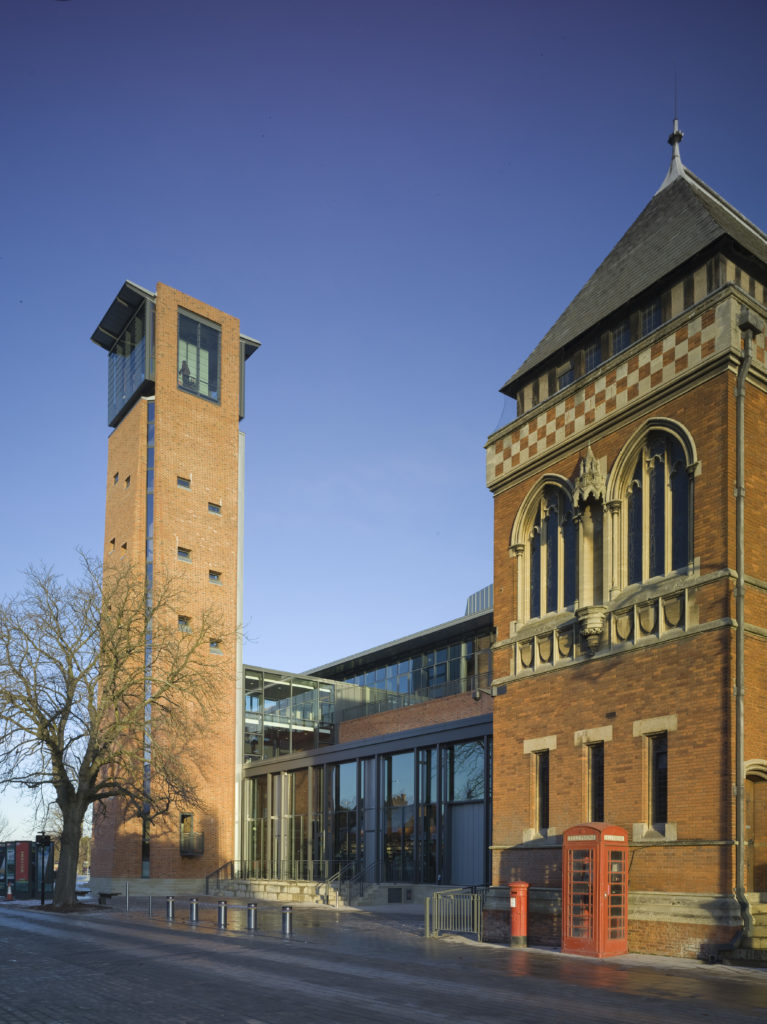 The Tower at the Royal Shakespeare Theatre (Pic: Peter Cook for the RSC)
Whatever you think of the aesthetic qualities of the enormous building, the money shot is from the opposite bank of the Avon, with weeping willows and swans (naturally enough) in the foreground, and the Holy Trinity Church — Shakespeare’s last resting place — just a little downriver.
Come next month the RSC will be presenting The Tempest, featuring Belfast man Kenneth Branagh as Prospero. This play, Shakespeare’s last, was written around 1610–1611 and is a meditation on art, power and freedom, directed by Richard Eyre.
The play opens with a violent storm at sea, conjured by the magician Prospero, the exiled Duke of Milan. Hence the origin of the expression “sea change”, which today is pretty much used as a synonym for “change”.
But in its original version it comes in a speech by Ariel.
Full fathom five thy father lies;
Of his bones are coral made;
Those are pearls that were his eyes:
Nothing of him that doth fade,
But doth suffer a sea-change
Into something rich and strange.
The shipwreck brings his enemies to the island where he has lived for years with his daughter Miranda.
Prospero’s brother Antonio, who usurped his dukedom, is among those cast ashore, along with Alonso, the King of Naples, and other members of the court.
They wander the island, separated, disoriented and more than a bit cross. Somebody needs to sort this out. Step forward Kenneth Branagh as Prospero.
It’s a nail-on certainty he’ll use his magical powers to manipulate events and bring them face to face with their past actions.
"This blessed plot, this earth, this realm” — aka the rest of town
SHAKESPEARE, of course, is an ever-present spectre throughout Stratford. Protocol demands that you first of all take a stroll along the banks of the Avon to the Holy Trinity Church. Standing at a striking position on the river, this is where Shakespeare was baptised, and where he was buried on April 25, 1616.
The church still possesses the original Elizabethan register giving details of baptism and burial, though it’s now kept by the Shakespeare Birthplace Trust. Shakespeare’s remains lie in the beautiful 15th-century chancel, with his funerary monument fixed on a wall alongside his burial place.
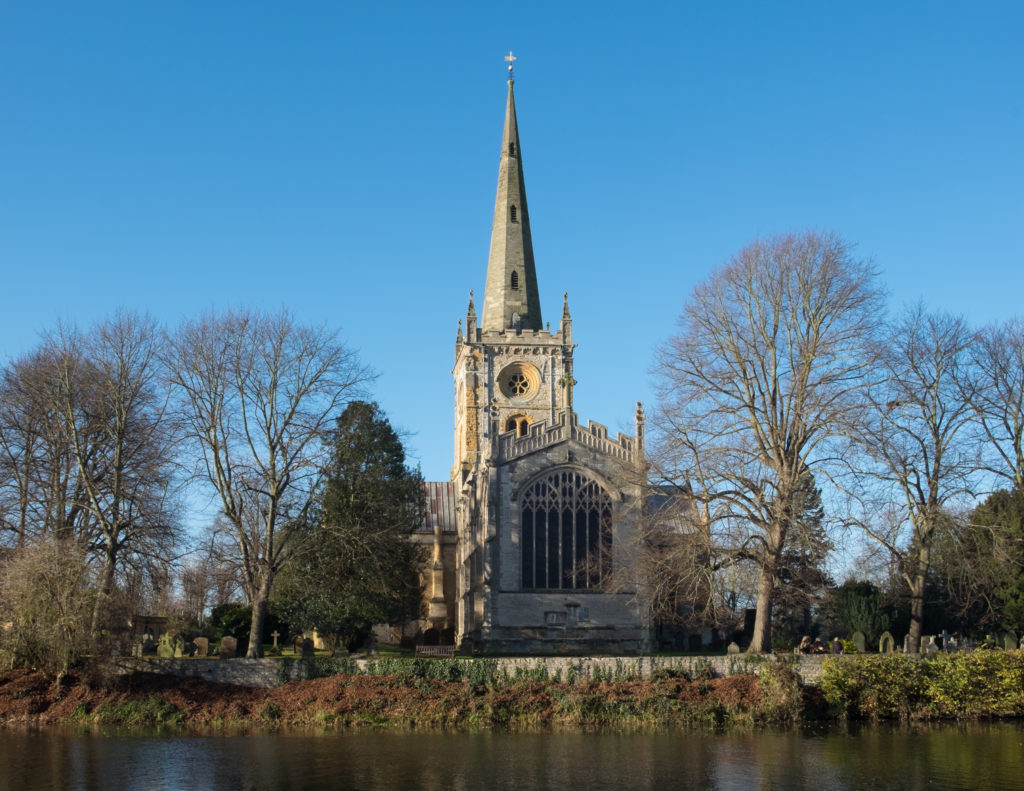 Holy Trinity Church (Pic: DeFacto CC-BY-SA-4.0)
The half-timbered, restored 16th-century house where Shakespeare was born stands nearby in Henley Street. Most of the house is open to the public, with documents, portraits, busts, books and correspondence all on show.
If you sign the visitors' book, you’ll be following the example of Dickens, Byron, Tennyson, Thackeray, Hardy, Shaw and Keats — all of whom in the past paid their respects to Shakespeare, and added their names.
These days, you can’t stand in Holy Trinity Church without Hamnet hovering somewhere in the background. Maggie O’Farrell’s novel — about Shakespeare’s young son, dead at 11 — has quietly shifted how many of us see the Bard.
Not just the man of kings and ghosts, but a father who knew something of loss. It lends Stratford an extra layer: behind the souvenir shops and sonnets, something altogether more human.
Of course there are always dissenters. There are those who believe Shakespeare was born in the nearby village of Snitterton — but somehow, the Swan of Snitterton doesn’t quite have the right ring about it.
In any case, most authorities put the playwright’s birthplace in Henley Street, Stratford CV37 6QW (although, surely some imaginative person in the Royal Mail could have made the postcode 2BOR NO2B, or the like?).
Anyway, the man who wrote some of the greatest plays and sonnets in the English language, and came up with expressions such as “Parting is such sweet sorrow”, “the course of true love never did run smooth,” and “a horse, a horse, my kingdom for a horse” took his first breath here in the heart of old Stratford.
He is rightly regarded as one of the world’s foremost dramatists — a truly great figure in world literature. As he himself put it, “Some are born great, some achieve greatness, and some have greatness thrust upon them.”
Bram Stoker, the Dublin-born creator of Dracula, was a frequent visitor to Stratford. This is revealed in one of the other five houses associated with Shakespeare: Nash's House and New Place at 22 Chapel Street.
Shakespeare spent his final 19 years here. Aside from snippets such as Stoker’s interest in Shakespeare, in this old, atmospheric house with its dark, oaken beams and creaking staircase, you’ll also learn that the Bard was a tax dodger.
Apparently he was listed for it twice in London. That was maybe when he wrote, “When sorrows come, they come not as single spies but in battalions.”*
(* It was Claudius who said that, and, as it happens, nothing to do with the evasion of tax.)
The Great Garden outside New Place is a tranquil haven where you can contemplate several Greg Wyatt sculptures inspired by Shakespeare’s words. The mulberry tree by the lawn is said to have been grown from a cutting planted by the Bard himself.
Even aside from its connection with Shakespeare, Stratford is a town where you immediately want to check out the property prices in an estate agent’s window (unless you’ve won the lottery, don’t bother).
Its natural scenic beauty, its river and ancient bridges, the willow trees and swans, and the old, rickety half-timbered pubs, houses and shops, make it an entrancing place.
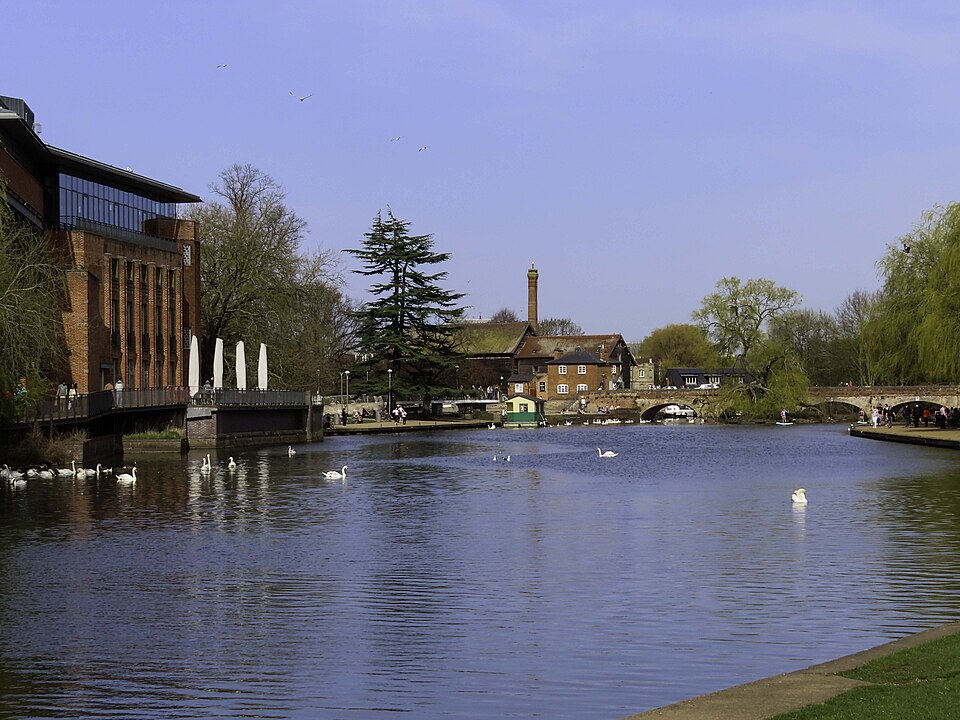 The River Avon (Pic: Steve Daniels CC-BY-SA-2.0)
Naturally, it is a magnet for tourists. But go midweek — if you can — and you’ll find you can wander down the riverbanks, or stroll through the old streets relatively untroubled by coach parties or mobs of camera-wielding visitors.
It's an ideal place for wandering. Within a few turns, you can slip from busy streets into something altogether quieter — ducking down narrow alleyways, skirting canals, or crossing the Avon as it loops and bends its way through the landscape.
What makes it particularly appealing is how well the town has repurposed its past. Old routes have been given new life. A former horse-drawn wagonway now survives as the Tramway — a leafy, well-used path that carries walkers away from the centre, passing pubs, playing fields and the everyday business of local life.
Head across the Avon near Holy Trinity Church and the landscape opens out further. From here, you can pick up the Greenway, a long, straight stretch that follows the line of a disused railway.
Once part of the Honeybourne line, it closed in the 1970s but has since been reclaimed as a walking and cycling route, running for miles through open countryside towards Long Marston. It now forms part of a wider network linking cities like Oxford and Derby, though here the pace is decidedly gentler.
At the Stratford end, the Greenway begins beside a cleverly repurposed railway carriage, now a café serving strong coffee and an easy excuse to pause before heading out into the open.
About a mile from the centre of Stratford Anne Hathaway's Cottage, a timber-framed, thatched farmhouse dates back to 1463. Set in the village of Shottery, just outside Stratford, it was the childhood home of Anne, wife of William Shakespeare..
Surrounded by orchards and cottage gardens, it offers a glimpse into rural Tudor life, with original features such as exposed beams and historic furnishings.
A break from the Bard
The MAD Museum is one of Stratford’s more offbeat attractions, and a nice break from all things Shakespeare.
“MAD” stands for Mechanical Art and Design. It’s essentially a hands-on museum filled with moving sculptures, quirky machines, and inventive contraptions — think kinetic art, automata, and Heath Robinson-style gadgets brought to life.
Inside, you’ll find everything from intricate marble runs and whirring robots to playful, slightly bonkers creations powered by gears, levers and imagination. The key thing is that it’s interactive: lots of buttons to press and things to set in motion, which makes it as appealing to adults as to kids.
It’s right in the centre of town on Henley Street and takes about an hour to explore, so it’s an easy add-on to a Stratford wander.
Kenneth Branagh stars as Prospero in the Royal Shakespeare Company's (RSC) production of The Tempest, running at the Royal Shakespeare Theatre in Stratford-upon-Avon from May 13 to June 20, 2026.
Directed by Sir Richard Eyre, this production marks Branagh's return to the RSC for the first time in over 30 years.
The Bard, the bed and the breakfast — where to stay in Stratford
Arden Hotel
Waterside
www.theardenhotelstratford.com
“To bed, to bed,” as Lady Macbeth put it. The Arden really is the place to stay in town if you’re going to the RSC. Even Hilary Mantel lodges here when in town.
The luxury hotel is directly opposite the RSC; they do a special early dinner at 5pm so you can catch a show at 7pm, and keep your dessert for you on your return.
Ettington Park Hotel
Alderminster, near Stratford-upon-Avon
hotel-ettington-park.h-rez.com
A Grade I-listed Victorian Neo-Gothic mansion near Stratford-upon-Avon is reputedly haunted.
Sadly, although I had my smartphone ready at all times, no spectral beings appeared during the night.
A few lines from A Midsummer Night’s Dream didn’t help, “At whose approach, ghosts, wandering here and there, Troop home to churchyards: damned spirits all.” But to no avail.
Still, the swimming pool, sauna and spa bath more than made up for it. The restaurant serves top notch nosh. As Shakespeare himself said (in a slightly different context), “A dish fit for the gods.”
See More: Hilary Mantel, Shakespeare, Stratford-upon-Avon, Travel
