

ASK an Irish football fan which English club they support, and there is a good chance the answer will be Liverpool or Manchester United.
For decades, the two Premier League teams have attracted enormous followings across the Irish Sea.
But their popularity is no coincidence.
A combination of emigration, footballing success, Irish sporting heroes and family traditions has helped make both clubs part of Ireland's football culture.
Research by digital marketing agency Adaptive & Co, using Meta's Facebook and Instagram audience data from October and November 2021, found Liverpool narrowly ahead of Manchester United in the Republic of Ireland, according to their demographic study.
Liverpool had an estimated 443,500 followers, compared with United's 441,000. The gap was considerable when compared with Chelsea (254,100) and Arsenal (246,400), who occupied third and fourth place.
The relationship between Ireland and English football stretches back well before the Premier League was established in 1992.
For generations, Irish people emigrated to British industrial cities in search of work.
Liverpool is the closest major city to Ireland, and its port served as a gateway to those emigrating in the 1800s.
The city developed a massive Irish community, creating family and cultural links that continue to this day.
So it's not that surprising that Liverpool FC would become so popular across the water.
Interestingly, Everton initially enjoyed stronger connections with Irish supporters, partly because of its recruitment of Irish players and the establishment of supporters' clubs in Dublin.
Liverpool's popularity grew during the 1970s, helped by its extraordinary success and Irish players.
Manchester also had generations of Irish workers settling in the city, who were naturally attracted to its main club.
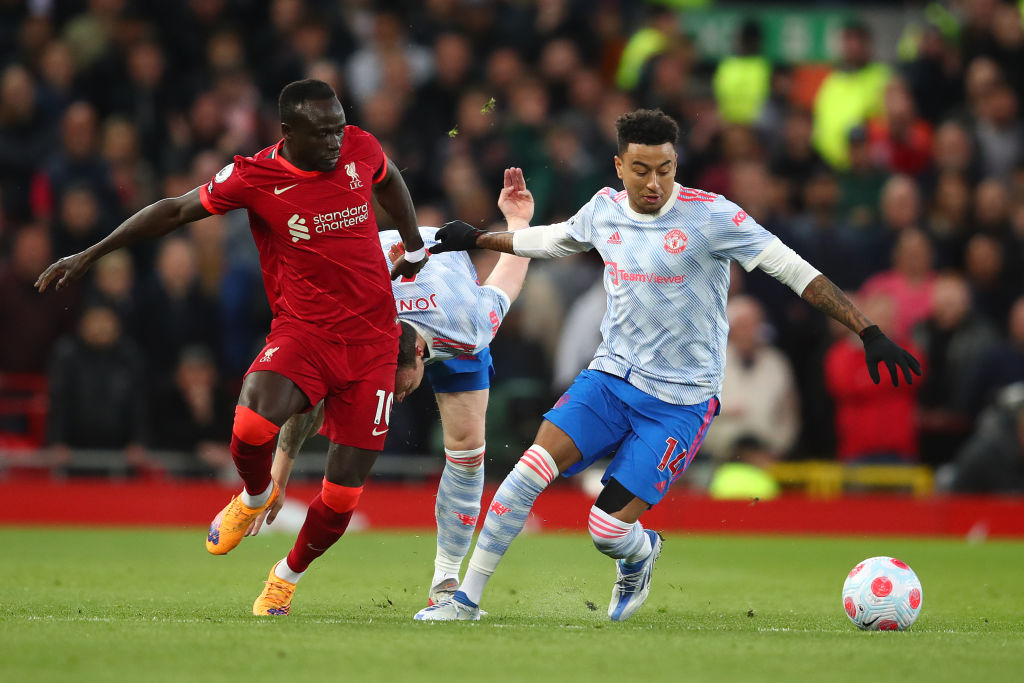 Sadio Mane of Liverpool in action with Jesse Lingard of Manchester United during the Premier League match on April 19, 2022 in Liverpool, England. (Photo by Chris Brunskill/Fantasista/Getty Images)
Another big reason for the popularity of both clubs has been the number of Irish footballers who have worn their shirts.
For Manchester United, the list includes some of Ireland's greatest ever players.
Belfast-born George Best became one of football's most recognisable figures, winning the European Cup in 1968 and the Ballon d'Or that same year.
He was followed by Cork's Roy Keane, who captained United through one of the most successful periods in its history, winning seven Premier League titles and playing a central role in the famous 1999 Treble.
Denis Irwin and John O'Shea also became hugely popular figures at Old Trafford.
Liverpool also had many great Irish players over the years, especially during its glory years in the 1970s and 1980s.
Ronnie Whelan became a massively important player, winning multiple league titles and two European Cups.
For supporters back home, these players provided a personal connection with clubs hundreds of miles away.
The birth of the Premier League and the expansion of football into TV allowed Irish families to follow their favourite teams every weekend.
A parent who grew up watching Keane at Old Trafford or Whelan at Anfield will usually introduce their children to the same club.
However, the landscape is changing, with Chelsea and Manchester City attracting younger supporters over the years.
But Liverpool and Manchester United still remain the two titans in Premier League Irish football culture.
Everything from irishpost.com and the print edition is available on the Irish Post App — plus more! Download it for Android or Apple IOS devices today
