





IN THE 3rd century, two hundred years before St Patrick came to Ireland, St. Valentine was born.
Believed to have been a Roman priest, he was imprisoned and beheaded under Emperor Claudius on February 14, becoming one of the earliest Christian martyrs.
There are many stories as to who he really was, what he did and why he became the patron saint of love, but one account claims he miraculously cured his prisoner’s daughter of blindness. Whether she fell in love with him as a result is another matter.
St. Valentine never made it to Ireland, not while he was alive at any rate. His bones take their eternal rest in the 19th century Byzantine-style Whitefriar Street, Church of Our Lady of Mount Carmel. Brought to Dublin in 1835 by one Father John Spratt, they were donated by a grateful Pope.
Had Valentine come during his lifetime he might well have stayed. You can certainly imagine such a holy romantic falling for this island which was then thought by pagans and Christians alike to be on the edge of the world… its mountains and cliffs, loughs and islands, bays and beaches. Indeed, everyone who visits Ireland seems to find themselves bewitched by its wild, untamed, otherworldly beauty. I certainly was. This is my love letter to Ireland.
Let’s begin with the mountains. From the Mournes in the north to the Galtees in the south, the Wicklows in the east and the Twelve Bens in the west, you are never far from these mighty monuments that literally rise up from the earth. Whether you see them in the distance or stand beneath them, it is impossible not to feel a deep sense of awe.
There are well over 200 of them in Ireland, but no matter how many of them you have seen, nothing prepares you for the Conor Pass.
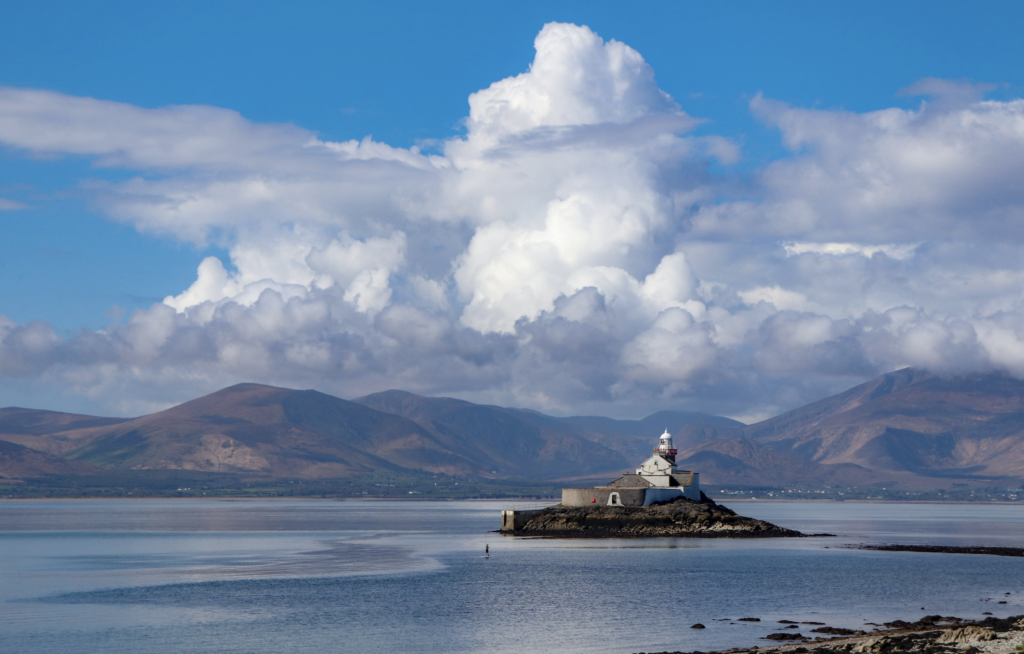 Fenit Lighthouse in Co. Kerry with the mountains of Slieve Mish in the background
The mountains of Slieve Mish run through the eastern end of County Kerry’s Dingle peninsula and are responsible for Ireland’s highest mountain pass.
Taking the R560, my drive started in the lively fishing port of Dingle on the peninsula’s south side. It is nothing short of a 12km rollercoaster ride of twists and turns around treacherous cliff faces, rocky chasms and bottomless lakes that stretch back to the Ice Age. It is guaranteed to make your heart skip a beat.
There are literally only two points where you can park the car, but if you’re thinking of stretching your legs, make sure you’re ready for the adrenalin overload or blind panic – whichever hits you first! The drive finishes on the peninsula’s north side, heading down to either the shores of Brandon Bay or the golden sands of Castlegregory. It is a drive you will never forget.
Competing with Ireland’s mountain passes are its dramatic sea cliffs and it is impossible to talk about them without mentioning County Clare’s famous Cliffs of Moher, the dark brooding giants that have become one of Ireland’s most iconic landmarks.
But if you’re looking for a landscape that harnesses the truly mystical power of the Wild Atlantic Way, head further north to Slieve League in County Donegal. Three times the height of Moher, these are said to be the second highest sea cliffs in Europe.
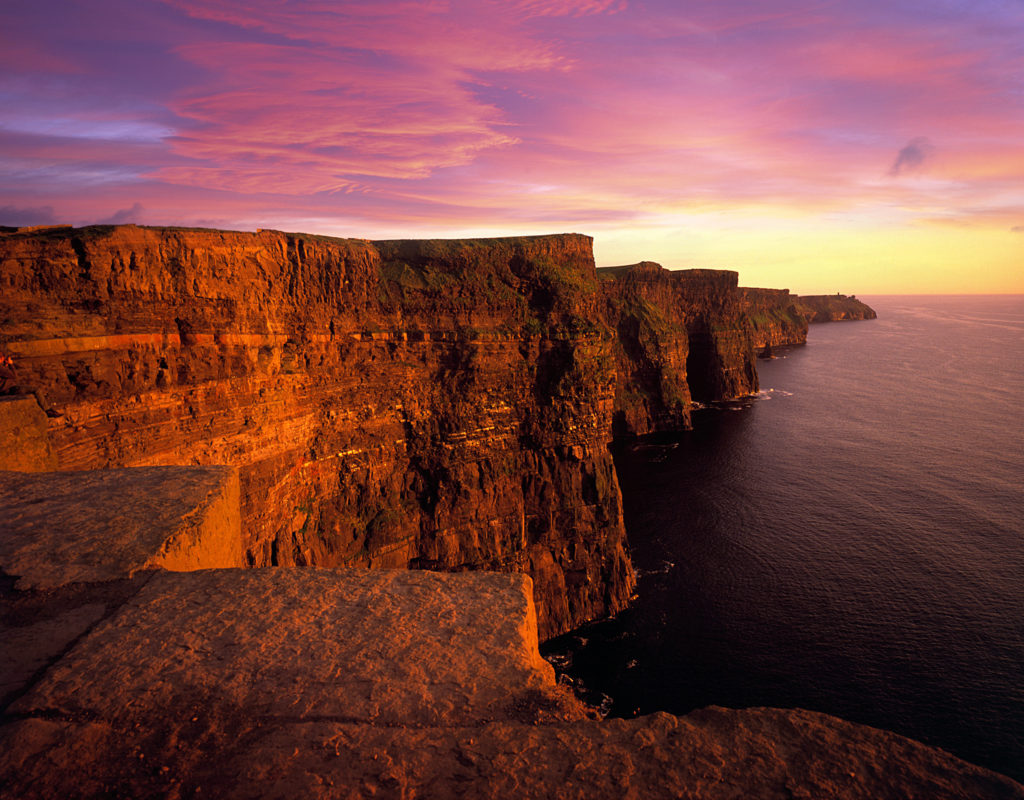 The majestic Cliffs of Moher
I first drove to the top of Slieve League in 2000. I headed west from the bustling town of Donegal on the N56 and picked up the R263 at Five Points. The drive takes you past Killybegs – the largest fishing port in Ireland – but you keep going until you reach the remote village of Teelin, where the road begins its climb. It is tight, it is wild… it is nerve-wracking. Several times, I almost turned back.
Once at the top, the landscape flattens into a rocky plateau. Back then, there was no barrier between you and the cliff edge – maybe there is now – and every gust of wind seem to tighten my grip on the steering wheel. When I got out, I practically crawled my way along to the edge. Directly below, a black angry sea smashed against rocks. It was utterly bleak and yet there was an overwhelming sense of beauty here, too. An early autumn fog wisping through the purple heather; sheep sheltering amongst the rocks; the dark outline of a still lake just a few metres away
After such dizzying heights, there is nothing quite as comforting as the soothing waters of a sun-drenched bay. Galway Bay and Bantry Bay are embedded in the national psyche, their people and stories conjured up in countless songs. But have you heard the one about Liscannor Bay in County Clare?
Stars out to play love, on a spring fairy night
Call of the curlew, oh the willow is blind
Sound of the sea break on emerald spray;
A sunset or moonbeam on Liscannor Bay
The impressive crescent-shaped bay is named after the small village of Liscannor on its north side, but it’s known the world over as Lahinch, the seaside town on the south side and the meeting place for brave surfers ready to pit their wits against the full force of the Atlantic swell. The bay itself seems to have been perfectly crafted by nature, tightly hugged on either side by ragged cliffs, rolling hills, luscious green fields and Hollywood sunsets – as if an artist had painted it all.
Ireland is not only surrounded by water but is overflowing with it. There are over 12,000 loughs and many of them have their own islands. I have been fascinated by them ever since I was a child and would hear stories about St. Patrick’s Purgatory, a place of Christian pilgrimage on an island in the middle of Loug Derg in County Donegal. It was founded, it is believed, in the 5th century by one of St. Patrick’s disciples St. Davog and attracted people from all over Europe, including many Medieval knights. Pilgrims still come today. Every summer they walk barefooted, live on water and dry bread and pray for three days and nights. Not for the fainthearted.
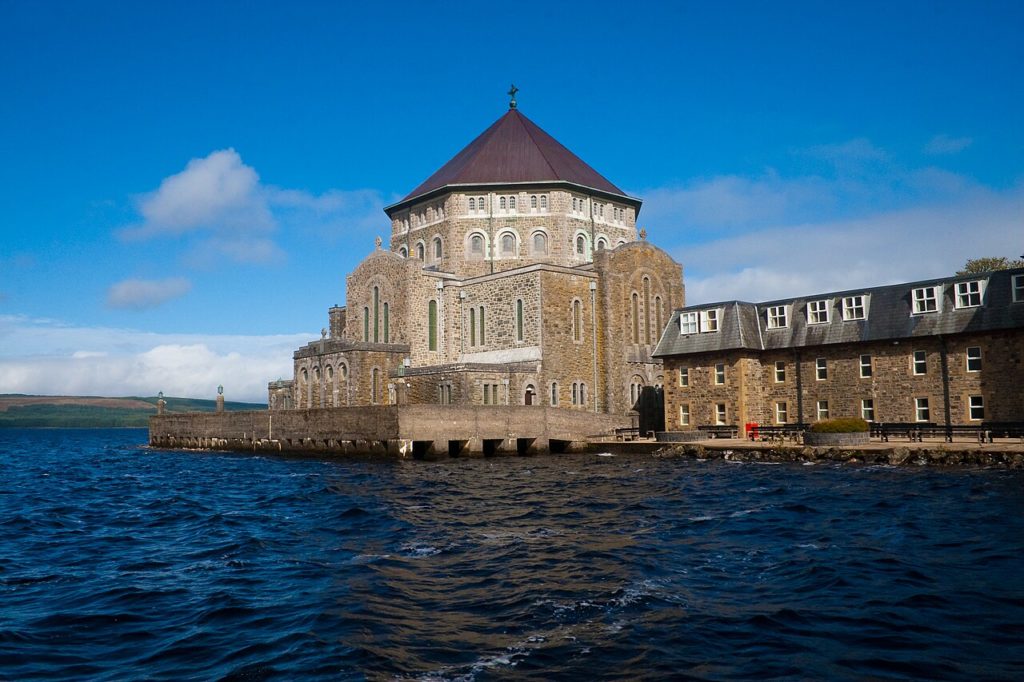 Lough Derg Station Island Basilica County, Donegal
But it is an island in neighbouring County Fermanagh in Northern Ireland which really stole my heart. About 12 years ago, I went to interview Pat O’Doherty, a butcher and rare breed pig farmer who inherited his father’s shop in Enniskillen. O’Doherty’s Fine Meats sits in the middle of Belmore Street, and his black bacon has become famous across Ireland thanks to his ancient curing process.
As a pig farmer, he is also passionate about the way his pigs are reared and in 2005 he bought Inish Corkish, a small island on Lough Erne which was filled with trees, shrubbery and wildlife. On a late spring day, I climbed into Pat’s small boat and he took me over to see his Saddlebacks – a breed which nearly became extinct in Ireland. The sky was blue, the clouds were deliciously fluffy and there was barely a ripple in the water. Everything about it was serene.
As we got closer to the island, the pigs could hear us coming and came running up to the long grasses on the shoreline to greet us. There is something so wonderfully harmonious about what Pat had created: the wisdom of old traditions and the forward thinking of what the future could look like. And it continues to this day. They have to be the happiest pigs in all of Ireland.
Finally, we are back down south to a place that had me swooning at first sight. Hidden beneath the Shehy mountains in County Cork and surrounded by a forest of spruce, larch and pine, a mist gently rises from a motionless lake that mirrors the entire landscape. In the middle of it is a tiny island and on it is a tiny stone church. The place is called Gougane Barra and in the 6th century, Saint Finbarr, an Irish scholar and hermit made it his mission to set up a monastery in the most isolated place he could find – he settled her.
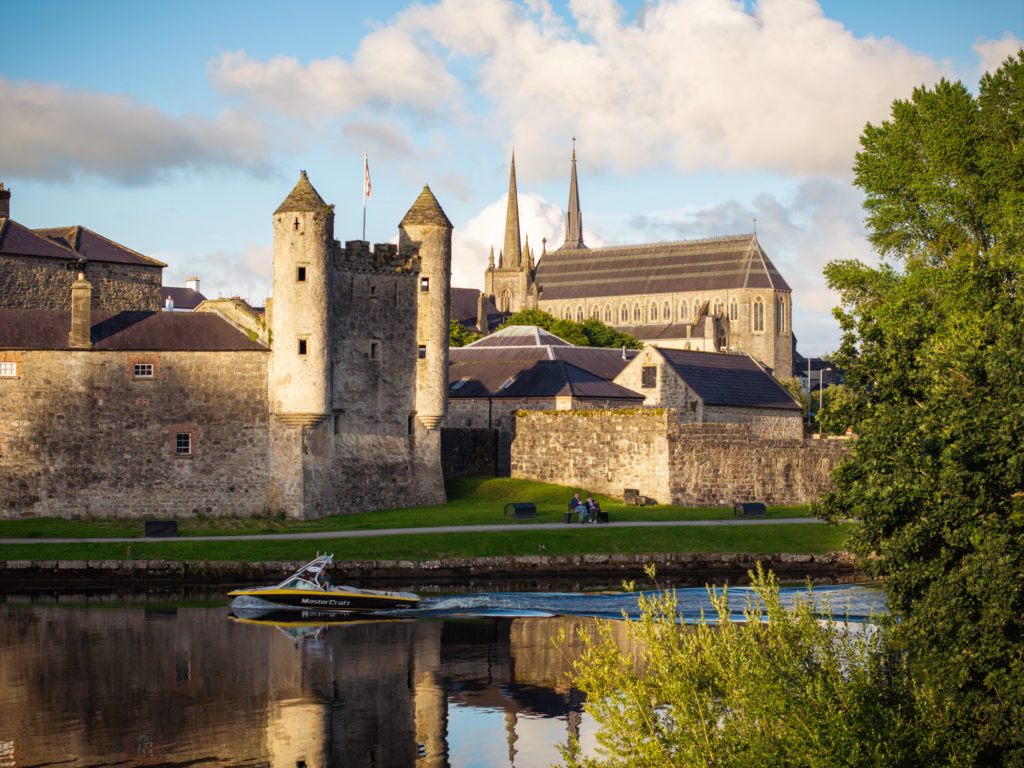 Enniskillen Castle in Co Fermanagh
The church there now was built in the 19th century and at certain times of the day, the waters recede, revealing a thin causeway to the island. Other times, it is completely covered over. Over the years, many fairytale weddings have taken place here. But if the weather turns, the water rises and many a poor bride has been left stranded on the shore unable to get across – leaving a nervous groom at the altar thinking it is all over.
A Cork taxi driver once told me that he knew of a bride – and her ten bridesmaids – who met such a fate. But she was a clever farmer’s daughter, and she wasn’t going to give up so easily on her special day.
She picked up her long flowing white train and her bouquet of lilies and went in search of the nearest farmer. He got his tractor out and ferried them all over. Love, as St Valentine would say, conquers all.
For more information visit www.ireland.com and www.ireland.com/northernireland.com.
See More: Ireland, Travel, Valentines Day
