



WARM memories of pootling through ancient Irish towns and along twisting country lanes came spilling back as I spotted the Almond Green body and the varnished ash wooden frame of what could easily have been my father’s Morris Minor Traveller.
Here was the car (or, at least, a sparkling restored version of it) which took me on those treasured summer trips in the 1960s from England to stay on the Mayo and Leitrim farms of our relatives, where the smell of the smoking turf and the sound of the braying donkeys remain imprinted on my senses to this day.
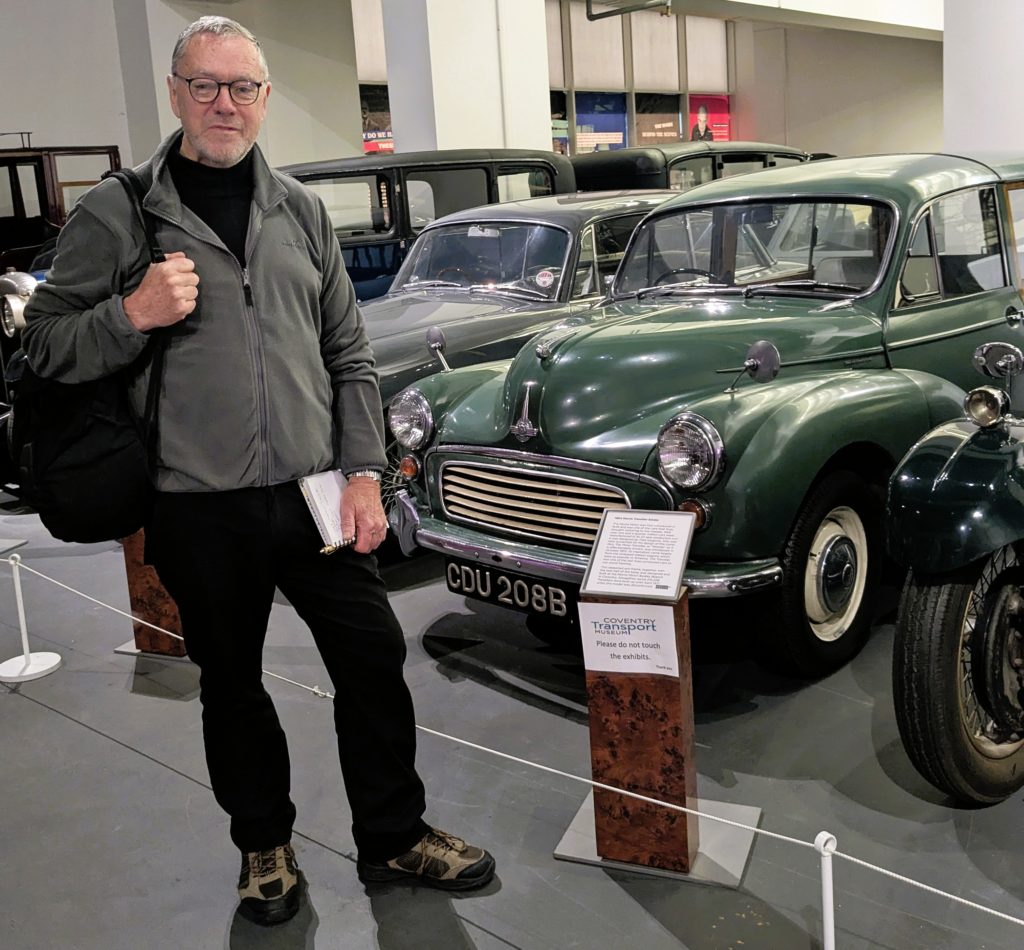 Memories of Morris trips to Ireland flood back for James
Those recollections were sparked as I walked through Coventry’s huge and fascinating Transport Museum, which celebrates the Midlands city’s century spent as the beating heart of Britain’s motor industry.
Among such showpieces as the gleaming Daimlers, Rovers and even Barbie’s ‘shocking pink’ Jaguar XJS promotional vehicle, I came across that little ‘Woody’ Morris that reminded me of those long-past journeys on the Holyhead cattle ferries to Dun Laoghaire before heading through Dublin and on to the 9-hour motorway-free ‘expedition’ to Belmullet or Ballinamore.
Gruelling it certainly was. But utterly engrossing too. As my mother gripped her rosary beads and my father tested his patience behind stubborn herds of dopey cattle, clip-clopping horses pulling turf-laden carts and the quirky directions of old Irish fingerposts, my sister and I gaped at the soaring hills and quaint centres of the likes of Mullingar, Longford, and Castlebar.
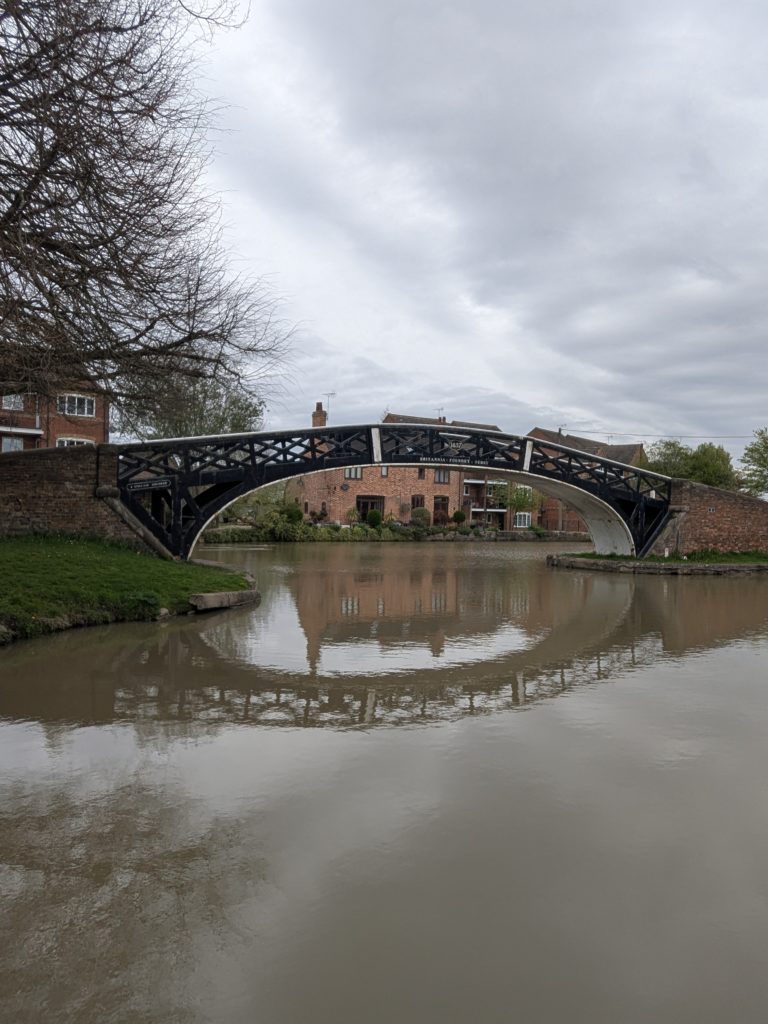 An elegant 19th century Iron Bridge at Hawkesbury Junction on the Coventry Canal
Ah, such heavenly thoughts and dreams, I felt as I stood and gaped at a car that had brought motoring to the masses (my father’s was second-hand and cost him £240 in 1963) and was one of the many recognisable cars, vans, motorcycles and pedal cycles that poured out of Coventry before overseas competition killed off mass production in the 1980s.
My recent visit to the UK’s one-time ‘Motor City’ was via a different type of transport, a hired narrowboat which I picked up at Springwood Haven Marina just outside The Mill on the Floss’ author George Eliot’s home town, Nuneaton, for a four-day round-trip voyage along the Coventry Canal to the city’s chilled and historic basin, where you can tie up just a short walk from the bustling centre.
The vessel was a 40-foot steel boat, the Musician Wren, named after a South American songbird, and had berths for four people, along with a well-stocked kitchen-diner, a shower and toilet, a sundeck and push-button central heating for any chilly nights. After an hour’s training lesson, the whole operation becomes pretty straightforward.
And the Coventry is a great beginner’s journey, as it’s largely uncrowded with no locks to negotiate, plenty of mooring places and, most importantly, has lots of decent pubs in easy walking distance of the canal, built under arduous conditions in the late 18th and early 19th centuries with the help of gangs of ‘navvies’ attracted by the work from across Ireland.
Many of them settled in Coventry itself, which had one of the highest per capita Irish populations in the UK – around 20,000 – by the late 1960s, recruited from job-scarce rural areas like Mayo, Kerry, Galway and Donegal for the post-war motor factory boom by such world brands as Jaguar, Rootes, Alvis and Standard-Triumph.
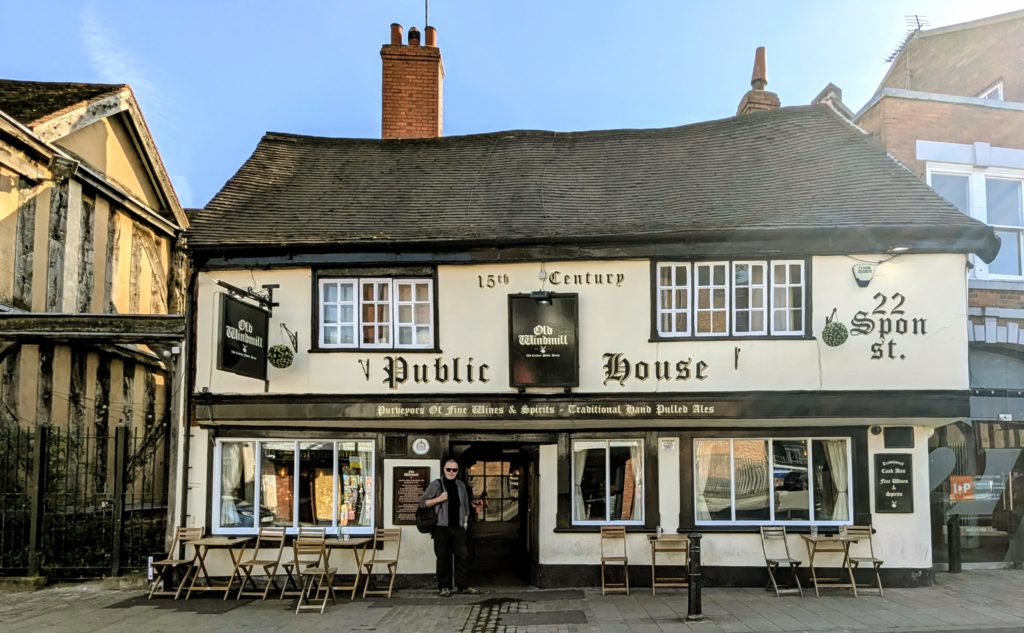 Coventry's 15th century Old Windmill, said to be the city's oldest pub
Today that legacy of ‘an Irish accent on every street corner’ in the city has been diluted by new immigration from across the Commonwealth and the wider world, but there remains a sizeable multi-generation diaspora in many neighbourhoods, where history, culture and faith links burn brightly.
Among the latter, my partner and photographer Sue Mountjoy, and I took the Number 8 bus out to the city’s historic watch-making area for ‘Coventry’s best Guinness’ at the Irish family-run Hearsall Inn, where popular trad music sessions take place on Tuesdays – often featuring The Dubliners’ legend Sean Cannon, who lives in the city. We missed him, but the Guinness was legendary!
Of course, Coventry’s history is ancient and wide-ranging. A walk round the lively centre reveals the medieval and Tudor gem of Spon Street, with its clutch of meticulously relocated and re-erected timbered houses, as well as the lively 15th-century Old Windmill pub (said to be the city’s oldest, despite some debate) which is built around a tree trunk and includes a ghost (allegedly) and a rare priest hole for sheltering clerics from attack.
Unmissable, too, nearby, is the 14th-century St John the Baptist Church, where Scottish Royalist soldiers were held prisoner during the English Civil War and were shunned so deeply by the city’s Parliamentary population that it is thought to have given rise to the term ‘being sent to Coventry’.
Another shady legend, of course, is that of Lady Godiva (her bronze statue was unveiled in Broadgate in 1949). Historians feel that this highly religious 12th-century noblewoman had pleaded with her husband to cut taxes on the poor and was told it would only happen if she rode naked through the streets. This she did, but the ‘naked’ is thought to have been without her jewellery and noble clothing. The questionable story of ‘Peeping Tom’, a tailor struck blind for sneaking a peek at her, was added centuries later.
Other major historic places we toured included St Mary’s Guildhall, regarded as one of the finest medieval guildhalls in England, and boasting a 500-year-old world-renowned Flemish tapestry still hanging in its original location in the Great Hall.
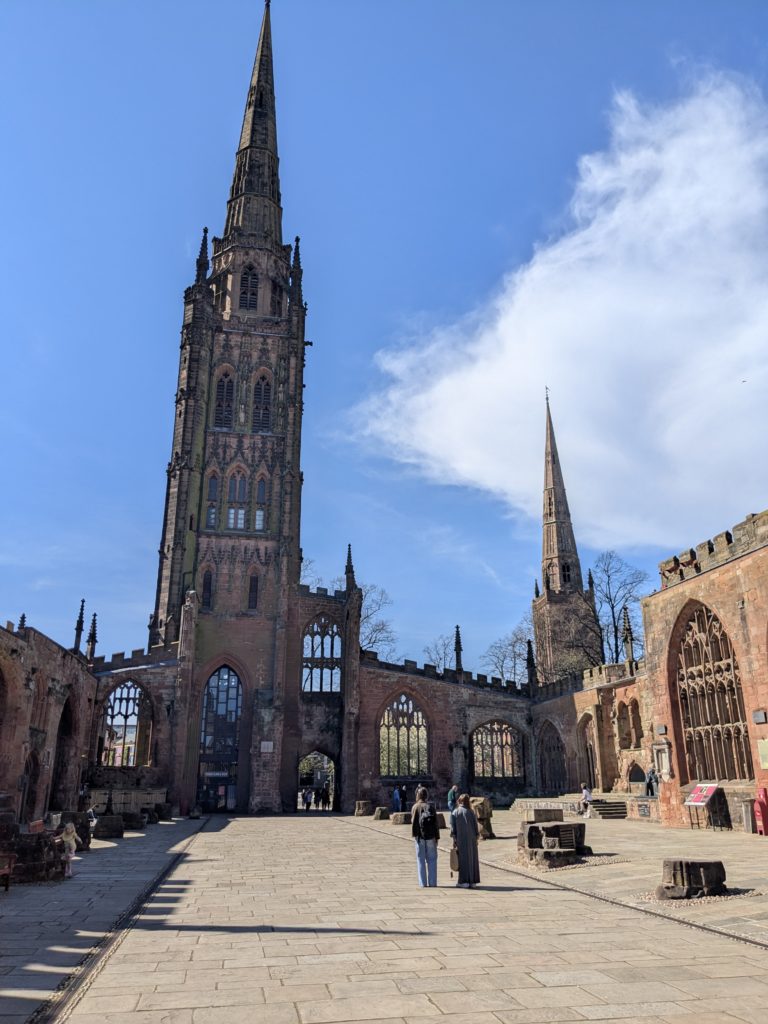 Coventry Cathedral blitzed ruins with the spared tower and spire
Coventry’s ‘crowning glory’, though, has to be its cathedral complex which includes the ruins of the 14th-century Gothic masterpiece of St Michael’s, which was mostly destroyed by the November 14, 1940 Nazi Blitz, in which the 90m tower and spire miraculously survived.
Alongside is the New Cathedral, imaginatively designed by Sir Basil Spence and consecrated in 1962, which houses some incredible 20th-century art, including Graham Sutherland’s tennis court-sized tapestry and John Piper’s soaring Baptistry window made of 198 dazzling, coloured glass panels.
Together with a Charred Cross and a Cross of Nails created from the 1940 wreckage, the whole site has become a global centre of forgiveness and reconciliation – something passionately supported by late Northern Ireland Secretary Mo Mowlam, who grew up in the city and was, as we know, at the heart of the Good Friday Agreement.
Of course, Coventry lost many of its ancient buildings during World War Two – in which it suffered no fewer than 42 other air raids, drawn by its many vital war factories – causing Nazi propagandists to create the specific new word ‘Coventrieren’ meaning ‘overwhelming bombing’.
That shattering experience is recorded in the Transport Museum as well as in the small but detailed Blitz Museum in the cathedral ruins. Caroline Brogan, of the thriving Coventry Irish Society, revealed that much of the rebuilding work post-war was carried out by a major influx of construction workers from across Ireland.
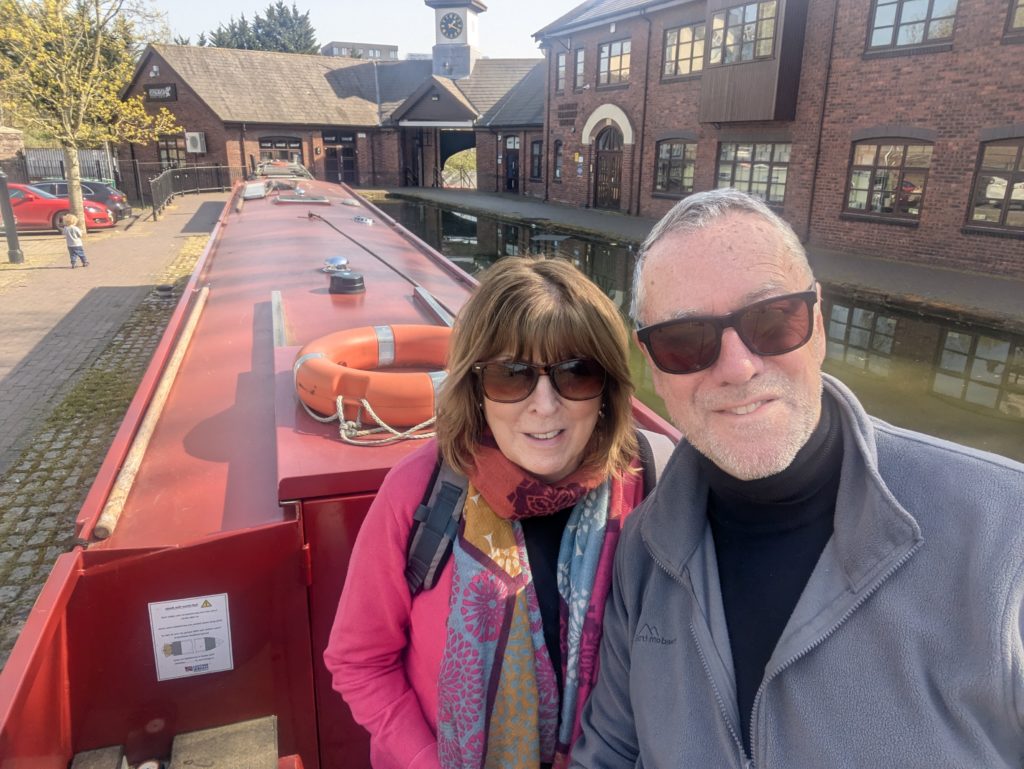 James and Sue prepare to reverse the Wren out of Coventry Canal Basin
Today the city has reinvented itself with its strong multi-cultural feel, which for us included two superb meals, one Taiwanese and the other Vietnamese, and a sample of the city’s ancient English ‘God Cakes’ – similar to Eccles Cakes but triangular and bearing three Holy Trinity holes in the sugary pastry – dished up, specially, to godchildren and at New Year.
On our peaceful narrowboat journey back to the marina, we moored at the historic Greyhound canal-side pub at Hawkesbury Junction, where the Coventry Canal meets the Oxford Canal, and we sampled that other Coventry staple, Faggots, Peas, and Mash (sometimes chips).
Verdict? Not for me. Indeed, I was reminded of what my father once asked a waiter when we pulled up at a Ballina café toward the end of a long day driving the Morris Minor Traveller westwards to Mayo: “Is there any chance of four big bowls of steaming hot Irish Stew as quickly as possible please?”
Factfile
Check out over 500 self-drive canal boats for hire from 40 locations across England, Scotland and Wales at Drifters: 0344 984 0322 or visit www.drifters.co.uk
Hire prices start at £715 for a short break, £980 for a week on a boat for up to four people www.canalrivertrust.org.uk.
For information about Coventry click here.
