





HE REMAINS one of the most famous figures of the Irish diaspora, a president whose life and violent death continue to fascinate the world.
John F Kennedy was respected and admired, even loved. He was also feared, particularly by the Soviet Union and disparate factions in the US.
Although John Fitzgerald Kennedy’s reputation has been tarnished over the decades as revelations about his extra-marital affairs have emerged, he remains a charismatic figure and the subject of much what-iffery: what if he had not been assassinated? Would America, and the world, be substantially different places? As many answers to that exist as there are to the question of who killed him and why.
John Fitzgerald Kennedy was the first Catholic to hold the office of President of the USA. News of his assassination on November 22, 1963 flashed around the world, becoming one of the defining news events of the television age.
Almost overnight the conspiracy theories began: that it was a coup d’état orchestrated by the CIA and the military, that it was the Mafia, or the Ku Klux Klan – even Ulster loyalists at one time came under suspicion.
At least the Ulsterman who died the same day, Belfast man CS Lewis, author of The Chronicles of Narnia, was not implicated, even in the wildest theories. But multiple actors, it seems, had good reason to kill the young president: the communists in Russia, China, Cuba; the Israelis because of Kennedy’s dismissal of that country’s nuclear weapons programme. Conspiracy theories and even figures within the American establishment were pointed out.
Whatever the truth, the fact that the assassination of Kennedy became a defining moment in the 20th century is itself staggering. Because the President’s forebears were from Irish emigrant stock who had somehow clawed their way up from abject poverty in Wexford to become one of the most famous families in the world.
As President Kennedy himself put it to the assembled Dáil Éireann fifty years ago in June 1963: “If this nation had achieved its present political and economic stature a century or so ago, my great grandfather might never have left New Ross, and I might, if fortunate, be sitting down there with you.”
Less than five months later, on November 22, 1963, JFK was fatally shot while travelling through Dallas in a presidential motorcade with his wife Jacqueline, Texas Governor John Connally and Connally’s wife Nellie.
The Warren Commission subsequently concluded that Lee Harvey Oswald had fired the shots that killed Kennedy and had also murdered Dallas police officer J. D. Tippit later that day.
Oswald was arrested but denied responsibility. On November 24, while being transferred from Dallas police headquarters to the county jail, he was shot dead by local nightclub owner Jack Ruby.
Ruby later claimed he had wanted to spare Jacqueline Kennedy the ordeal of returning to Dallas for Oswald’s trial.
Ruby was convicted of murder and sentenced to death in 1964. A Texas appeals court overturned his conviction in October 1966 and ordered a retrial. He died on January 3, 1967, after being diagnosed with advanced cancer, before the new trial could take place.
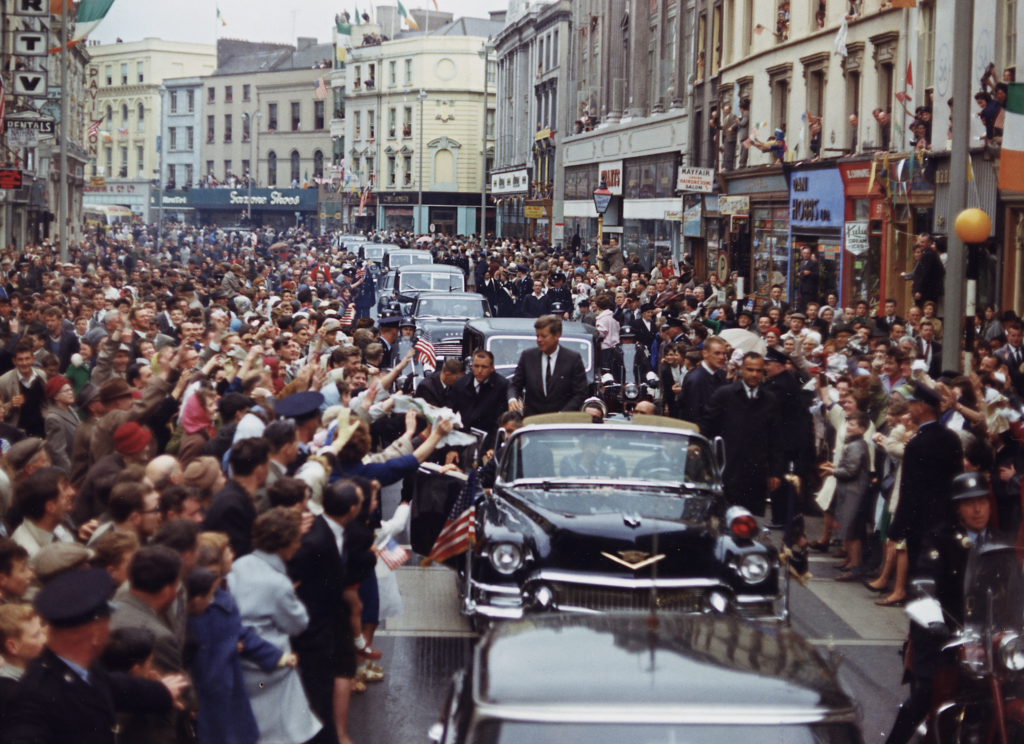 United States President John Kennedy's motorcade in Patrick Street, Cork fifty years ago on June 28, 1963 (Robert L. Knudsen / JFK Library / US National Archives — public domain)
The enquiries
IN 1964, THE Warren Commission, established by President Lyndon B. Johnson, concluded that Lee Harvey Oswald had assassinated Kennedy and acted alone. It also found no evidence that Jack Ruby’s killing of Oswald was part of a conspiracy.
A later congressional investigation reached a different conclusion. In its final report in 1979, the House Select Committee on Assassinations said Kennedy was probably killed as a result of a conspiracy. Its finding rested heavily on an analysis of a Dallas police recording that appeared to indicate a fourth shot, suggesting a second gunman had fired at the president.
The committee found that the CIA, FBI and Secret Service were not involved, nor were the Soviet or Cuban governments. It also concluded that organised crime and anti-Castro Cuban organisations, as groups, were not implicated, although it could not exclude possible involvement by individual members. It was unable to identify a second gunman or establish the extent of any conspiracy.
However, in 1982, a National Research Council panel rejected the acoustic evidence underpinning the second-gunman finding. It concluded that the sounds identified as gunshots had been recorded about a minute after the assassination. This undermined a central basis for the congressional committee’s conclusion, without conclusively settling every question about a possible wider plot.
The committee also identified failures in Kennedy’s protection and shortcomings in the investigation of a possible conspiracy. Those findings provide firmer ground for scrutiny than speculation about whether Oswald seemed capable of committing the crime.
Sixty-three years after the assassination, the competing theories continue to fill books, documentaries and websites. Ruby’s killing of Oswald before he could stand trial helped ensure that suspicion would endure: the man identified as Kennedy’s assassin never faced questioning in court.
The assassination continues to divide opinion — and to cast its shadow over the presidency Kennedy sadly never lived to complete.
Everything from irishpost.com and the print edition is available on the Irish Post App — plus more! Download it for Android or Apple IOS devices today.
See More: Assassination, JFK
