





DÓNAL LUNNY, a colossus of Irish music, has died at the age of 79. One of the most influential figures in Irish music, he was a member of Planxty, the Bothy Band and Moving Hearts, and was at the forefront of helping reimagine how Irish traditional and folk music could be played.
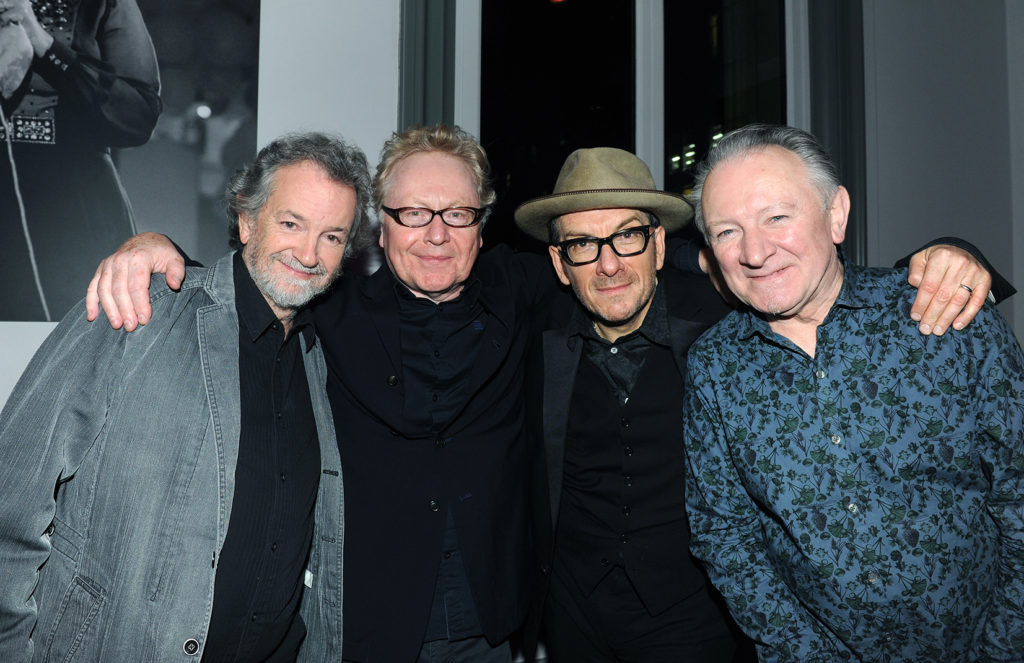 Andy Irvine, Paul Brady, Elvis Costello and Donal Lunny, taken at the Ceiliúradh concert at the Royal Albert Hall, 10th April 2014, during the State Visit by Irish President Michael D Higgins (image by Malcolm McNally)
The 20th century was kind to Ireland’s music. The tradition was given fresh impetus in the early years of the century by the likes of piper Patsy Touhey and fiddler Michael Coleman, whose recordings in America awakened Irish people to the cultural treasure trove they were sitting on.
The two cultural pillars of rural Ireland and the diaspora — the showbands and the céilí bands — were joined, and sometimes challenged, by the Clancys and the Dubliners. Along with Seán Ó Riada, they gave graphic evidence to a waiting world that Ireland boasted one of the finest stores of traditional folk music anywhere.
Irish music was becoming a cultural — and commercial — phenomenon by the 1970s, and the arrival of Planxty, was key to that development.
Two of the original band have passed away: piper Liam O’Flynn in 2018, and Dónal Lunny this week. Christy Moore and Andy Irvine are the two surviving members.
That original four-piece was responsible for many innovations, all the while staying true to the tradition.
On their first album, the pairing of The Raggle Taggle Gypsy with Tabhair Dom Do Lámh helped establish one of the most memorable devices in Irish folk arrangements: segueing from a song straight into an instrumental piece. The tune, known in English as Give Me Your Hand, is traditionally attributed to the harper Rory Dall O’Cahan.
The bridge between the two became one of Planxty’s great musical signatures. Years later, reunion audiences would greet that transition with a roar of recognition. It was an arrangement that showed how the journey from one piece to another could become a musical event in itself.
Such imaginative transitions were among Lunny’s many contributions. Instinctively drawn to harmony, rhythm and structure, he wanted to colour tunes in his own way. His musical vision brought fresh possibilities to a tradition whose great strength had always been melody, and in which solo performance had long held a central place.
Lunny’s sonic vision was first heard by a wider Irish audience through Emmet Spiceland, whose best-known trio comprised Lunny and brothers Brian and Mick Byrne. Their tight arrangements and fresh take on traditional ballads marked them out immediately, and with the release of Mary from Dungloe in 1968, they found themselves at No. 1 in the Irish charts. For many listeners, it was their first encounter with Lunny’s instinctive ability to enrich a melody with subtle yet striking harmonies — a hallmark that would run through all his subsequent work.
Planxty was one chapter in a career that repeatedly changed the possibilities of Irish music. With the Bothy Band, he helped create a sound of extraordinary drive and intricacy. Here was music that could pin you to the back wall without an electric guitar in sight.
Moving Hearts took the adventure elsewhere, bringing traditional instruments into conversation with rock and jazz. Lunny’s curiosity was the connecting thread. Whatever the setting, he seemed interested in what might happen if musicians listened closely enough to one another.
His bouzouki became part of the vocabulary of the tradition. An instrument with Greek origins sounded thoroughly at home beneath an Irish air or a set of reels. Lunny helped make that happen through his playing and through the development of the flat-backed instrument now familiar as the Irish bouzouki. What had once been an import became, in Irish hands, almost an honorary native.
Italy features too, through the mandolin and its relatives. Between them, Lunny and Andy Irvine helped establish an influential approach to accompaniment using the bouzouki, mandolin and related fretted instruments. These could supply rhythmic drive, counter-melodies and harmonic colour, alongside or in place of the guitar. The mandolin, already familiar as a melody instrument, acquired fresh possibilities within the ensemble.
Whatever ancient resonances listeners might hear in these sounds, their use in this form was a modern development — and the tradition was the richer for it.
Lunny carried his imagination and innovation into production and arrangement, helping other musicians find the shape and force of their own music. Much of his influence therefore lives beyond the recordings that carry his name most prominently.
There is a temptation, when a musician of this stature dies, to describe an era as ending. With Lunny, that seems inadequate. His ideas have travelled too far and passed through too many hands.
Somewhere, a young band will use an arrangement originally played by Planxty, and there will be a sudden lift in the room, an immediate thrill among the audience and the musicians.
They may never have met Dónal Lunny. They will nevertheless owe him something. In fact - they will owe him a lot.
A musical family
LUNNY was the father of four children. His first marriage, to Judy Slott, produced a son, Oisín, who also became a musician. His daughter with German photographer Julie Buthe, Cora Venus Lunny, established herself as a violinist and composer. He later married Japanese musician Hideko Itami, with whom he had a daughter, Sora.
He also had a son, Shane, born in 2004, with Sinéad O’Connor. Shane died in January 2022, aged 17. O’Connor herself died in July 2023.
Music ran through Lunny’s wider family too: his brother Manus became a respected musician and producer.
See More: Andy Irvine, Bothy Band, Christy Moore, Planxty
