



In April 2022 a Sunday Independent/Ireland Thinks poll to mark the centenary of the State asked the Irish public who they believed to have been the best taoiseach.
The clear winner was Seán Lemass. Lemass’s record as taoiseach from 1959 to 1966 was such that even political opponents wondered what kind of Ireland would have emerged had he ascended to the role earlier in his career.
For all his achievements Lemass left no memoir or authorised biography in his lifetime. Neither did he donate his papers to a university, as many politicians have done. It was assumed he had no interest in giving his own version of events for posterity.
This assumption is confounded by these recordings, which arose out of a series of 23 interviews between April 22, 1967 and January 9, 1969 with the businessman Dermot Ryan who moved to London in the 1970s. They are and were intended to be Lemass’s own take on his life in politics – his political memoir, but they have not been published until now.
Lemass is best remembered today firstly for his role in transforming the Irish economy. In 1957, on Fianna Fáil’s return to power, he implemented along with the civil servant TK Whitaker, the First Programme for Economic Expansion, a process which began the transformation of the Irish economy.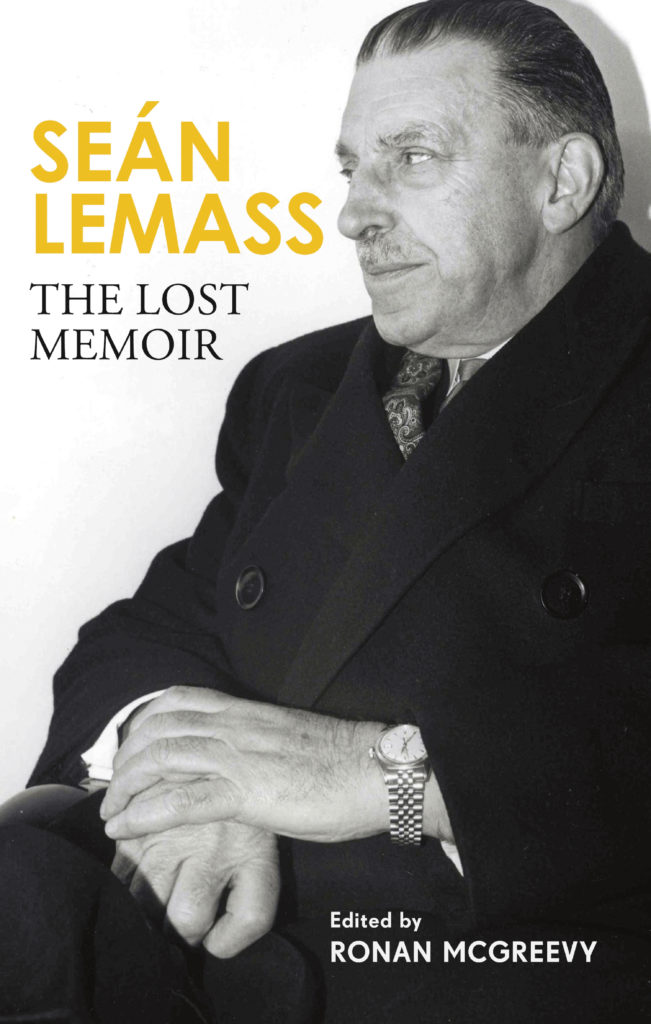
Between 1957 and 1967 the Irish economic doubled in size. Emigration which was running at a completely unsustainable 45,000 a year in 1957 was down to just 14,000 a year 10 years later. Between 1961 and 1971 the population of the Irish State increased for the first time since independence.
Secondly, he broke 40 years of a futile anti-partition policy by travelling north in January 1965 to meet the Northern premier Terence O’Neill.
Lemass wanted to end partition, but he saw the problem differently to his predecessor Éamon de Valera. De Valera blamed the British for it. Therefore, only the British could end it. However, Lemass sawMacmilla it as issue between Unionists and Nationalists.
“I could see it as almost a disease which would ultimately destroy the nation, and I therefore began to talk about unity as a spiritual and not a political conception – something which would only follow upon the removal of these misunderstandings, these bigotries, these historical animosities.”
Lemass and O’Neill parked the issue of partition, concentrating on issues in common such as agriculture, tourism and energy that would build up trust over time.
Sadly the attempts by both men to foster better relations between North and South were brutally pre-empted by the outbreak of the Troubles in 1969.
A third enduring legacy that is much less talked about in relation to Lemass was improving relations with Ireland’s old colonial master Great Britain.
Lemass had every reason to carry a grudge against Britain. As a teenager he had fought in the Easter Rising and had been wounded. He was arrested again in November 1920 and was not released until the signing of the Anglo-Irish Treaty in December 1921.
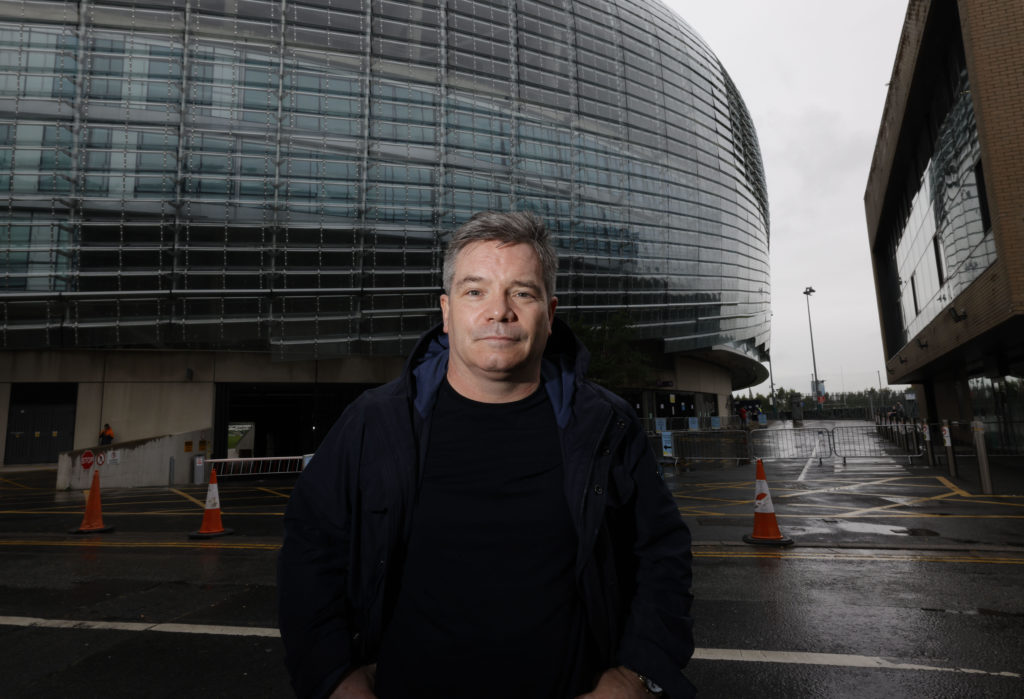 Writer Ronan McGreevy edited the book
Yet, he never bore a grudge, neither against the British nor against those on the pro-Treaty side who had murdered his brother Noel in July 1922 after the end of the Irish Civil War. He saw no purchase in picking at the scabs of historical grievances. “Once you start feeling sorry for yourself, you are finished,” he said at one time.
When he became Taoiseach in 1959, Lemass prioritised better relations with Great Britain. His goal was to get Ireland into the Common Market and that could only be achieved by cooperation with Great Britain. As far as the founding six members of the Common Market were concerned, Ireland was an adjunct of the much bigger British economy such was the economic dependency that Ireland still had with Britain.
Lemass, through no fault of his own, did not succeed in his goal of obtaining membership of the Common Market for Ireland. French president Charles de Gaulle vetoed the British bid on two occasions believing they were not serious about European integration. As Britain’s membership and Ireland were tied together, it followed Ireland could not join either.
Despite his deep disappointment, Lemass understood de Gaulle’s rationale in a way that would turn out to be uncannily prescient 50 years later when the UK left the EU.
"I do not think that either MacMillan or any member of the British government ever fully understood that they could not be half in and half out of the EEC. They had to make up their minds whether Britain was to be a part of a united Europe and, if so, they would have to resign themselves to the fact that they could not have a special relationship with the US which would give them rights and privileges against their Common Market partners or try to maintain the Commonwealth preferences.”
Nevertheless, Lemass persisted in his application for Irish Common Market membership. To do that he needed to dismantle the tariff regime that had been the cornerstone of the Irish economy until the late 1950s.
Relations between Britain and Ireland were still frosty until Harold Wilson became British prime minister in 1964. Wilson represented the constituency of Huyton outside Liverpool which had one of the largest electorates of Irish origin in England at the time and had a better understanding of Anglo-Irish affairs than any of his predecessors.
One of his first acts as British prime minister was to order the repatriation of Sir Roger Casement’s remains to Ireland.
This had been a point of contention between the British and Irish governments for decades after Irish independence. Casement was the only leader of the Easter Rising to be executed outside Ireland. He was convicted of treason and, after a very public trial, hanged in Pentonville Prison in August 1916. Winston Churchill, in his last term as prime minister, was minded to grant the repatriation, but was eventually dissuaded because of the opposition of the Northern government.
Harold Macmillan rejected Lemass’s request to return the body in 1959. Harold Wilson’s election in 1964 finally ended the impasse, something that he recalled in his memoir: ‘The refusal to return [Casement’s] body had soured Anglo-Irish relations for almost half a century and I felt the time had come for us to set it right.’
In The Lost Memoir, Lemass recalled: “He was very conscious of the fact that he represented a constituency with sixty or seventy per cent population of Irish origin. He professed his desire to have the friendliest relations with us.”
Casement’s remains were brought back to Ireland in February 1965 and reburied in Glasnevin Cemetery.
In December 1965 Lemass added another significant achievement to his time in office with the signing of the Anglo-Irish trade agreement. The agreement was a realisation that Ireland’s applications for membership of the Common Market had failed and there was no certainty as to whether or not it would ever succeed.
Britain agreed to abolish all import duties on Irish goods from 1 July 1966. Ireland agreed to cut import duties on all British goods by 10 per cent, and by another 10 per cent each successive year until all industrial duties eventually disappeared in 1975. The agreement allowed unrestricted, duty-free access to the British market for Irish livestock.
For Lemass the agreement was not just about free trade with Ireland’s biggest market by far, but a further step in weaning Irish industry away from protectionism and towards an export-driven free trade economy.
This overlooked trade agreement was a crucial staging post for Ireland’s eventual entry into the EEC in 1973 along with Britain.
Lemass’s legacy was an Ireland more at ease with itself and looking forward rather than backwards. He is justly remembered as Ireland’s greatest Taoiseach and his memoir is a timely reminder of his enduring legacy.
Seán Lemass: The Lost Memoir edited by Ronan McGreevy is published by Ériu priced £25. The UK launch of the book takes place at the Irish Cultural Centre in Hammersmith on Wednesday, November 4th at 7pm. Copies of the book will be for sale on the night.
Everything from irishpost.com and the print edition is available on the Irish Post App — plus more! Download it for Android or Apple IOS devices today.
See More: Ronan McGreevy, Seán Lemass, Taoiseach
