





A SIGNIFICANT solar eclipse is set to be visible across Ireland on Wednesday.
The upcoming celestial event is said to comparable to previous eclipses in 2015 and 1999.
While it won't be a total solar eclipse, up to 98 per cent of the Sun will be covered during the event from certain areas in Ireland.
A solar eclipse occurs when the Earth, Moon and Sun align.
As the Moon moves between the Sun and Earth, the Sun's light is blocked, casting a shadow on parts of the Earth.
Areas of Greenland, Iceland and Northern Spain will see a total eclipse, while Ireland will see between 93-98 per cent coverage.
This is the highest percentage of coverage for a solar eclipse in Ireland since the eclipse of August 1999.
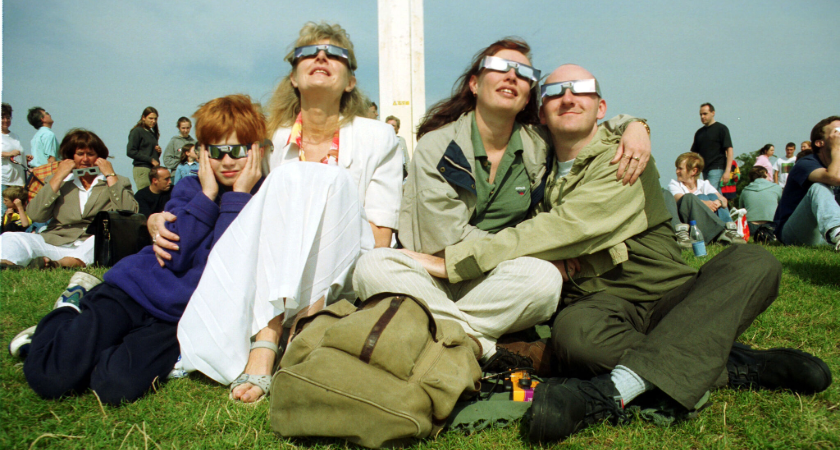 People watch the August 1999 solar eclipse from the Phoenix Park in Dublin (Image: RollingNews.ie)
The last total solar eclipse visible in Ireland was in 1724 while the next isn't due until 2090.
At maximum coverage, enough of the Sun will be covered to make a noticeable difference in temperature and light levels.
However, unlike a total eclipse, the sky will not become dark but will instead feel more like a cloudy day or close to dusk or dawn.
According to Royal Museums Greenwich, Dublin and Galway will experience first contact at 6.12pm when the Moon first covers the disc of the Sun.
Maximum coverage will occur at 7.10pm while the Moon will finish its pass of the Sun at around 8.05pm.
Exact timings of Wednesday's eclipse will vary around Ireland but viewers will be able to see more coverage the further south-west they are.
Belfast in the north-east will see around 93 per cent of coverage while the likes of Valentia Island and Mizen Head will experience almost 98 per cent.
Eclipse flight
While people in Ireland won't see totality, a team of Irish scientists will be among a group taking to the skies to study the total solar eclipse.
Researchers from the Dublin Institute for Advanced Studies, Trinity College Dublin, Technological University Dublin and Italy's National Institute for Astrophysics (INAF) will be aboard an Irish Air Corps Airbus C295 aircraft to study the Sun's atmosphere during the event.
The team will be using a new telescope called E-CorMag, developed by the INAF and built using spare flight components from two European Space Agency solar missions.
During the observation, the aircraft's bubble window will be opened, giving the telescope a clear view of the eclipsed Sun.
This means the instrument can observe without looking through standard aircraft windows, which can blur or distort the images.
For those on the ground, while only a fraction of the Sun will be visible during maximum coverage, it is still dangerous to observe the event with the naked eye.
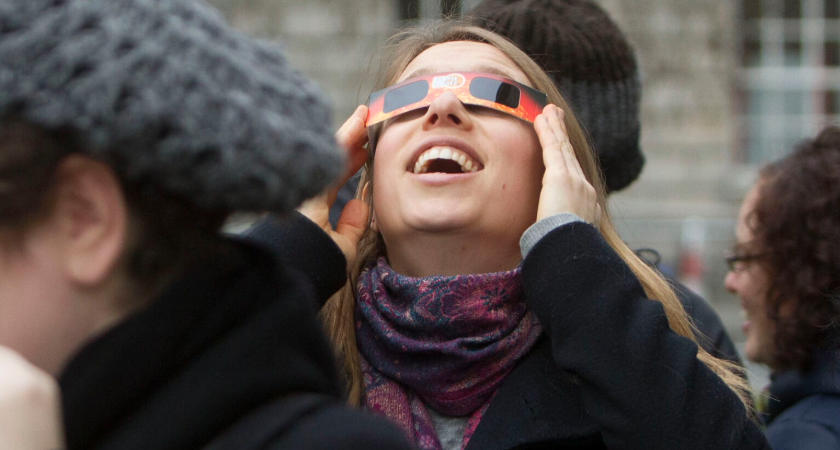 People gather in the Trinity College Front Square in March 2015 to watch the solar eclipse (Image: Sam Boal / RollingNews.ie)
Only certified eclipse glasses should be used to observe the eclipse directly while a homemade pinhole projector can let you view it indirectly.
Viewing events are taking place across Ireland on Wednesday, including at the Visitor Centre in Phoenix Park in Dublin organised by the Irish Astrological Society.
MTU Blackrock Castle Observatory, in collaboration with Cork City Council's Night Time Economy, have organised a public viewing event at the observatory, with free eclipse glasses provided.
Armagh Observatory and Planetarium is holding a Family Fun Day, culminating with a viewing of the eclipse from its Astropark.
For details of eclipse events around Ireland, visit the ESERO Ireland website by clicking here.
Everything from irishpost.com and the print edition is available on the Irish Post App — plus more! Download it for Android or Apple IOS devices today.
See More: Eclipse
