





THE situation around the Garvaghy Road is one of those periodic reminders, even for those of us right at the other end of the country, that peace cannot simply be taken for granted.
It doesn’t take much, does it? An old dispute returns and those distant echoes from the past suddenly sound much closer.
The Good Friday Agreement was an extraordinary achievement. But it could not make everybody agree about history, identity or the country they wanted to live in. It gave us a framework for managing those differences without returning to the agony that had gone before.
And why not? For all its difficulties, look at what it helped us leave behind.
There was compromise. There were arrangements that nobody would have chosen if they had been writing the whole thing themselves. There was an acceptance that people could share a place without sharing an understanding of it.
Perhaps some of us hoped that, given enough time, the old arguments would lose their force. Then somewhere like Drumcree reminds us that an argument can grow quiet without going away.
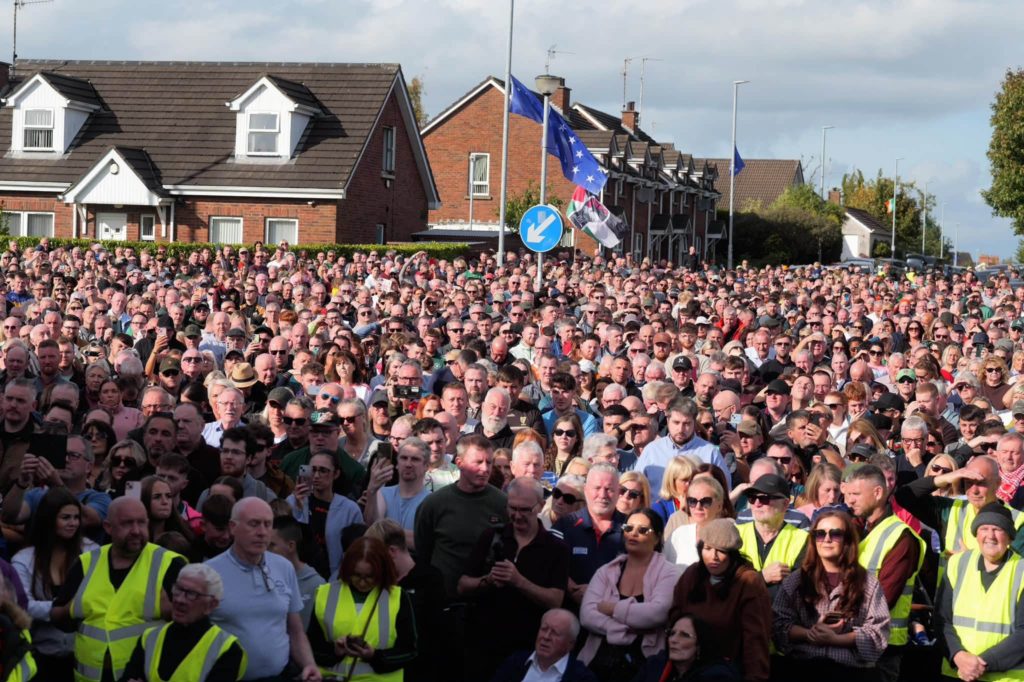 Thousands of protestors descended on Garvaghy Road over the weekend (Pic: Sinn Féin)
I find the insistence on marching along a route where residents object difficult to understand. Whatever the attachment to tradition, surely there must also be room to consider what that tradition means to the people whose neighbourhood it passes through.
Jamie Bryson, who has been advising the Portadown District Orange Lodge during this dispute, is entitled to argue its case. The rest of us are entitled to question that case, and whether the approach being taken offers any prospect of accommodation.
But it would be easy to spend the whole discussion criticising loyalism. From my own political starting point, perhaps rather too easy.
It would be easy to rehearse the arguments against partition, to describe the injustices associated with it and to explain why I believe this island would be better united.
None of that makes the people who disagree disappear.
Northern Ireland has existed for more than a century.
There are people born and brought up there who identify as British, whose families have been on this island for generations, and who have no wish to live in a united Ireland.
They belong here.
That brings me to a question I return to again and again.
I ask it as someone from a southern Irish republican family, with a history in the struggles that helped establish the Republic. I ask it as someone who believes in the justice of a united Ireland. I’m on, if you like, a certain side.
But what would that united Ireland mean for the people who most profoundly did not want it?
There is a democratic route to unity. Under the Good Friday Agreement, it requires consent North and South, including a majority in Northern Ireland.
An overall majority across the island cannot simply override that requirement. The agreement also protects the right to identify as British, Irish or both, and to hold British and Irish citizenship, regardless of a future change in Northern Ireland’s status.
Those are substantial foundations. But the practical questions still need answering.
What would make someone who had voted against unity feel secure in the country that followed? What would tell them that their traditions, their identity and their place in public life were respected?
“It’ll be grand” is a familiar Irish answer. I’m not sure it is a sufficient constitutional prospectus.
Nor is telling people that they will just have to get used to it. They might have to accept a democratic result. That does not mean they would cease to feel British, or suddenly regard the outcome as a happy one.
There is also the possibility that some might seek to exploit those fears or threaten violence. Any such threat must be resisted. Peaceful unionist opposition, however, must never be confused with support for violence.
People are entitled to oppose a united Ireland. In a united Ireland, they would still be entitled to oppose it.
That is something republicans need to think about now, while unity remains an ambition. How would we share power? How would we protect difference? How would we ensure that winning a vote did not become an excuse to stop listening?
Those Orangemen at Drumcree would still be our neighbours. The people who disagreed with us most strongly would still belong here.
What place would the republic we imagine make for them?
Everything from irishpost.com and the print edition is available on the Irish Post App — plus more! Download it for Android or Apple IOS devices today.
See More: Garvaghy Road, Northern Ireland, United Ireland
