





DON’T LET them wind you up. Don’t take the bait. It was my Da’s way of saying ‘turn the other cheek’, and though no one ever expects you to be a full-on Christian, there was practical good sense in passing up the opportunity for a fight.
Or as the girls would sing, ‘sticks and stones may break my bones, but names will never hurt me’.
They were taught that rhyme so that they might recover their confidence when others jeered at them or remarked on their looks.
This was all good, sound advice for children but apparently unacceptable as a tenable formula for peacemaking in Northern Ireland between its big Protestant and Catholic communities when they irritate each other. Hence, I seem to be in a minority when I take the position I do in relation to the massive confrontation in Portadown at the end of last month.
First the background. In the 1990s several nationalist/Catholic communities raised objections to Orange Order parades passing through their neighbourhoods. In Northern Ireland many, perhaps most, towns, villages and housing estates are predominantly of one community or the other. Orangemen marching through Catholic areas and beating their drums were seen as lording it triumphantly over a minority community which had already been subjected to discrimination in housing allocation and jobs.
So protesting against this insult was understandable. Except, of course, for the fact that it produced huge confrontations, street violence and murder. There was an argument which said, put up with it and it will pass and no one will get hurt.
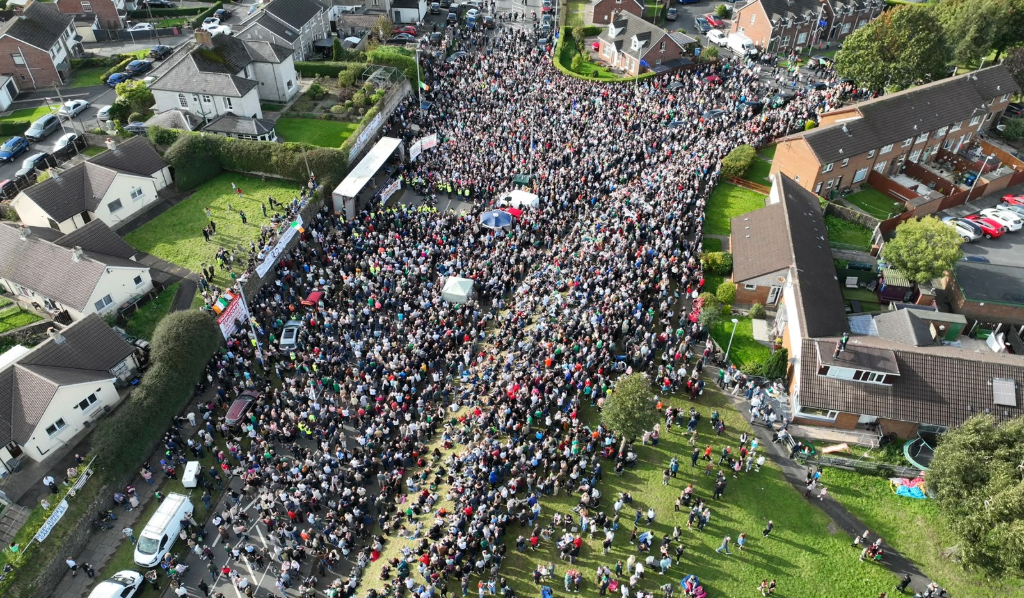 Around 15,000 people came out in support of the Garvaghy Road residents last Saturday (Image: Sinn Féin)
The most contentious of the parades was in Portadown, from Drumcree parish church to the town centre along the mainly Catholic Garvaghy Road. On occasions, the police in riot gear cleared protesters off the road with batons to let the parade through.
Ultimately it was agreed that a Parades Commission would determine which parades should be rerouted, and Orangemen, much aggrieved, were repeatedly refused access to Garvaghy Road and repeatedly applied again.
That fixation strikes me as eccentric and understandably irritating, but I am not an Orangeman.
Then, at the end of last month, the Parades Commission approved a parade down the Garvaghy Road. It acknowledged that this could be offensive, so restricted it to 35 people with one banner and no band. It said they could only march down at 8.30 on a Sunday morning, when most people would still be in bed.
The commission had, before that, been exposed in court as having too readily rubber-stamped the bar on parades. The Garvaghy residents, represented by Sinn Féin and their own organisation, refused to accept mediation, so the decision to allow a small, meek and silent parade was probably the sort of compromise that mediation would have come up with had they engaged.
The reaction of groups speaking for the residents was outrage. The First Minister of Northern Ireland, Michelle O’Neill, Sinn Féin president Mary Lou McDonald and other activists with a long history of street protest first challenged the decision in court and, when that failed, blocked the Garvaghy Road, insisting that no parade would be allowed through.
This was on the last Sunday of September. The police weighed up the prospects of clearing protesters off the road and decided that too many people would get hurt for it to be worth it.
And 35 men, mostly grandfathers, waited at their parish church for permission to proceed. It never came.
First Minister Michelle O’Neill described their plan to parade down that road as ‘harassment and intimidation’.
At which point I think to myself, hang on a minute. Really?
Yes, there is a lot of inherited pain from the clashes of 30 years ago, but were the protesters not creating far greater inconvenience for themselves and their neighbours than those 35 men would have caused? About a thousand of them stood out all night and day, much of the time in pouring rain, determined to repel any effort by the police to facilitate a parade.
The police warned them that they were breaking the law.
Next day, Michelle O’Neill, our First Minister, stood up in the Stormont Assembly and declared that ‘the days of unionist domination are over’.
But they have been over since 1972, the last time a unionist party governed Northern Ireland without having to govern in partnership with nationalists.
I am Irish. I am confident of that. Orangemen often parade down the road I live on and it bothers me not one whit. Well, OK, sometimes they are accompanied by ill-mannered and truculent bands. But I let them do their own thing and pass.
For the sake of peace. It’s what your granny advised.
And I am bewildered by people who were so much part of the transformation of Northern Ireland yet speak as if it had never happened.
Being confidently Irish here should not express itself as anger and fear but as a contented sense that nothing others do within their own different culture erodes that identity.
Everything from irishpost.com and the print edition is available on the Irish Post App — plus more! Download it for Android or Apple IOS devices today.
See More: Garvaghy Road
