



CHATTING recently with a Joyce enthusiast, I mentioned that I was reviewing Frank Callanan’s book, James Joyce: A Political Life.
The reaction was instantly dismissive. He recoiled from the idea of Joyce having had ‘a political life’ of any description. And yes, Joyce was certainly no activist and often showed a disdainful attitude to political developments during his lifetime, in Ireland and beyond.
Frank Callanan argues that Joyce took an active interest in the politics of the country he left behind when he moved to Trieste in October 1904.
His writing continued to be fully anchored in the Ireland of that era. Callanan presents Joyce as an Irish nationalist, espousing views of his own making, who “refused to think in conventionally nationalistic terms.”
Indeed, he maintains that Joyce’s nationalism was most evident “in his critique of nationalism”.
I made a similar argument in my book, Ulysses: A Reader’s Odyssey (New Island Books, 2022), but in less detail and with, I freely admit, far less erudition than Frank Callanan, a prominent barrister who died suddenly in 2021 with this magnum opus on Joyce almost completed. It has been finalised by some academic friends of his. They have done us – and James Joyce – a favour.
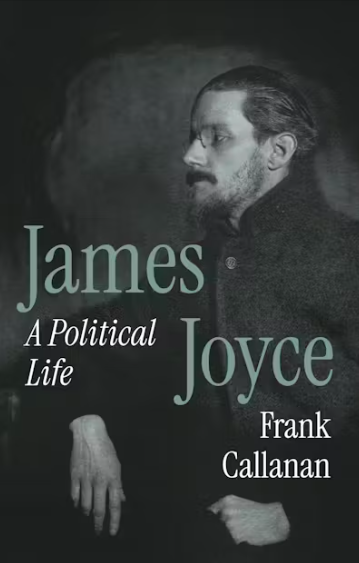 Frank Callanan's book James Joyce: A Political Life
I say that because of a belief that Joyce’s reputation can suffer from the image many have of him as a remote occupant of an inaccessible eyrie of literary modernism. Callanan offers a corrective, delving into his deep engagement with the affairs of turn-of-the-century Ireland. With the thoroughness of a lawyerly brief, but in accessible prose, Callanan takes us forensically through Joyce’s life, highlighting those elements of Irish history with which he interacted and how they influenced his work.
The book’s introduction contains a brilliant observation that “Joyce took from his experience of the fierceness of political and historical controversy in an inchoate Irish polity a scarred wisdom that set him apart from contemporary modernist writers who were scions of established states and empires.” In other words, his Irishness shaped his work, distinguishing it from that of his British and European contemporaries.
This book could easily be titled James Joyce: A Parnellite Life because, aside from Joyce himself, Charles Stewart Parnell is the colossus that inhabits its pages. Is there any modern political figure who can match Parnell in the way in which he attracted the creative attention of two major writers, Joyce and Yeats?
Callanan sees the bitter controversy over Parnell’s relationship with Katherine O’Shea, which split the Irish Party in 1891, as a formative influence on the young writer, albeit that Joyce was only nine years old at the time. He argues that Joyce “dwelt all his life on Parnell’s undaunted defiance of crushing adversity in the Split.” Joyce viewed Parnell as a heroic figure, contrasting him with the late 19th century’s two leading British Prime Ministers, Disraeli and Gladstone, whose careers he deprecated.
This book challenges the commonly held view that Joyce inherited his fascination with Parnell from his father, John Stanislaus Joyce. It argues that the elder Joyce only became a fervent admirer of Parnell after the 1891 Split, although he was acquainted with individuals who were in Parnell’s inner circle.
In my book, I speculated, fancifully I admit, about the possibility that, had Parnell survived to deliver Home Rule to Ireland in the 1890s, James Joyce, son of a Parnellite, might have stayed at home and become part of the ruling elite attached to the restored Irish parliament. Frank Callanan would undoubtedly dismiss such a suggestion, but you have to wonder if an Ireland without Parnell as tragic hero and victim would have been as imaginatively appealing to Joyce.
Callanan argues that John Joyce’s precipitous economic and social decline in the 1890s had more to do with his reckless character than with his disappointment at the eclipse of Parnell and the prospects his stellar ascent had briefly opened up for Ireland.
James Joyce: A Political Life maintains that an identification with Parnell, and an attachment to his brand of politics, were part of Joyce’s intellectual formation, and that he took that preoccupation with him through his life as a writer. Joyce was particularly scornful of the role of the Catholic bishops in Parnell’s downfall, causing him to believe that, as an Irishman, he was “the servant of two masters … the imperial British state … and the holy Roman catholic and apostolic church.” (Ulysses)
Parnell appears in all of Joyce’s great works. In Dubliners, the story Ivy Day in the Committee Room resounds with his memory on the anniversary of his death. The most memorable scene in A Portrait of the Artist as a Young Man recreates a fiery dispute around the Christmas dinner table between Mrs ‘Dante’ Riordan, a devout Catholic and bitter critic of Parnell, and Mr Casey and Simon Dedalus (based on Joyce’s father), both ardent admirers of their Chief and quick to condemn the Catholic Church for contributing to his betrayal.
Somewhat regretfully, Callanan suggests that this scene might be fictional, although it undoubtedly provides a penetrating insight into the raw divisiveness of the Irish Party Split. There are plenty of references too to Parnell in Ulysses and in Finnegans Wake, which this book calls to mind.
Callanan acknowledges that Joyce was largely silent about developments in Ireland after 1916, by which time he was absorbed with the herculean task of writing Ulysses. He describes Finnegans Wake as “an extravagantly Irish text”, but it is fair to say that its Irishness is elliptical, like everything else in that intricate linguistic ensemble.
Callanan’s key insight into Joyce’s political life is that his “imaginative rendering of history warrant[s] consideration in [its] own right for what [it tells] us about Irish history and politics”. I agree.
Daniel Mulhall is a retired Irish Ambassador and author. His latest book is Pilgrim Soul: W.B. Yeats and the Ireland of his Time (New Island Books, 2023)
James Joyce: a Political Life (Princeton University Press 2026), £38.
See More: Frank Callanan, James Joyce
