




THE story of Ireland’s rural shop is one of community and connection but also, increasingly, of decline.
For decades, family-run businesses sat at the heart of towns and villages, but today many of these shops have disappeared as people move and competition from big supermarket chains reshapes rural life.
In Louisburgh in Co. Mayo, Andy Durkan recalls a very different time.
His family’s shop, S. Durkan, first opened in the 1940s and remained a cornerstone of the community for generations.
“My mam and dad ran a very small shop, and they started selling groceries, you know cooked ham and meats,” he said.
“We also grew our own vegetables in the garden at the back of the shop.”
Farmers supplied eggs, customers relied on credit, and the shop acted as a hub for everything from buying your tea to catching up with the shopkeeper over a cup of it.
 Prendergast's Shop, Bridge St.
(Photo by Imelda O'Grady)
“There was no industry around us at the time, so most things were done on credit,” he said.
In the early 60s daily life revolved around the shop in ways that are now almost unimaginable.
With few cars and limited transport, people travelled by horse and cart, and shopping was a slower, more personal experience.
“You stood behind the counter, and a customer came in with their list, and I would run and get them everything,” he said.
“At the time we only had two types of cheese; there would have been no pre-packed cooked meats.”
Simple tasks defined the rhythm of the day, weighing loose tea into customers’ wooden tea chest, bagging sugar and raisins by hand, and even collecting empty whisky bottles from local pubs to refill with milk to sell to visiting tourists.
Despite its modest size, the shop evolved with the times.
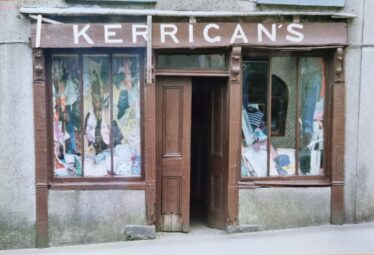 Kerrigan's Shop, Long St.
(Photo by Imelda O'Grady)
Renovations in the 1960s introduced refrigeration, while later decades even included a home bakery run by Mr Durkan’s wife, Janet.
In the 1970s Mr Durkan added a refrigerated display unit that he says people were shocked and delighted by, calling it "real space-age stuff".
“On a Sunday some of the women would come in to get their shopping, and they might stay for a cup of tea in the back to chat and catch up.”
These moments, he says, are what defined the rural shop: not just a place to buy your groceries, but a space where village life unfolded.
Across Ireland, such businesses have long played a crucial role in sustaining rural populations.
Around 37% of people live in rural areas, yet many places in the West and the Midlands, have experienced steady population decline despite overall national growth.
That shift is reflected in places like Louisburgh. “When I was growing up there would have been a much bigger population than there is now,” Mr Durkan said.
As populations fell and car ownership increased, shopping habits changed. Residents began travelling to larger towns, drawn by wider choice and lower prices.
“We wouldn’t have the range of things that people wanted.”
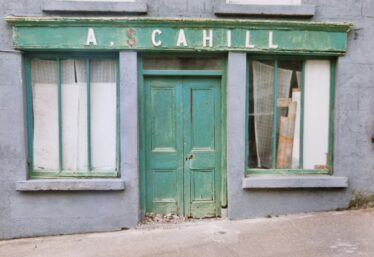 A. Scahill Shop, Bridge St.
(Photo by Imelda O'Grady)
Industry figures suggest that up to 100 local shops close across Ireland each year, with several shutting their doors every fortnight, according to the Convenience Stores and Newsagents Association (CSNA).
For Mr Durkan, the pressures became too great. “It was tough with all the regulations; we couldn’t keep up with the big stores like Tesco or SuperValu,” he said.
The family eventually sold the shop around eight or nine years ago, marking the end of an era not just for them but for the wider community.
Today, only a small number of shops remain in the area, like a petrol station half a mile outside town with a Spar attached.
“The local shop is nearly a thing of the past now,” he said.
Yet the sense of loss goes beyond just money. For Mr Durkan, what has faded is the familiarity and warmth that once defined rural life.
“It’s sad because people used to love coming in.”
“Even the holiday people coming in for a couple of weeks over the summer, you’d know them, and you’d say welcome back and you’d remember all their names.”
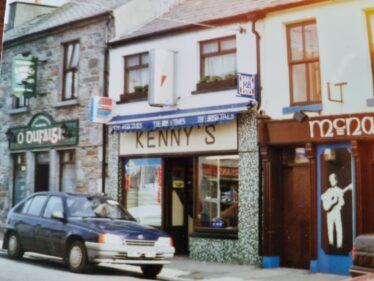 Kenny's Shop, Bridge St.
(Photo by Claire Kenny)
For more information you can find it: here
Everything from irishpost.com and the print edition is available on the Irish Post App — plus more! Download it for Android or Apple IOS devices today
