





TWO Irish brothers have joined forces to explore the experiences of those who fled Ireland during the Great Famine in a new five-part podcast.
Across the Briny Ocean follows the journey of Irish emigrants from their preparations to leave home through to their arrival in the New World and shows the challenges they faced along the way.
The series is based on The Coffin Ship, a book published in 2021 by Cian McMahon, a historian at the University of Nevada, whose research focuses on Irish and American immigration history.
His brother, Daithí McMahon, an Associate Professor of Media and Culture at the University of Derby, helped with his long experience in podcasting.
The podcast is divided into five episodes: Preparing to Leave, Embarking on the Ship, Life at Sea, Death and Dying and Arriving in the New World.
Each one explores the different stages of people’s lives during and after the Famine, when more than two million people left Ireland between 1845 and 1855.
For Cian, the idea behind The Coffin Ship began with an unexpected source of inspiration.
‘I was deeply inspired by Professor Marcus Rediker, who was talking about his book, The Slave Ship,’ he said.
‘On the walk home that evening, I realised that no one had ever written about life at sea during the Great Famine. Suddenly, it dawned on me: The Coffin Ship.’
The research and writing process took six years in total.
Cian spent two years gathering primary sources from archives in Ireland, Britain, Australia, Canada and the US, followed by two years reading and analysing the material and a final two years outlining and writing the book.
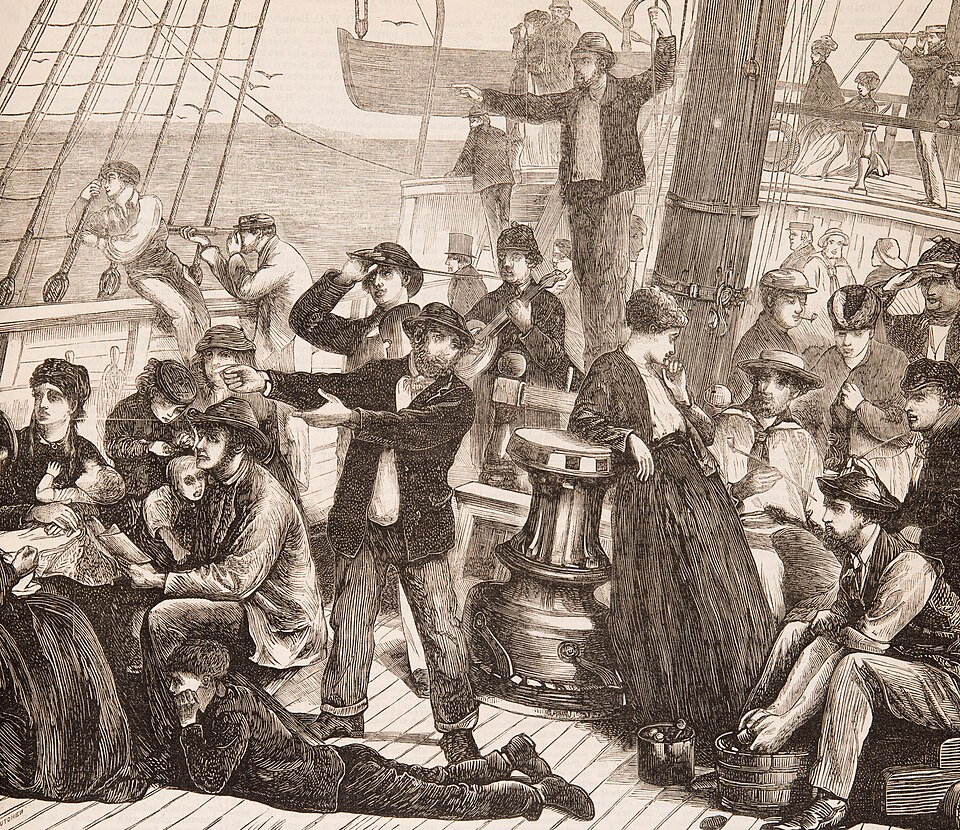 Woodcut print from an emigrant ship in 1873 (WikiCommons/State Library of New South Wales)
The book shows Irish people's individual accounts of their voyages, which goes far beyond the typical narrative associated with the ships that carried people overseas.
Cian said his interest in the subject also came from his own schooling in Ireland during the 1970s and 1980s, when he first came across the familiar image of the so-called coffin ships.
He said he became worried that it presented emigrants as helpless victims rather than individuals who actively sought ways to survive.
“At every step of the journey, the people who left Ireland during the Famine employed a variety of strategies, primarily relating to fostering personal relationships, to survive the ordeal,” he said.
“I wrote my book as a way to commemorate their courage and creativity.”
One of the most striking findings from his research concerned the book's title.
Cian said the term ‘coffin ship’ was rarely used to describe Irish emigrant vessels during the Famine itself, despite its now widespread association with the time.
According to his research, the expression had circulated in Ireland and Britain since the late eighteenth century but gained wider attention in the 1870s, when British MP Samuel Plimsoll used it during his campaign for improved safety laws for sailors.
Irish nationalists then adopted the term during the Land War of the late 1870s and early 1880s, before it became associated retrospectively with the Famine era.
The podcast also draws on the historical records that underpinned the book.
“We really wanted to make sure that we represented a wide range of voices in the podcast,” Cian said.
“There was tonnes of material to work with, but we chose quotes from different kinds of people to represent the scope of experience during the Great Famine.”
The brothers also worked with actors and sound engineers to bring the historical accounts to life.
By combining Cian’s research with Daithí’s experience in audio storytelling, Across the Briny Ocean aims to give listeners a deeper understanding of the people behind one of the defining chapters of Irish history.
You can listen to the podcast for free: here
Everything from irishpost.com and the print edition is available on the Irish Post App — plus more! Download it for Android or Apple IOS devices today
