





AS THE evening clouds scudded quickly overhead, we left behind all signs of human life and entered a world of blanket bog inhabited by a few grass-chomping sheep who looked up with mild curiosity at our passing car, in which the GPS system suggested we were heading for the nearby cliffs, high above the snarling Atlantic breakers.
Then, magically, civilisation reappeared in the shape of a handful of white-walled houses, including the one where we aimed to spend an autumn week of extremely slow travel alongside a sheltered bay called Danish Cellar.
This was Erris Head House, a Sykes Cottages five-bedroom holiday home in a spot so remote that if you rowed 1,880 miles directly west and managed to survive fierce ocean storms, you would arrive to a hero’s welcome in Newfoundland’s historic settlement of St Anthony.
Instead, my partner and photographer Sue Mountjoy and I decided that the five-mile drive across the empty boglands had been enough and we opted to settle down in front of the roaring turf fire and enjoy a Jameson nightcap whilst we munched our way through the fresh scones that had been cooked for us that afternoon by the very welcoming owner Delia.
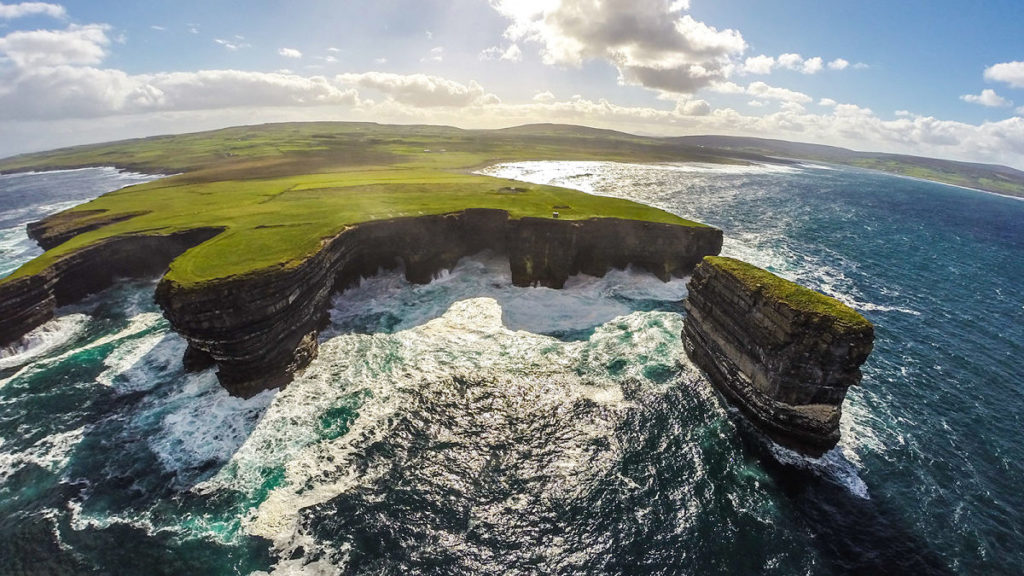 A global icon, Downpatrick Head, in autumn sunshine
In some ways, that parallel between the wild and hostile beauty of this region and the modern comforts to be enjoyed by visitors – even in autumn and winter – encapsulated our aims for a week of immersion in the wind, rain and even storms we expected to encounter as we discovered what was on offer in this tricky time of year.
Indeed, it was earlier this year that Fáilte Ireland and Minister Alan Dillon launched a five-year plan to transform North Mayo into a stronger year-round tourism destination while protecting the wild landscapes, Irish-speaking communities, traditional culture and the authenticity that make it so distinctive.
It’s early days to examine that strategy in a place where my late father was born and raised, and which I visited from England many times in my youth on family diaspora holidays, loving the donkey cart rides but enduring the tortuous mail and cattle boat crossings.
This time, after a smooth voyage on the Stena Adventurer, we sped our way to Erris Head, around 195 miles from Dublin.
On our first morning the ocean view at the kitchen window became our private cinema with scores of starlings nagging on the electric wires, red-blobbed sheep in the fields, and a sky changing from orange to gold before opening into autumn blue. That day promised no rain, although we knew there would be plenty eventually. But we also knew there would be beaches almost entirely to ourselves, extraordinary museums, memorable meals and the eternal craic in local pubs and cafés.
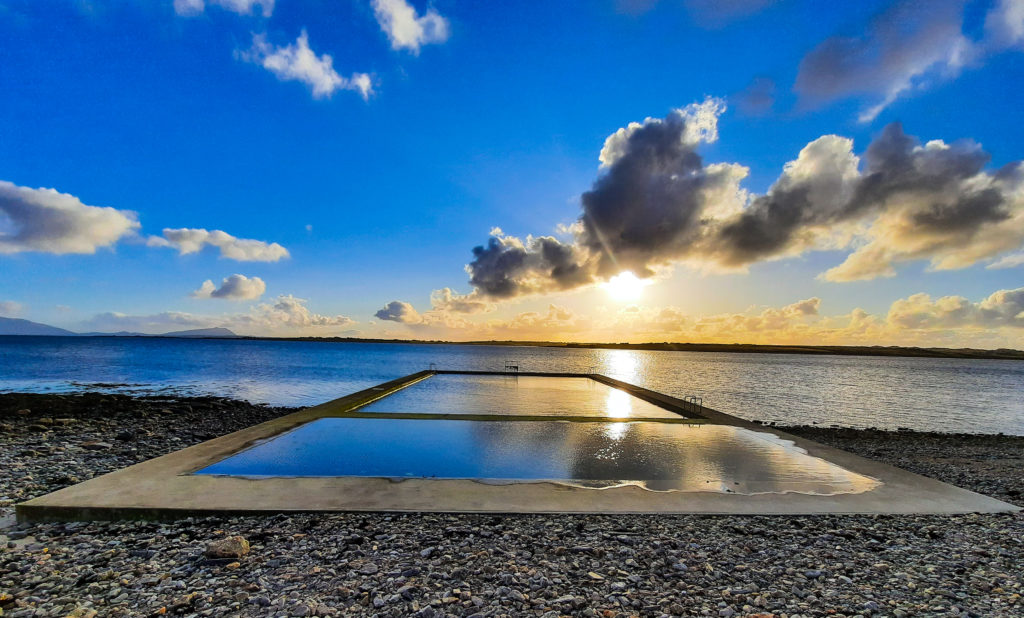 A cold morning dip awaits you at Belmullet Tidal Pool
So off we headed, first to remote Blacksod Lighthouse, on the very tip of the remote Mullet peninsula, where local filmmaker and guide Fergus Sweeney brought his family’s historic story vividly to life. It was here that his grandmother Maureen had sent the weather observations that helped shape the Allied D-Day landings, in June 1944, and the course of World War II. I had just watched the new film of that historic event, Pressure, in which even Hollywood gives full credit to her role.
Nearby, at the bustling SOLAS centre at Eachléim, we had lunch among a room of lively diners and took another absorbing journey into the peninsula’s past with its exhibitions on the nearby islands, maritime heritage, the Irish language and the area’s emigrations, which sent so many thousands of local people overseas, separating families in the race to beat poverty and past famines.
Later, we met another brilliant guide, Bill Duffy, who runs boat trips to the abandoned and hauntingly beautiful Inishkea Islands and, off-season, takes curious visitors like us on fascinating deep-dive walks round places like Blacksod itself.
Like Fergus, he shone with a passion for these chunks of land where humans have lived, worked, foraged and died, surrounded by a wild and teeming ocean, for over 6,000 recorded years. His face lit up and the words poured out, telling of orcas arriving in May to eat seals, of winkles once gathered for food but now sent to Japan, of the peninsula’s extremely rare great yellow bumblebees, of long-gone pubs and dance halls, of hardy people adapting and persisting.
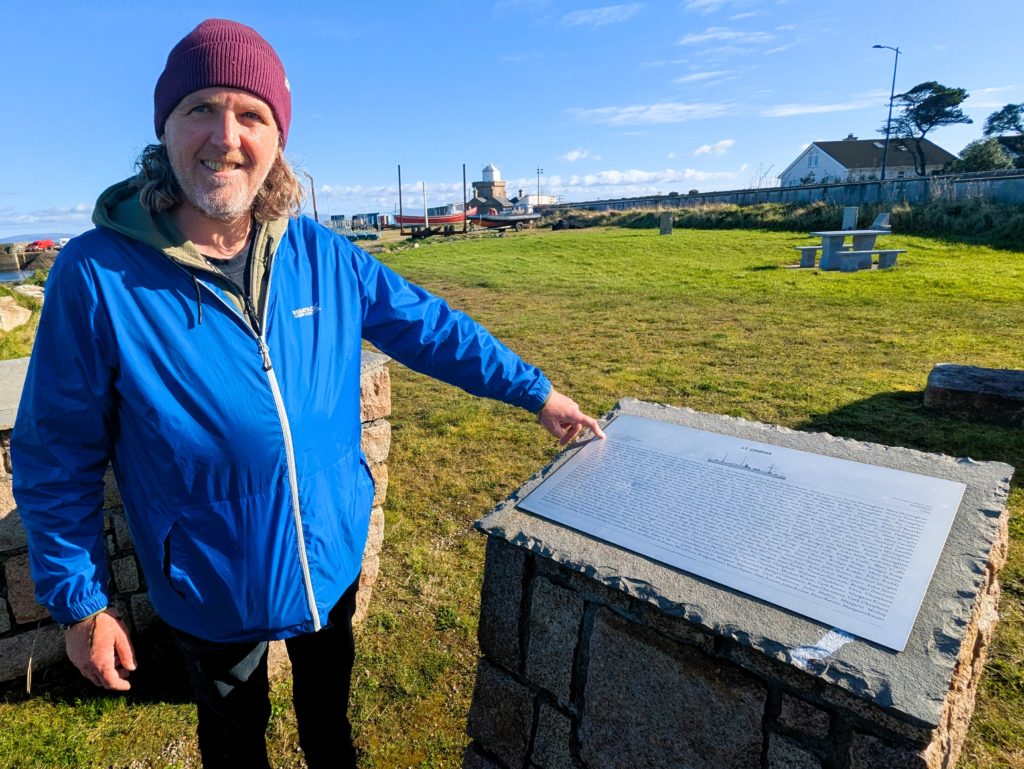 Guide Bill Duffy shows a panel at the Blacksod memorial to the 19th century emigrants to North America
Next morning, blessed again by another of those sunny days that are an autumn gift from heaven, I stepped out of our door and strode the few yards down to the start of the Erris Head Loop Walk, a three-mile, grassy wilderness that skirts the peninsula’s northernmost soaring cliffs, alongside jagged sea stacks continuously pounded by huge white breakers and a sea that stretches, turquoise and threatening, seemingly to the world’s edge.
With Sue nursing a knee injury, I wandered for two hours in solitude as lonely as a grave, with just seabirds and those ubiquitous wandering sheep for company. As I gazed out at distant Eagle Island and its lighthouse, my mind wandered to thoughts of the ancient Vikings said to have sought shelter here and the unlucky coast-watchers who shivered for years in a crumbling concrete World War II lookout post as they scanned sea and sky for the military aircraft that occasionally crashed nearby and the submarines, of both sides, that sheltered here.
Such natural emptiness is one of the treasures to be had here. Even on short trips to the main local town, Belmullet, it felt special to be a rare visitor when the high summer hordes had gone home. At McDonnells, the celebrated bar and undertakers, members of the Murphy family were having a reunion and soon our commitment to ‘just one drink’ was shattered as conversation and the craic flowed as freely as the limitless Guinness.
Creamy chowder at the nearby Talbot gave us another reason to linger. So too did the town’s shops, where simple purchases turned into long chats about life and everything in between. Some spoke of the squeeze on the area’s fishing jobs: huge foreign trawlers scooping up the fish while diesel and bait costs were shooting up and catch prices were not keeping pace. Once more in the area’s painful emigration history, its younger men were seeking work in England during the off-season. Such concerns gave the tourism strategy a sharper relevance.
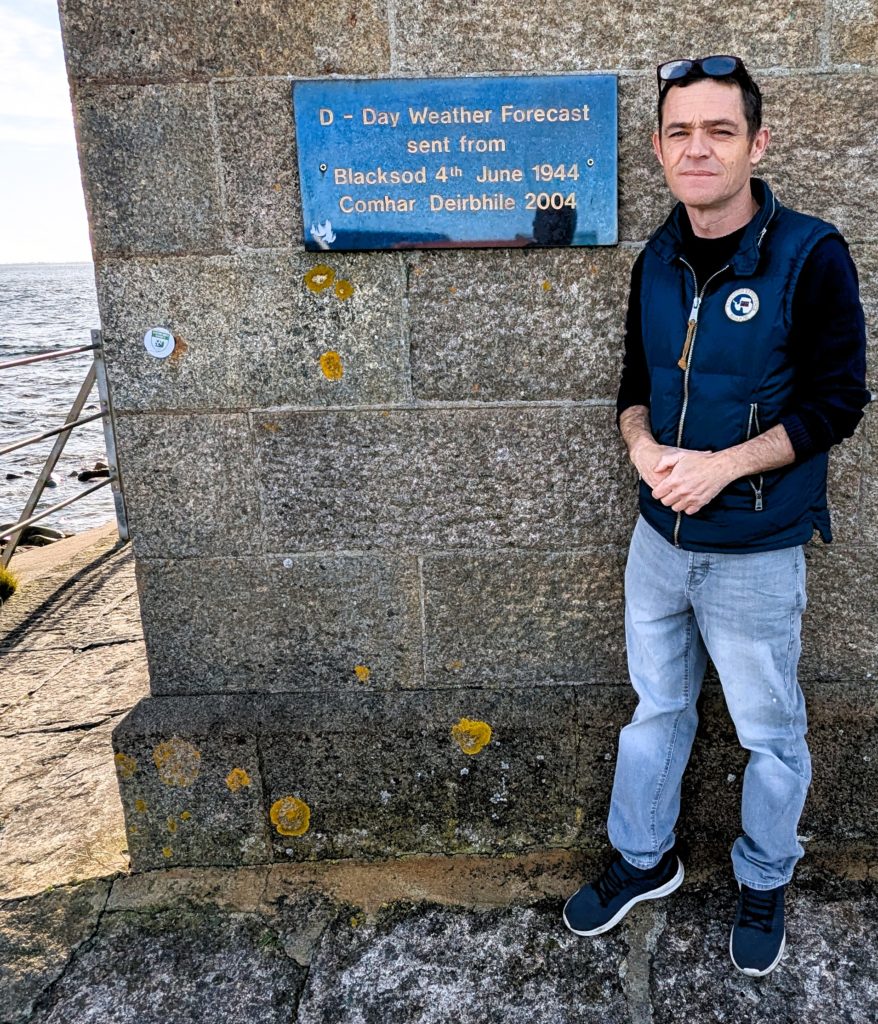 Guide Fergus Sweeney, at the sign recording how his grandmother, Maureen, sent the historic D-Day weather message
And, even in autumn, before some places closed up for winter and those ‘miracle’ blue days of sunshine faded to grey, there was plenty to enjoy. Along the coast, the Céide Fields centre took us back six millennia to farming communities whose stone boundaries can still be seen. At nearby Ballycastle, we toured Ballinglen Arts Foundation and gallery, which offered another way of seeing the region with workshops and residencies for visiting artists and local people. Just along the coast, at Downpatrick Head, the great sea stack of Dún Briste rose from the Atlantic, soon to be linked by a new coastal path to Céide Fields.
In Ballina, the Clarke Museum of Irish History offered another compelling indoor expedition, opening windows onto the remarkable collecting passion of a local businessman. Later, at the National Museum of Ireland’s Country Life galleries at Turlough Park, near Castlebar, familiar objects and accounts of rural work took me back to those childhood days of riding in donkey creels on the way to the turf bog and making straw ropes (sugans) using a thraw-hook twister attached to my waist.
We still seized the bright intervals. Along the exceptionally empty beaches of Doohoma and Doolough came chats and laughter with local people, walking dogs or simply enjoying light breezes with air so fresh you could bottle it. Even when the rain came, we headed into Belmullet, too wimpy for a windy stint in the tidal pool and adjoining sauna but pleased to scoop up a home-made fruit cake from five-generation O’Donoghue’s bakery, lottery tickets at ‘lucky’ Careys shop and a Guinness at Linda’s Corner House. And on damp evenings ‘at home’ there was a huge settee to sink into with Netflix, books, games and the smell of the glowing turf fire. Simple pleasures but lasting memories.
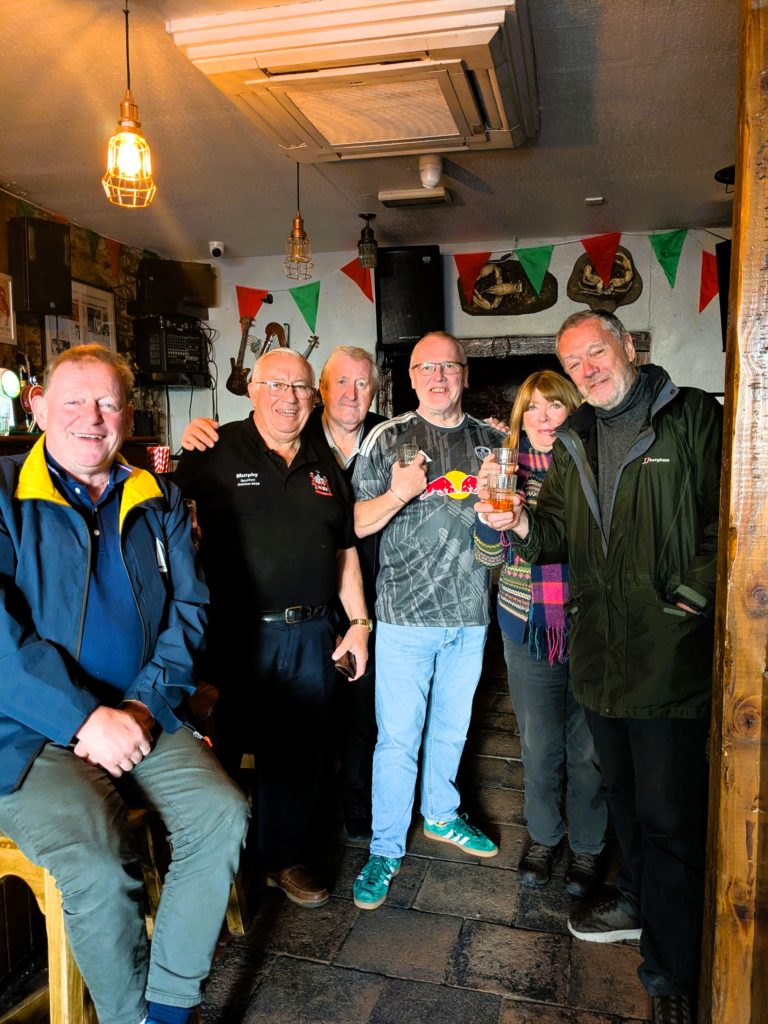 James and Sue with locals at McDonnells historic bar and undertakers in Belmullet
Food, too, was a recurring comfort. At the Erris Coast Hotel in Geesala, seafood chowder preceded a succulent striploin steak from nearby Reilly’s butchers, with the whole meal sourced less than a donkey ride away. Back at our holiday haven, mutton, potatoes, onions, carrots and bottled Guinness became an Irish stew. Eating out and cooking our own feasts went hand in hand.
Even when we left Erris Head House at the end of our week and headed for a night at nearby Broadhaven Bay Hotel – amid one of those named autumn storms with 80-mile-an-hour winds – the laughter was everywhere among our fellow diners, as hats blew off in the car park and the power was cut for a couple of minutes.
Sue and I agreed that North Mayo off-season feels truly special, even without its planned new visitor attractions. It has unique scenery, packed with huge and empty boglands and mountains, skirted by a ruggedly beautiful coastline dotted with miles of deserted beaches. It is also awash with history and culture. But, most of all, it is home to people whose everyday warmth is as fresh and inviting as Delia’s oven-fresh scones on a silver platter.
As they say, you don’t go to Ireland for the weather!
Factfile
Where to stay: Erris Head House, Glenlara, near Belmullet, is the Sykes Cottages property used for this visit. It sleeps up to 11 and is available from £2,643 for seven nights. Lots of North Mayo properties stay open through winter. Go to www.sykescottages.co.uk/county-mayo-holiday-cottages.html
Also available off-season are Broadhaven Bay Hotel: www.broadhavenbay.com and Erris Coast Hotel: www.erriscoasthotel.ie/en
Getting there: Stena Line operates up to four sailings daily each way on the route of around 3.5 hours from Holyhead to Dublin. Fares start from £155 single for a car and driver, with special duty-free day trips and promotional offers available. The Stena Plus Lounge can also be booked. Go to www.stenaline.co.uk
For plenty of information about visiting North Mayo, go to www.northmayo.ie
For visiting Ireland www.ireland.com
Pictures: Sue Mountjoy, Mayo North Tourism, Fáilte Ireland.
