





ABNEY Park in the London borough of Hackney began life as one of the Victorian garden cemeteries known as London’s “Magnificent Seven”.
These were originally commercial ventures set up in the 1830s to provide a private alternative to the increasingly overcrowded burial space of London’s old churchyards.
Today, Abney Park Cemetery is a beautiful woodland memorial park and local nature reserve. It also contains many, sometimes unexpected, traces of the entangled histories of Ireland and Britain.
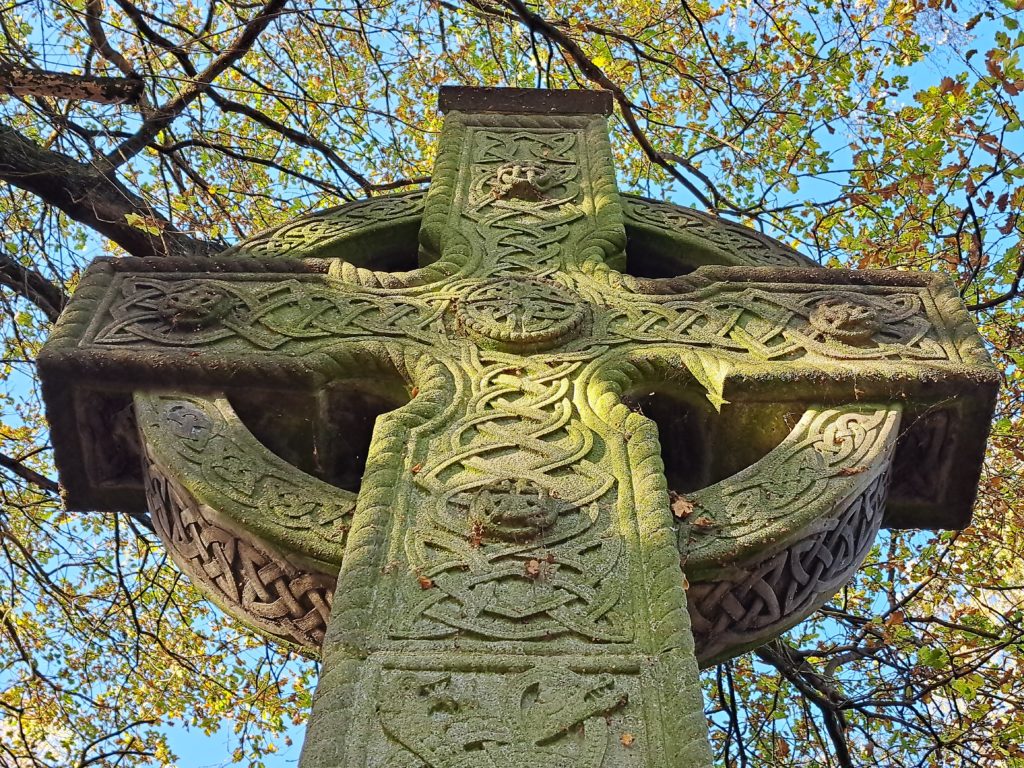 A Reed Celtic Cross in Abney Park Cemetery, London
Abney’s best known Irish inhabitant is Longford-born James ‘Bronterre’ O’Brien (1804-1864).
O’Brien was a radical journalist and a leader of Britain’s Chartist movement of the 1830s which campaigned for parliamentary reform and universal male suffrage.
A lesser-known Irish connection is that Abney Park Cemetery was created from lands which included an estate once owned by Charles Fleetwood, son-in-law of Oliver Cromwell and Lord Deputy of Ireland for three years during the seventeenth-century Cromwellian conquest.
There is then a certain irony in the fact that the cemetery section closest to the long-gone Fleetwood House contains an impressive example of a late nineteenth-century Celtic Revival artform which became a symbol of Irish nationalism.
A majestic Celtic Cross, exquisitely carved with interlacing designs and standing over five metres high, catches the eye when you enter Abney Park from the cemetery gate on Stoke Newington Church Street, London N16.
Known as the Reed Celtic Cross, it was erected in December 1893 as a grave marker memorialising two sons of Hackney’s first MP Sir Charles Reed, Andrew Holmes Reed and Talbot Baines Reed.
Following Andrew’s death in 1892, his widow Jessie Reed (née Tillie) commissioned the artwork from the Irish monumental sculptor Edward O’Shea. She had previously seen one of his Celtic Crosses while walking through Dublin’s own Victorian garden cemetery, Glasnevin.
Edward O’Shea (1853-1910) came from a family of stonemasons and sculptors in Callan, Co. Kilkenny. His father James and uncle John O’Shea are still renowned today for their decorative work on the exterior of Oxford University’s Museum of Natural History. Edward chose to make Celtic Crosses his speciality, winning prizes at the great Exhibitions of the 1880s in Ireland, Britain and America.
 Breda Corish
In creating the Reed Celtic Cross, he introduced into Abney Park Cemetery “Irish interlacery” designs which were directly inspired by the ancient High Crosses of Ahenny.
These are considered amongst the finest examples of early medieval Christian stone carving in Ireland. They can still be seen today in the graveyard associated with the eighth-century monastic site of Kilclispen, just outside the village of Ahenny in Co. Tipperary.
The combination of Edward O’Shea’s Celtic Cross in Abney Park and Hackney’s Reed family reveals a story which traverses one thousand years of Ireland’s history, from the ninth to the nineteenth centuries.
Three generations of the Reed family were regular visitors to Ireland. They came as Congregationalist missionaries from the NonConformist Protestant tradition.
They represented The Honourable The Irish Society, the City of London corporation first established in 1613 to finance the Plantation of Ulster.
They documented the origins of Irish language printing in the Old Irish typeface known as Cló Gaelach. And they came on holidays, fell in love, and created an extended family network across the counties of Derry and Antrim.
You can find out more about this fascinating family and Edward O’Shea’s beautiful Celtic Cross in my talk for the 2026 Hackney History Festival.
The Reed Celtic Cross: One thousand years of Ireland's history in Abney Park Cemetery takes place at 3pm on Sunday, May 10, Sutton House, 2 & 4 Homerton High St, London E9 6JQ. Tickets £3 from here.
About the author
BREDA Corish is an Irish public historian who welcomes every opportunity to share and discuss the many, sometimes surprising, connections between London and Ireland over the centuries. After growing up in Kerry and Limerick and studying science at University College Dublin, Breda emigrated in the late 1980s to London where she adopted Hackney as her new home. You can find out more about her historical research and get in touch at www.IrishLondonHistory.com.
The Hackney History Festival
THE Hackney History Festival returns for the third year in May 2026. A diverse programme of talks, walks, and guided tours will take place across multiple venues in the London Borough of Hackney on Saturday 9th May (Hackney Archives), Sunday 10th May (Sutton House), Saturday 16th May (Round Chapel), and Sunday 17th May (Chat’s Palace). Tickets are available online at https://hackneyhistoryfestival.org/
Everything from irishpost.com and the print edition is available on the Irish Post App — plus more! Download it for Android or Apple IOS devices today.
See More: Abney Park, Hackney, Irish, London
