





THERE is no border in Irish literature, wrote David Marcus, the eminent Cork-born literary editor, whose Jewishness doubtless helped him see beyond Ireland’s reductive binary identities.
As a Northerner who lived in Britain for 20 years before moving home in 2006 to the Republic of Ireland, where I am now Books Editor of The Irish Times, I apply that inclusive principle to embrace writers not only from the North’s two major traditions but also from the diaspora in Britain.
My new book, A Hosting: Interviews with Irish Writers 1991–2026 (Lilliput Press), draws on 35 years of conversations with authors, many of them published by The Irish Post, which I joined in 1992 and left as Editor in 2001. At least half of the 60 writers featured were born or lived in Britain. Some names might surprise you.
Paul Howard is the phenomenally successful author of the Ross O’Carroll-Kelly series of novels and plays, a playful satire on south County Dublin’s privileged, privately educated elite. Howard grew up from the age of eight in Ballybrack, a sprawling working-class estate beside the rich suburbs of Killiney and Dalkey that are his fictional anti-hero’s spiritual home.
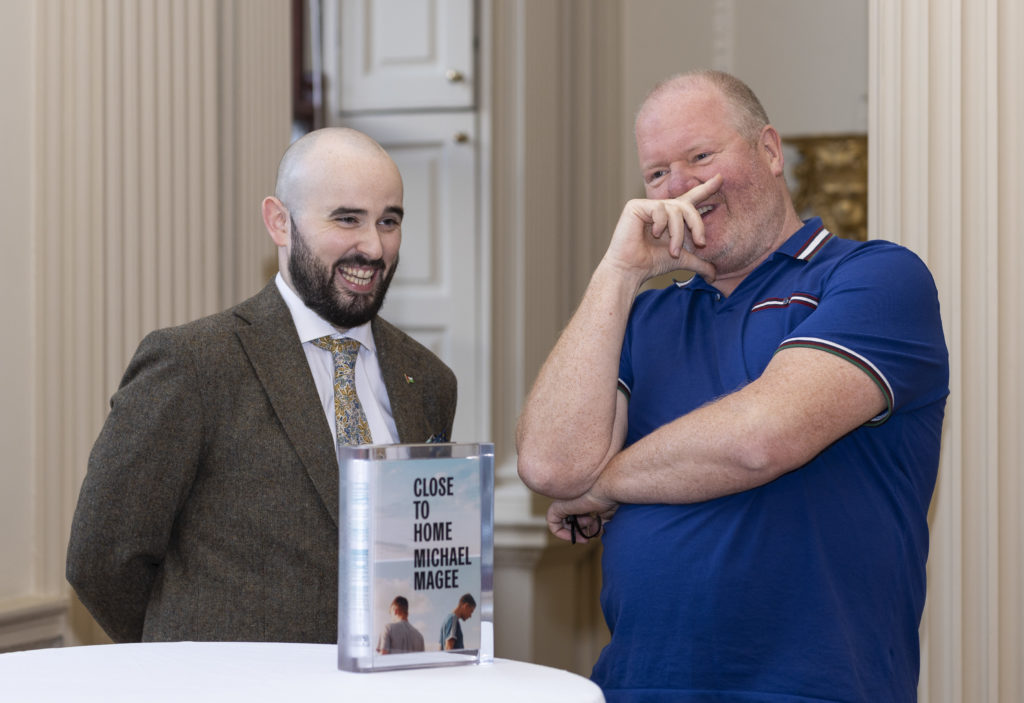 Michael Magee (left) pictured with fellow author Martin Doyle
He was born, however, in Hackney, east London, and grew up in Luton until his father decided in 1979 that he could not live in a country run by Margaret Thatcher, so the family moved back. The Troubles were at their height and an English accent was as popular in Ballybrack as Thatcherism was in the Howard home, so the move was unromantic.
"It was a really odd thing to be brought up in England and be told you were Irish – we went to St Vincent’s RC primary school in Houghton Regis; Mass every Sunday; all our parents’ friends were Irish – then to come to Ireland and to discover you weren’t Irish at all, you were looked on as something else," he told me in 2008.
"I have terrible memories of it. I remember seeing graffiti on walls saying ‘Brits out’ and my younger brother saying to my mother, ‘what are they going to do to us?’
"Then there was this strange language spoken in school. I didn’t know what anseo meant; I had no idea there was an Irish language. I remember looking at walls and seeing the Proclamation of Independence. It all looked a bit hostile to me; it felt like we had moved to a foreign country. We got bullied. I remember kids dancing round us singing, ‘what shall we do with the English bastards?’
"My first year in that school, I had a fight every week. These kids were eight or nine, and obviously just repeating what they were hearing at home. There was huge anti-English sentiment at the time, which is why when I hear people talk about anti-Irishness in England, I have another story to tell. Irish people are no different; there was pure hatred of English people, we all felt the sharp end of it."
Mike McCormack won the Dublin Literary Award for his masterpiece novel Solar Bones, which was adapted into an award-winning play. Like all his work, it is set in Mayo, where he grew up.
McCormack, however, was also born in London to emigrant parents from Mayo. At the age of three, having spent the summer with his grandparents on their farm in Doohoma, he announced he was staying — and he did.
"Isn’t that crazy? I lived with my grandparents and aunts on a farm in north Mayo. The older I get, the more vivid and valuable it becomes to me. My grandfather was a big hero. I followed him around like a lamb. He seemed to me to be a giant. I drew on it heavily in Crowe’s Requiem."
If he rejected London for Mayo aged three, it feels as if the metropolis was never on his wavelength either.
"Do you know, it’s funny: I’ve never worked with an English editor. Robin [Robertson at Cape] and Francis [Bickmore at Canongate] are Scottish. I don’t think English editors get what I do. When I did my fourth book with Lilliput, I found it really striking, the amount of things I didn’t have to explain or nuance. I realised before I’d been translating myself, continually in explanatory mode.
"It reminded me of an essay by Desmond Fennell: there is no such thing as Irish literature as long as we are trying to win the ear of Oxbridge graduates. He overstates the argument for effect, but he has a point. It was a smoother process again bringing Solar Bones to Lisa [Coen of Tramp Press, his publisher], who is from Cross, outside Ballinrobe. In retrospect, it was obvious that it had to have an Irish publisher."
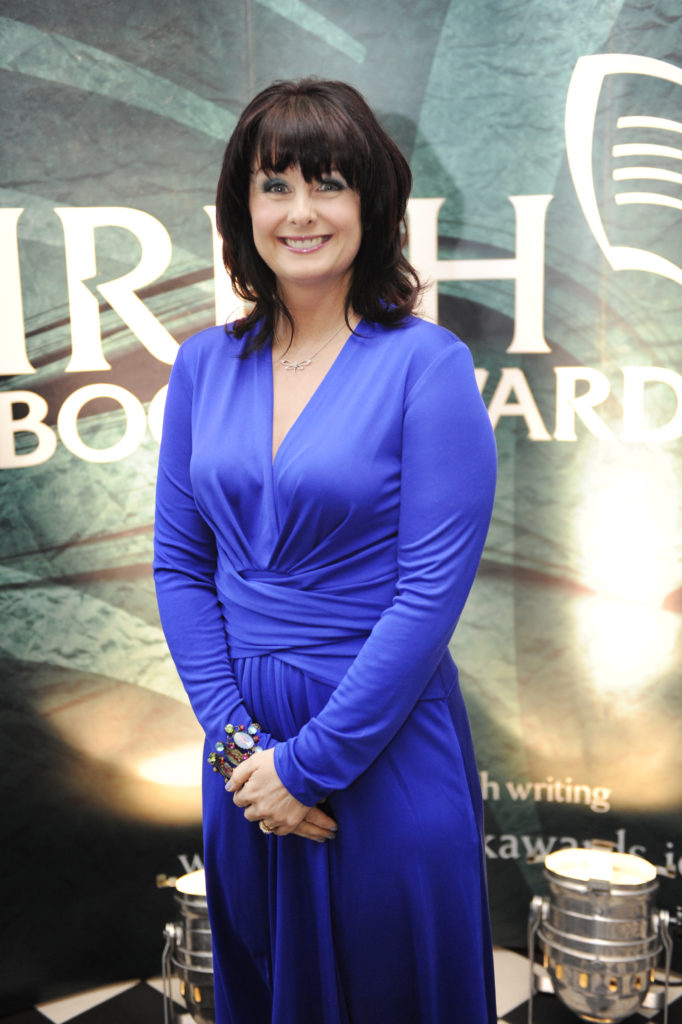 Irish author Marian Keyes began her career while living in London before moving home to Dublin
Marian Keyes believes she benefited from being an Irish writer in London, where she started out before moving home to Dublin. "It gives me a different perspective," she told me in 1997.
"I’ve been here for so long. I’m an outsider and I think outsiders write better because they have more distance. In another way, it puts limits because there are things I might write which an Irish audience would immediately recognise but which wouldn’t work here. I find that frustrating."
Desmond Hogan has an ambivalent relationship with both England and Ireland. "For many Irish people," he writes, "England, the country between Ireland and Europe, is a purgatorial world not unlike Lough Derg in Lovers of the Lake, ‘a sensation of the world’s death’."
"So many people choose to leave Ireland behind and they come here. It’s the basis for a lot of my fiction. People who didn’t fit in in Ireland leave only to run into a sea of anti-Irish racism over here. The real escape is to Europe or to the States, but there too there is loss and gain. What you lose finally, if you cut yourself off from the British Isles, is language — and that is a great loss.
"What I really fear about England is people like me who don’t conform to patterns have been reduced to digits. That is not to say that life here has no benefits. I like London. At best it leaves you alone and allows you your dignity, and allows you to live poorly without passing any judgement on you. That’s the wonderful thing about London: I don’t see myself as a writer at all. Last week in Dublin, I was a writer, but here you’re a brick in the wall."
Anna Burns left Belfast for London to get sober. After winning the Booker Prize for Milkman, she moved home, settling in the Antrim coastal village of Cushendun. "England is getting more and more authoritarian. I thought if I don’t go, I might not get out; I don’t feel safe here. I wanted to get back to my family, my sisters in particular."
The late poet Paul Durcan spent several years in London. England had been good to him and, speaking during the IRA’s bombing campaign in London, he was angry.
"Like many Irish people, I feel helplessly angry with what the IRA do because London was a home to me when I had nowhere else to go. It gave me work — work which I wouldn’t have got back in Ireland. I worked in the London Planetarium, where my official job title was Stellar Manipulator — I was the guy who flung the stars up on the ceiling — and here I was married and here my children were born. This country has been home to thousands and thousands of Irish people."
Martina Evans, the Cork-born poet and author, was taken aback by anti-Irish prejudice in London.
"It was a shock to come over and find it mightn’t be the best thing in the world to be Irish, having been used to Australians and Americans coming up and telling you that you were wonderful. Working in the Royal Northern in the casualty department, and meeting people who were around in the 1950s, you hear how the black Marias would be lined up outside the Gresham ballroom. To stay or go is a constant question for us."
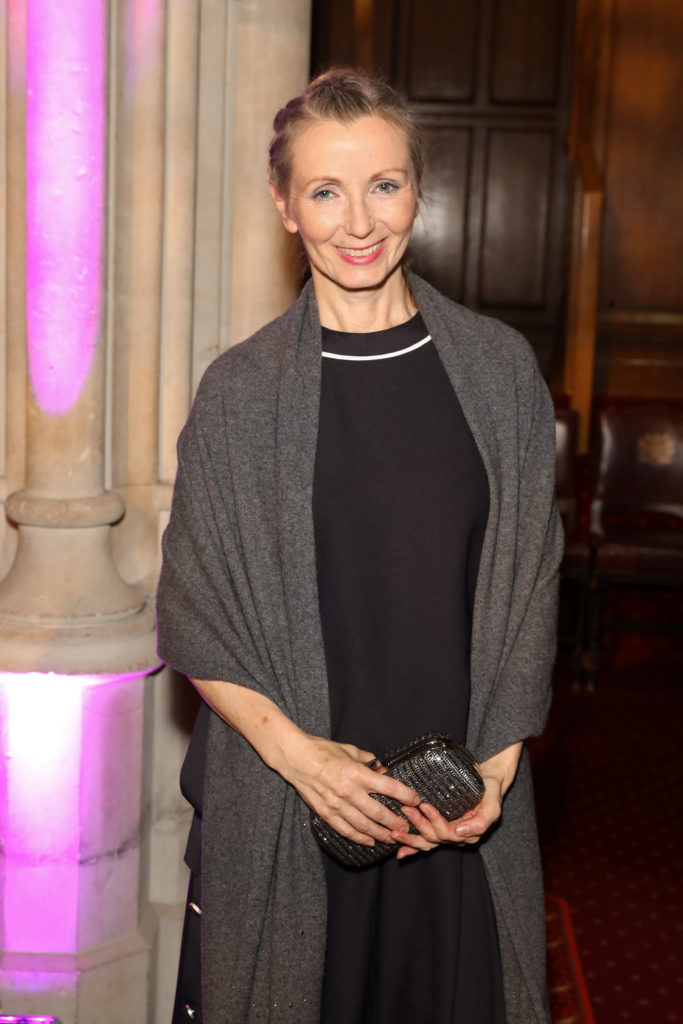 Author Anna Burns left Belfast for London to get sober
Historian Roy Foster believes Brexit has traumatised Anglo-Irish relations.
"If you’d asked me that before June 2016 I’d have given a very upbeat answer. The late Queen’s Irish visit crystallised that the past had been got over. Brexit has been one of the great shocks and horrors of my life and for many of my generation. What it did to Anglo-Irish relations has been uniformly deleterious. I cannot believe that people as mentally challenged as Theresa Villiers and other secretaries of state could have campaigned for Brexit saying it would make no difference for Northern Ireland. Anyone with a titter of wit could have seen what a disaster it was going to be. The condescension and crudeness and ignorance with which the Boris Johnson raft of politicians, such as the abysmal Lord Frost, treated Ireland over Brexit was a sobering shock. The damage will take a very long time to repair. I felt very antipathetic; the worst of England seemed to have taken over; the scum had floated to the top of politics. There was a nasty anti-foreigner racism."
Josephine Hart, the late author of Damage and Sin, who was married to Maurice Saatchi, felt comfortable in the English capital.
"My identity is profoundly Irish — I’ve never changed my passport, I’ve never changed my name — but I love living in England. That has never been a compromise. I have enormous admiration for English society. I admire its tolerance, its very slow-burning fuse. But I have great criticisms as well.
"We have a society in Ireland that is one of the most articulate in the world — a word society whose entire artistic, indeed psychological life is built on communication. And you have this reticent, reserved society here, and yet we singularly fail in Ireland — and I’m talking about the whole of Ireland — to solve our problems through communication. But I am very proud to be Irish and I do a lot of work for the Ireland Fund of Great Britain."
Eugene McCabe was born in Glasgow and brought up there until the age of ten — a world away from the drumlins and dunghills of Monaghan. McCabe’s grandfather John McMahon was one of the richest men in Scotland, owner of the biggest greyhound racing stadium outside London and chairman of Clyde football club. The family had a holiday home in Clones and, when the Second World War broke out, decided to stay in Ireland, changing the course of McCabe’s life. But his Scottish birth did give him an invaluable starter’s kit for a writer — the outsider’s perspective.
"I think it gave me a very objective, dispassionate view of the country," he told me.
It surprised Garry Hynes, one of Ireland’s leading directors, to discover that the local talent she thought she had discovered in Galway after reading Martin McDonagh’s Beauty Queen was born and bred in south London. McDonagh’s mother is from Sligo and his father is from Lettermullen in Connemara, where they have since retired, but his experience of Ireland had been restricted to summer holidays, yet he demonstrates an intimate knowledge of the speech patterns and social details of the West of Ireland. It was a subconscious process of absorption, he insists, unlike Synge eavesdropping on servants.
McDonagh explains the attraction of Irish subject matter as the strangeness and theatricality of a language at once familiar and slightly foreign. He also likes the distance it offers him, writing at a remove. It must be odd that when you grow up, it’s your parents who move out and leave you the key of the door at twenty-one. He sees himself as neither English nor Irish — not proud, but happy to have the influence of both cultures.
"I don’t feel you have to pick and choose between them, especially in a playwriting sense. It’s good to be both and to be neither."
Catherine O’Flynn won the Costa Debut Novel of the Year Award in 2007 for What Was Lost, and grew up in "a weird Irish bubble".
"My parents were Irish, the primary school I went to, St Joseph’s — all the teachers were Irish, 90 per cent of my classmates were Irish, the priest was Irish and the parish was very Irish too. We were living in inner-city Birmingham but it was a very densely concentrated Irish immigrant area. By the time I went to secondary school in a different area it was a bit of a culture shock for me because people there thought I had an Irish accent.
"I never felt the need to be over the top about it, like some people do if they feel a bit insecure about their identity. I always just felt very comfortable that that was my background and who I was."
O’Flynn was only four at the time of the Birmingham pub bombings in 1974, but she remembers the after-effects.
"It had a personal resonance for us because one of the pubs that was bombed, the Mulberry Bush, my sister went there every week with a friend and, for whatever reason, at the last minute they didn’t go there, so it felt very close to home for my parents and my family.
"At the same time my dad ran a sweet shop; he had always had good relations in the area but, a short time after the bombings, he had one or two phone calls threatening him, which upset him quite a lot. I was reminded of it recently by the 9/11 situation, which led to suspicion of all Muslims. Then there were suspicions against every Irish person."
"In What Was Lost, I didn’t make a big thing about it but all the names were Irish because clearly that was the background she was coming from. There is a lot about loss in my books. I think that for anyone who moves from one country to another, like my parents, there is a lot of loss, of melancholy, of nostalgia. That affected my writing."
Martin Doyle is Books Editor of The Irish Times and a former Editor of The Irish Post. He is the author of Dirty Linen: The Troubles in My Home Place (Merrion Press, 2023), which was shortlisted for Irish Nonfiction Book of the Year, and A Hosting: Interviews with Irish Writers 1991–2025 (Lilliput Press, 2026). The book is available here.
Everything from irishpost.com and the print edition is available on the Irish Post App — plus more! Download it for Android or Apple IOS devices today.
