



HISTORY has its broad thoroughfares along which we plot journeys through the past and see the main lines of our backstory.
Feeding into the mainstream, there are always plenty of rivulets containing sidebar insights which can at times be as revealing as the grand narrative.
As we look back at it, we can see that early 20th century Ireland had two big stories.
One concerned the final ascent of the Irish Party towards its peak achievement with the passage of the Third Home Rule Bill in 1914.
The second involved the emergence of more radical forms of nationalism represented by Arthur Griffith’s Sinn Féin and, clandestinely, by the revival of the Irish Republican Brotherhood.
That era had its tributary nooks and crannies too, and one of those was the All for Ireland League which flourished politically between 1909 and 1918, and is the subject of an excellent study by Patrick Murphy, who is the founder of the Nottingham Irish Studies Group and Chair of the Nottingham Irish Centre.
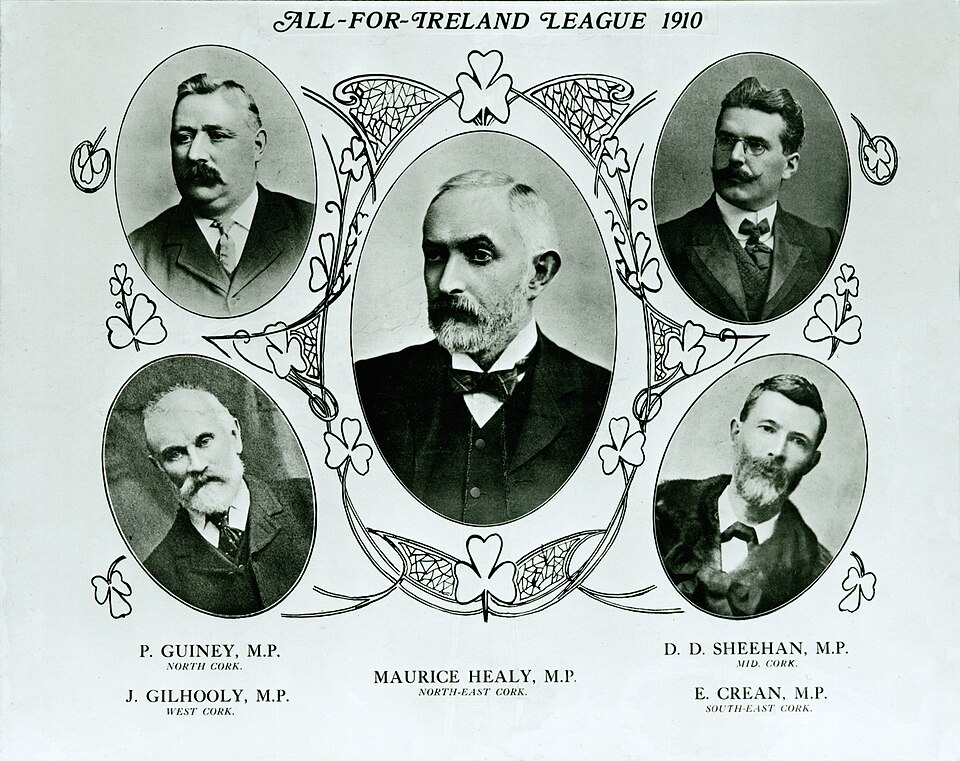 An All for Ireland League MPs poster from 1910
The book is based on his Ph.D. thesis at the University of Liverpool, the premier locus for Irish studies in Britain. It is good to have work of this quality appearing under the aegis of the Blair Chair of Irish Studies. It highlights the value of Irish studies in Britain.
The story goes back to the 1880s when Parnell’s star shone brightly and he gathered a coterie of younger allies around him. Tim Healy (1855-1931), John Dillon (1851-1927) and William O’Brien (1852-1928) were among the more active and effective members of Parnell’s team.
They all went against Parnell when the divorce scandal split the Irish Party in 1891, but O’Brien was the most reluctant of the three to break with their Chief.
Healy became Parnell’s most vituperative critic and was Ireland’s first Governor General while Dillon became the Irish party’s last leader.
O’Brien drove the setting up of the United Irish League in 1898, a mass membership organisation that spurred the reunification of the Irish Party in 1900 under the leadership of John Redmond.
O’Brien, for whom land reform agitation had always been a passionate priority, was heavily involved in the negotiations that produced the Wyndham Land Act of 1903 which began the transfer of Irish land ownership from the landlord class to tenants. O’Brien saw the conciliatory process that had helped deliver that Act as a model for the future of Irish politics.
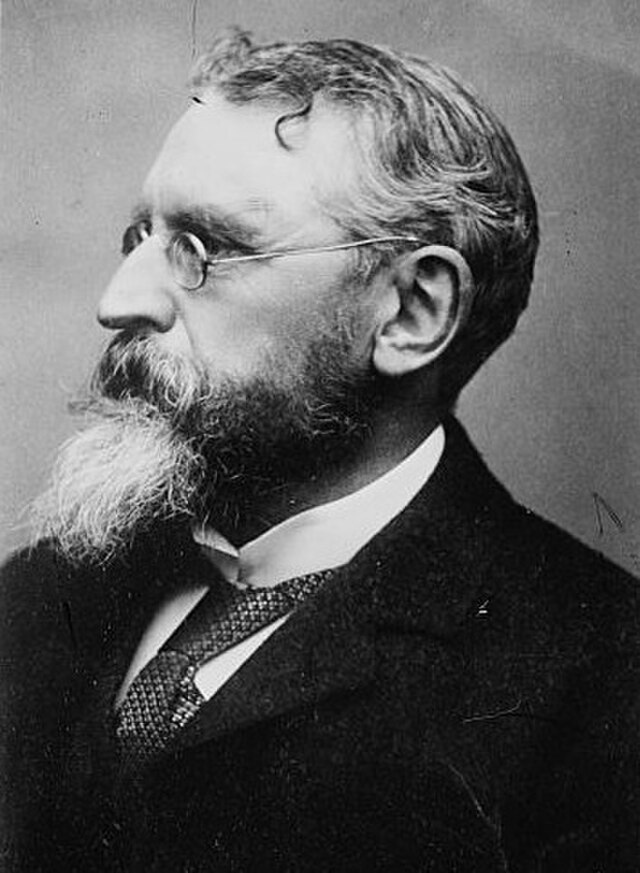 William O'Brien MP
O’Brien’s faith in the scope for conciliation with unionists was ultimately not shared by the leadership of the Irish Party.
O’Brien then left the Party, of which he became a rancorous critic. At that stage, his storied political career (an MP for all of two decades) looked to have come to a close, but it had a remarkable coda.
In 1909, he established the All for Ireland League (AFIL), which enjoyed a strong innings in Cork’s electoral politics, winning seats in both General Elections held in 1910, 6 seats in January and 8 of Cork’s 9 seats in December.
It also took control of local government in Cork, but made little headway in other parts of Ireland. The League inspired considerable passion and there were violent clashes at election time between supporters of the rival Irish nationalist parties in Cork city. Frank O’Connor brilliantly captures the intensity of this local rivalry in his short story ‘The cornet player who betrayed Ireland’.
Since the establishment of the Irish state, there has never been a regional party like the AFIL. Its success was down to O’Brien’s drive and determination, and his ability to draw on his French wife’s considerable wealth.
It was anchored too in a distinctive political culture in Cork with its prominent unionist community and a robust labour movement.
On the key issue of support for the British war effort in 1914, O’Brien took the same view as Redmond in favour of enlistment and that lost him backing in Cork where many of his supporters switched to Sinn Féin.
O’Brien saw the war as an opportunity to bring Irish nationalists and unionists together under a shared banner, but that was not to be. Like the Irish Party, the AFIL was swept away in the aftermath of the Easter Rising.
O’Brien joined the nationalist political consensus in 1918 in opposition to conscription, but by now his political race was run and he knew it.
A new political generation had emerged. The AFIL did not contest the 1918 election in which O’Brien endorsed Sinn Féin, which won all nine Cork seats.
He became a supporter of Dominion Home Rule but oddly he declined to join the Irish Convention of 1917, which was designed to explore the kind of consensual solution that he had been advocating since 1903.
Patrick Murphy has done readers a service by providing a lively and readable account of the AFIL and its charismatic leader. O’Brien’s belief in conciliation remains relevant.
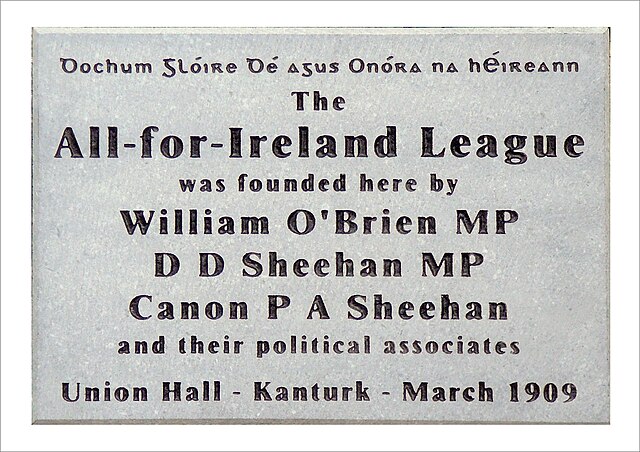 An All for Ireland League plaque in Kanturk, Co. Cork (Pic: Osioni CC-BY-SA-3.0)
If Ireland is to transition successfully to national unity, then some form of conciliatory effort will be required with regard to the unionist community.
O’Brien, who was a firebrand nationalist in his younger years, became a fierce champion of conciliation with landlords and unionists to the point of sundering a lifelong friendship with John Dillon who had been best man at his wedding. O’Brien had serious failings as a political leader.
Patrick Murphy describes him as messianic and thin-skinned, and quotes a description of him by the Liberal Chief Whip Alexander Murray as ‘an honest fanatic – a kind of Mad Mullah’.
In his concluding chapter, Murphy draws comparison between O’Brien and John Hume, a very different personality, who, fifty years after the demise of the AFIL, developed a similar belief in the possibility of breaking down the ‘partitions of the mind’.
He ends by quoting Hume’s acknowledgement of the difficulty of reaching out across deep political divides. ‘Its weakness is that it is not dramatic. Its virtue is that it is the only way.’ Indeed.
Patrick Murphy's The All for Ireland League: Conflict, Conciliation and The Banshee’s Kiss is published by Oxford, Peter Lang.
Daniel Mulhall is a former Irish Ambassador in London. His latest book is Pilgrim Soul: W.B. Yeats and the Ireland of his Time (Dublin: New Island Books, 2023)
Everything from irishpost.com and the print edition is available on the Irish Post App — plus more! Download it for Android or Apple IOS devices today.
