



The Donegal woman whose murder in wartime Scotland is finally being confronted
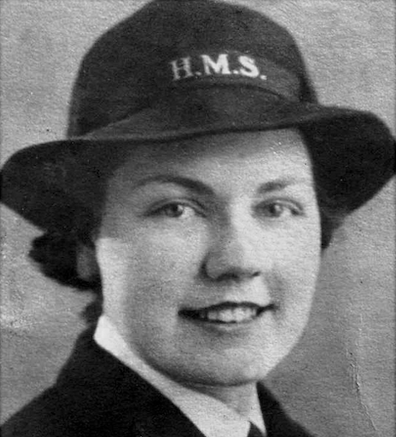 Gertrude Canning
WHEN the body of 20-year-old Gertrude Canning was discovered in a shallow ditch outside Inveraray in the summer of 1942, the shock rippled far beyond the quiet Argyllshire town. For her family in County Donegal, it was a moment of devastation that would cast a long, painful shadow for generations.
More than eight decades later, that shadow has been lifted by her nephew, Liam Canning, whose book A Wren for 99 Days brings together years of painstaking research into the killing of the young Irishwoman who had joined Britain’s wartime naval service in hope of doing her part.
Gertrude, known to family and friends as Gertie, was born and brought up in Donegal before moving to Britain for work. When the Second World War broke out, she enlisted in the Women’s Royal Naval Service — the Wrens — attracted, like many young women of the time, by a mixture of adventure, independence and indeed duty.
In early 1942 she was posted to HMS Quebec, a secret naval training base on the shores of Loch Fyne, near Inveraray, where Allied troops were preparing for the ill-fated Dieppe landings.
She had been a Wren for just 99 days.
On the evening of June 30, 1942, gunshots rang out across the wooded hills outside the town. In any other place they might have caused alarm, but Inveraray was surrounded by live-fire training camps and military exercises. Nobody raised the alarm. Five days later, locals discovered Gertrude’s body in a ditch near North Cromalt Woods. She had been attacked, sexually assaulted and shot.
The case stunned the town and baffled Scotland’s leading detectives. Chief Superintendent Robert Colquhoun of Glasgow Police was sent north to lead the investigation. Every .38 calibre weapon in the area was checked, but the trail went cold almost immediately when thousands of Canadian, American and British troops left Inveraray days after the killing to take part in Operation Rutter, the Dieppe raid in France. More than half were killed, wounded or captured. Many never returned.
Colquhoun later concluded that the murder weapon may have left Inveraray with one of the soldiers, perhaps killed on active service.
Back in Donegal, Gertrude’s family were left grieving, made all the worse because of all the unanswered questions.
The pain was so deep that the subject was rarely spoken of; it was a dark, dark secret.
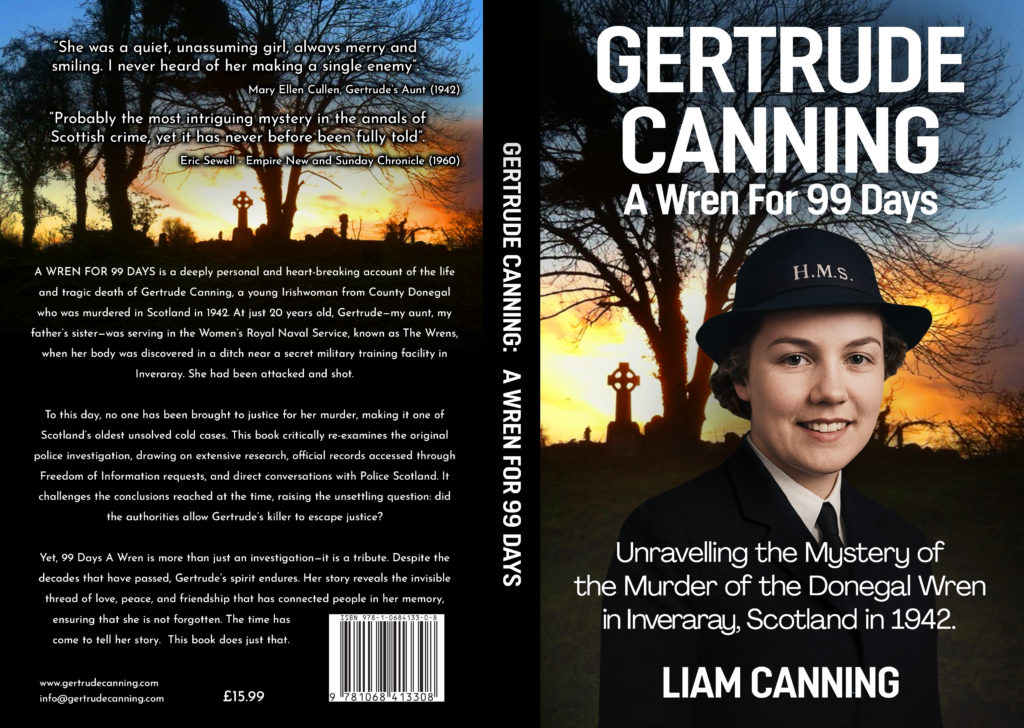
When Liam Canning was born in 1958, he knew almost nothing about his murdered aunt.
“I was grown up before I learned much about her,” he has said. “It was such a tragedy for our family that it was almost too painful to talk about.”
A retired social worker from Northern Ireland, Canning began quietly researching Gertrude’s death around 15 years ago. What started as a personal quest became a major historical investigation involving Freedom of Information requests, police records, military archives and interviews with retired officers and local historians.
“Carrying out the research to unravel what happened to my Aunt Gertrude has been a journey of discovery,” he says. “Not only for me, but for the wider Canning family.”
In 2012 his efforts led to a formal commemoration in Inveraray. The local Royal British Legion unveiled a memorial stone at the spot in North Cromalt Woods where Gertrude was found, and a bench was installed near the town’s war memorial overlooking Loch Fyne. For a young Donegal woman whose life had been cut short and largely forgotten beyond her family, it was a quiet but deeply meaningful act of recognition.
From there, Canning continued his research, uncovering long-overlooked witness statements, police notes and wartime records. He believes Gertrude was last seen walking along a country track towards the naval base, followed by a man. Her clothing had been ripped, suggesting a sexual attack, before she was shot and dumped in the ditch.
“If the horrific murder of my aunt had happened today, I believe there would have been a prosecution and conviction,” he says. “But back then, we were in the middle of a war. Very quickly, her case took a back seat.”
Canning now believes he has identified Gertrude’s killer as an English soldier attached to the Royal Pioneer Corps, a unit responsible for heavy labour around military camps. He says the man left the forces shortly after the murder and later spent time in a psychiatric unit. His book sets out the legal and historical case behind that conclusion.
Canning is careful to stress that the purpose of the project is not sensationalism but justice, however symbolic.
“This book is more than an investigation,” he says. “It is a tribute to my aunt. Gertrude may have been forgotten by the justice system, but she will not be forgotten by her family.”
The book also pays tribute to the people of Inveraray, who have quietly kept Gertrude’s memory alive. Every year the local Royal British Legion holds a remembrance ceremony at the memorial stone on June 28, and the bench by the war memorial remains a place of reflection for visitors and family members alike.
Canning says his family will always be grateful for that support. “The kindness shown to us by the Inveraray community over the years has meant more than they could ever know.”
A Wren for 99 Days is available online HERE
See More: Donegal, Wartime Crimes, World War II, Wrens
