





IF YOU come by the Rosslare ferry, you arrive at the outskirts of Tipperary and a sign declares: "Welcome to Tipperary. You’ve come a long way”. But you've still some way to go before reaching Galway.
On the Wild Atlantic Way, Galway is about an hour’s drive from Shannon Airport. Ireland West Airport Knock is also around an hour away by road. Or fly to Dublin and enjoy one of Ireland's finest cross-country drives, taking nearly three hours across the heart of the country.
As the song says: "From Bantry Bay up to Derry Quay, and from Galway to Dublin town."
Water surrounds Galway. There is the Atlantic Ocean, the broad River Corrib – the colour of Guinness, or peat if you prefer – flowing from Lough Corrib into Galway Bay. And, of course, there is a fair amount of water arriving from above.
Galway, or Gaillimh, is the largest city adjoining the Gaeltacht. Its name comes from the Irish Gaillimh, the river which formed the western boundary of the earliest settlement, Dún Gaillimhe.
Legend, however, tells a more romantic tale. The city is said to be named after the mythical princess Gailleamh, who slipped into the river and drowned. The first Galway Girl, perhaps.
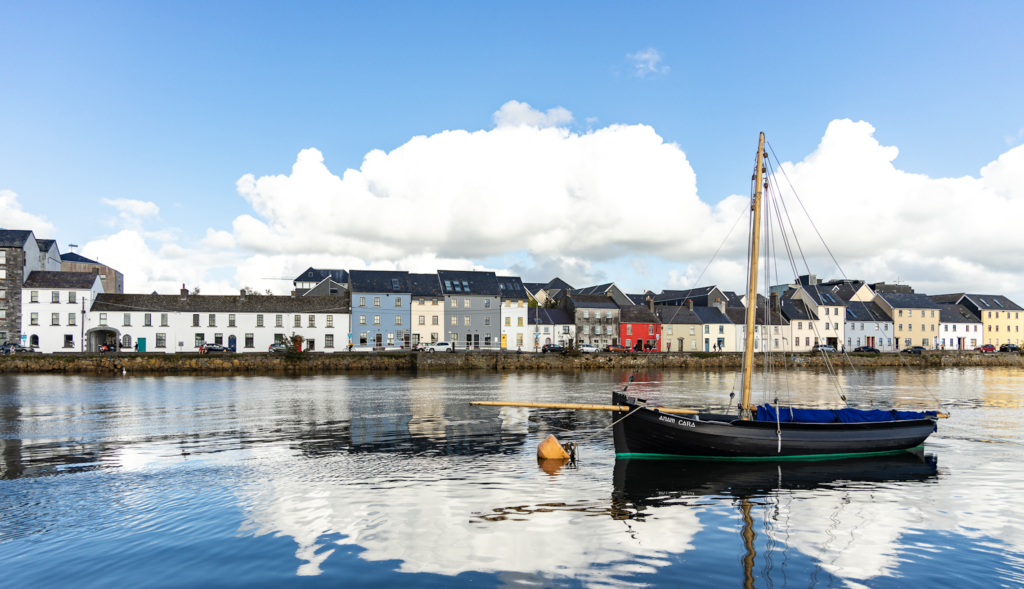 The Long Walk, Claddagh (Picture by Tiny Ark,Tourism Ireland)
Galway has been a maritime centre for centuries and has changed hands many times. The first fort was built in 1124 by the King of Connacht on what is now the quay area, although people had settled here long before that.
It seems very likely that Christopher Columbus called at Galway while sailing south from Iceland or the Faroe Islands, a common stopping point for mariners of the period.
By the Middle Ages Galway was ruled by 14 wealthy merchant families, most of them Anglo-Norman and many French-speaking. They became known as the Tribes of Galway, and their standards still fly above Eyre Square, today an Architectural Conservation Area and one of the city's favourite meeting places.
Sit beside the Quincentennial Fountain and admire the sculpture inspired by the brown sails of a Galway hooker. Then wander towards Bridge Street and you’ll likely spot one of these traditional fishing boats moored on the River Corrib.
At the northern end of Eyre Square stands the beautifully carved Browne Doorway, now fenced off for preservation. Dating from 1627, it once formed part of the Browne family residence, one of the Tribes of Galway. Confiscated during the Cromwellian period, it was later rescued and rebuilt in the square. The coats of arms commemorate the marriage of Martin Browne and Marie Lynch.
Romance and tragedy
ROMANCE lies at the heart of Galway, and nowhere more so than in the famous Claddagh ring. Jewellery and artwork inspired by its distinctive design can be found throughout the city, and visitors can even join the Claddagh Ring Experience to discover its fascinating history and symbolism.
The Claddagh itself, beside the river, was once a thriving fishing village. Stories differ about the ring's origins, but everyone agrees on the meaning of its famous symbols: the heart for love, the hands for friendship and the crown for loyalty.
President John F. Kennedy visited Galway in 1963 and addressed thousands gathered in Eyre Square.
"If you go down to the bay and look west, and your sight is good enough, you will see Boston," he joked.
Today a bust of Kennedy stands in the square.
The Irish-American connection has always been central to Galway's story.
Following the era of the Tribes, the city endured centuries of upheaval. Cromwell's conquest reached Galway, troops occupied the town and tradition holds that horses were stabled inside St Nicholas' Collegiate Church.
The Penal Laws brought further hardship, followed by the Famine of 1740-41 and then the Great Famine of 1845-50. Western Ireland suffered terribly from potato blight. Thousands died while many more emigrated, particularly to North America. Communities across the west took generations to recover.
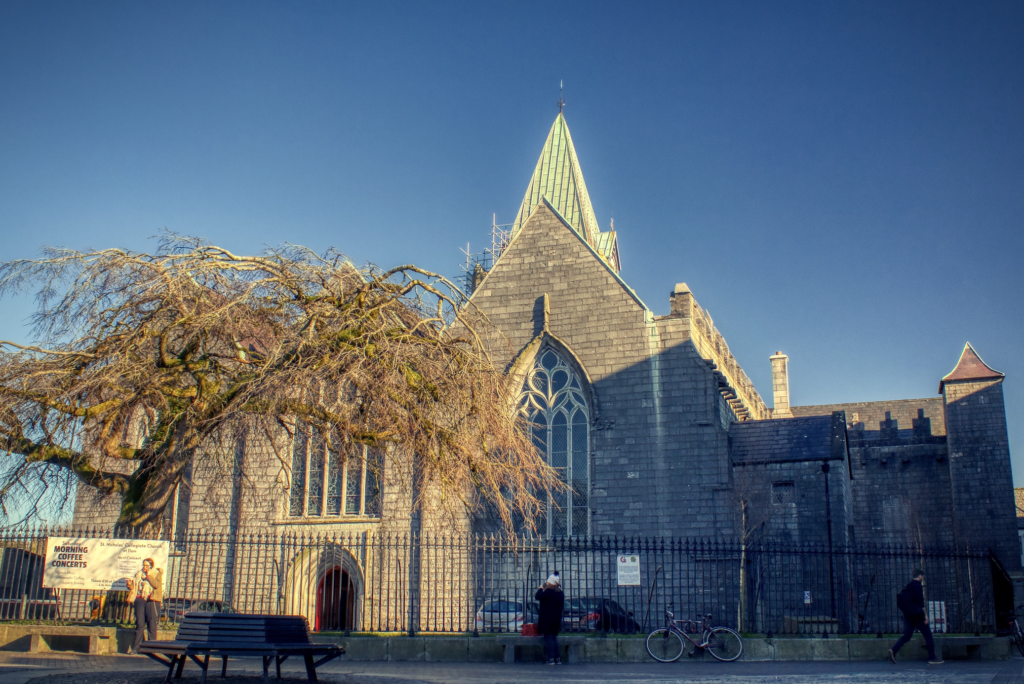 St Nicholas Collegiate Church Galway City (Pic: Tourism Ireland)
From the Gaeltacht to the Americas
COUNTY Galway contains one of Ireland's largest Gaeltacht regions, where Irish remains the principal community language.
Galway City is home to the University of Galway, Raidió na Gaeltachta and the Irish-language national theatre, Taibhdhearc na Gaillimhe.
Just west of the city lies the craft village of Spiddal (An Spidéal). Beautifully situated beside the sea, it is home to workshops where local artists create ceramics, paintings, woodcraft, glassware and jewellery. There is also an excellent Irish-language bookshop and a delightful café.
A Galway resident once told me the city is the best place in Ireland to live because "it has everything". It is hard to disagree.
You'll certainly never go hungry. From Sheridan's Cheesemongers near St Nicholas' Church to the cafés, pubs and restaurants of the Latin Quarter, Galway offers something for every taste. If fish and chips are your favourite, McDonagh's remains one of the city's great institutions.
St Nicholas' Collegiate Church has stood at the heart of Galway since 1320. Dedicated to St Nicholas of Myra, patron saint of seafarers, it is the largest medieval parish church in Ireland still in continuous use.
Tradition holds that Christopher Columbus worshipped here in 1477 before one of his Atlantic voyages. There is also a long-standing tradition that a Galway man sailed with Columbus on his first voyage in 1492.
The man is usually identified as William Harris (rendered in Spanish or Portuguese records as Guillermo Herries). Contemporary Spanish records include a crewman of that name among the men left behind at the ill-fated settlement of La Navidad in present-day Haiti. Some historians believe he may indeed have come from Galway, although it cannot be proved beyond doubt. Nor is there firm evidence that he was the first to leap ashore when La Pinta reached the Americas – a distinction that, if true, would make a Galway man the first European to set foot in the New World.
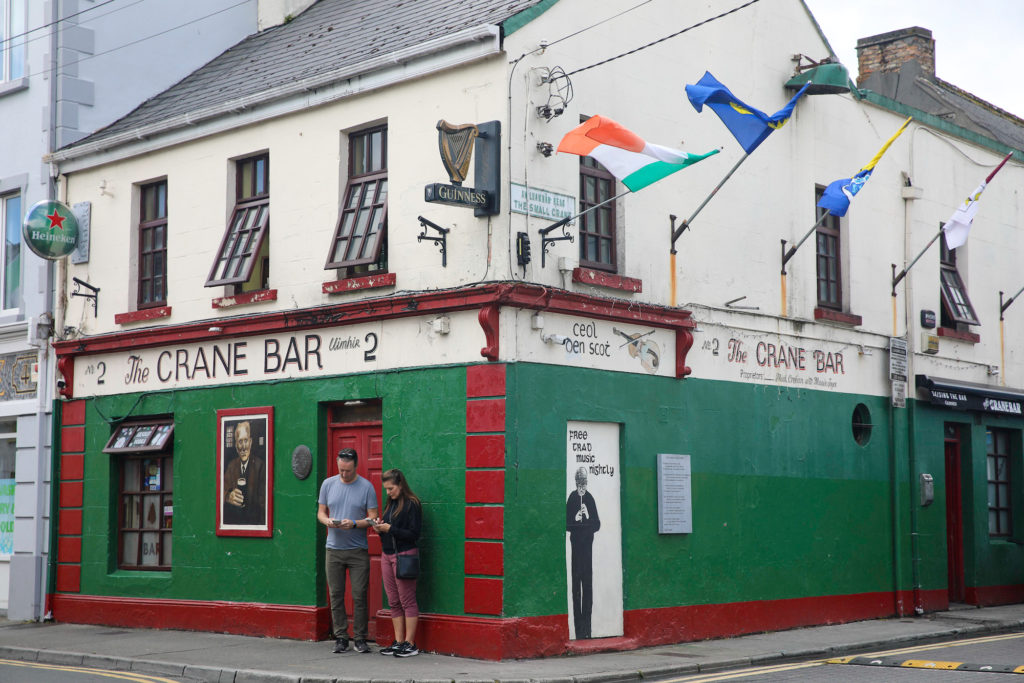 The Crane Bar (Pic: Tourism Ireland)
Quays, culture and craic
HEADING down to the quays, you'll pass beneath the Spanish Arch, one of Galway's best-known landmarks. Built in 1584 as an extension of the city's medieval walls, it protected quayside merchants and their valuable cargoes. Its name reflects the flourishing trade between Galway and Spain during the 16th and 17th centuries, particularly in wine.
Immediately behind the arch stands Galway City Museum, one of Ireland's finest free museums. It traces the city's story from prehistoric times through the medieval merchant era and the Claddagh fishing village to the War of Independence and modern Galway. Highlights include a traditional Galway Hooker, medieval artefacts and fascinating exhibitions on the city's maritime heritage. You’ll even find out why it’s called a hooker — in case you had any other theories, it’s ultimately from "hook and line" fishing, probably from the Dutch.
No visit to the city would be complete without a browse around Charlie Byrne's Bookshop, tucked away in the Cornstore. Holding more than 100,000 new, second-hand and antiquarian books, it is widely regarded as one of Ireland's finest independent bookshops. A favourite with readers and writers alike, it regularly hosts book launches, signings and literary events.
Founded in Galway in 1975, Druid became the first professional theatre company established outside Dublin. It has championed Irish playwrights for half a century and helped launch the careers of many leading actors, including Cillian Murphy, who appeared in its acclaimed 2004 production of The Playboy of the Western World.
Today, music is never far away. You can scarcely walk through the city centre without encountering buskers, while pubs throughout Galway host nightly traditional music sessions. Be sure to visit The Crane Bar, where musicians gather every evening. Climb the stairs to the upstairs bar and enjoy one of Ireland's finest traditional music venues.
And finally, where we began: the Galway Girl. Steve Earle's song has become something of an unofficial anthem for the city. No wonder. O'Connor's Famous Pub in Salthill became a global tourist attraction after appearing in Ed Sheeran's 2017 Galway Girl music video. Filmed with actress Saoirse Ronan, the video showcased Galway's lively pub culture and introduced millions of viewers around the world to the city's famous nightlife.
For more information on holidays in Ireland visit ireland.com.
Galway International Arts Festival
For nearly 50 years, the Galway International Arts Festival has transformed Galway into one of Europe's great cultural capitals, and this year's event promises another spectacular celebration of creativity.
Running from July 13 to 26, the festival brings together leading Irish and international artists for two weeks of theatre, music, opera, circus, dance, visual art and thought-provoking talks.
Highlights include world premieres, large-scale outdoor installations, the ever-popular Heineken Big Top concerts and the acclaimed First Thought series.
Since its foundation in 1978, the festival has helped launch new Irish work onto the world stage while attracting hundreds of thousands of visitors to the City of the Tribes each summer, cementing its reputation as one of Ireland's premier cultural events.
Everything from irishpost.com and the print edition is available on the Irish Post App — plus more! Download it for Android or Apple IOS devices today.
