





IN 1884, Michael Cusack became the founding father of the Gaelic Athletic Association, Ireland’s most successful cultural and sporting organisation, and among the most powerful amateur sporting bodies anywhere.
Cusack’s unstoppable drive and passion were behind the revival of hurling and other indigenous Irish sports at the end of the nineteenth century.
Born in Carron in the Burren region of rural west County Clare, Cusack’s first home, as with many historical places connected to famous Irish national figures – Michael Davitt’s baptismal church in Straide, County Mayo or Michael Collins’ birthplace in Woodfield, County Cork – was restored and reopened in 2006 to visitors. And yet Cusack remains a controversial figure within Irish history.
Mostly this is down to a single allegation that Cusack was the inspiration behind one of Irish literature’s most obnoxiously racist characters: James Joyce’s ‘The Citizen,’ the bigoted anti-hero ‘Cyclops’ in his classic novel Ulysses.
It was Joyce’s biographer Richard Ellmann who, in 1959, pointed the finger at Cusack as the man behind the one-eyed ‘Cyclops’ who throws a biscuit tin at Leopold Bloom. It is an allegation that has since been debunked, principally because despite Cusack having his own newspaper – Celtic Times – to propagate his prejudices, there is no evidence he ever voiced antisemitism.
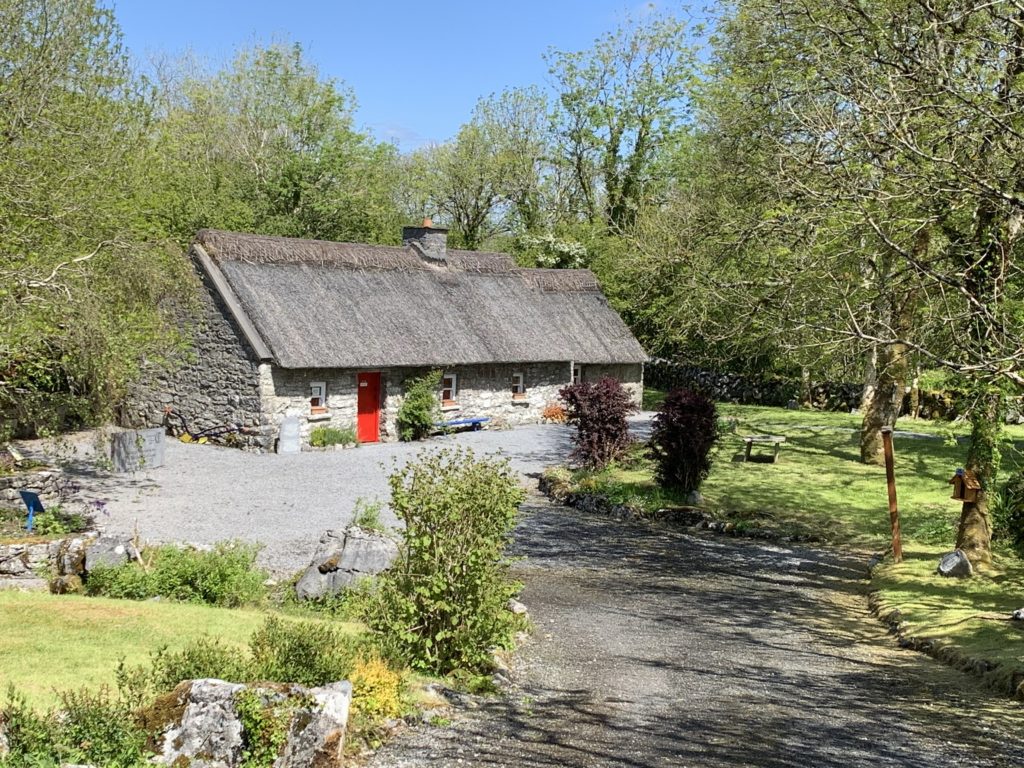 The cottage at the the Michael Cusack Centre, in Co. Clare (Pic: Michael Cusack Centre)
Cusack, like many, was a product of his time. Born at the height of An Gorta Mór in 1847, he was a highly intelligent child.
He was a school monitor at twelve, teaching the youngest infants in Carron National School, and would train as a teacher, working at schools including Blackrock College and Clongowes Wood before establishing his own academy in Gardiner Place, Dublin, to serve as a prep-school for the civil service.
By the 1880s, sport in Ireland was completely dominated by British codes. Cricket was already overwhelmingly the most popular summer sport, while rugby (IRFU founded in 1874) became the top winter game, taught at most prestigious Catholic schools.
Soon it was challenged by association football in the north-east of Ireland (IFA founded 1880), while a gentile version of hurling – ‘hurley’ – similar to hockey, was being promoted at Dublin University: it was played by Edward Carson as a student. Finally, athletics was run by an elitist Amateur Athletic Association (AAA: founded 1880) which denied the working labourer membership because it saw manual work as an unfair advantage.
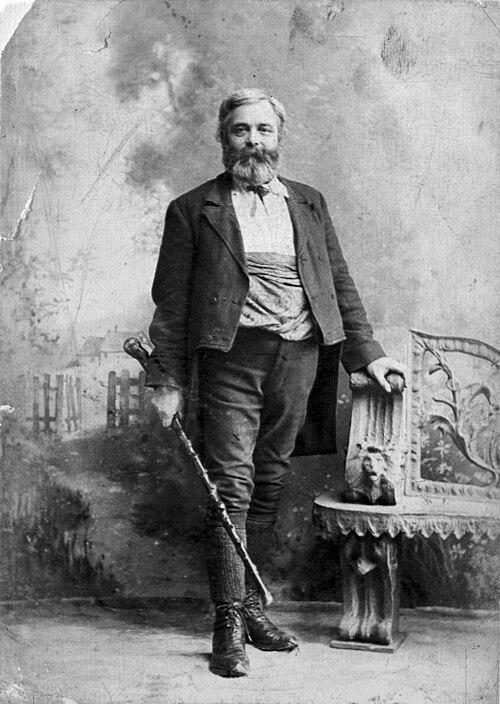 Michael Cusack (Source NUI Galway Digital Collections, in public domain)
Cusack was a superb sportsman. In 1881 he became Irish 16lb Shot champion with a throw which his biographer Marcus de Búrca claims was ‘better than the current British standard’. He played both cricket and rugby, introducing the latter to his academy.
He was also a committee member of the snooty Irish Champion Athletic Club, the forerunner to the AAA in Ireland. But as a nationalist – and suspected Fenian – he also wanted to revive the Irish games of hurling and Gaelic football while introducing an athletics culture for all Ireland’s people.
Writing in the nominally unionist Irish Sportsman in July 1881, he argued for a controlling body of Irish athletics, adding that while he was someone ‘trying to keep the platform of sport clear of the party spirit,’ he deplored how sport suffered, with what de Búrca called ‘each new political crisis in Ireland.’
To create a separate athletic organisation in an era of aggressive proselytising of British sports required the tenacious personality, energy and intelligence of Cusack: its achievement was nothing short of a miracle. However, Cusack was not an easy man to get on with.
Within eighteen months of the GAA’s foundation in 1884, he was kicked out of the organisation’s management. Things began with a spat with Archbishop Thomas Croke and ended with allegations of ‘neglect of his duties.’
The fact that the name of the cathedral of Irish sport was given to his clerical rival, while Cusack in contrast received a mere stand in 1938, is a reflection of how unkind history has been to him.
This poor reputation is reflected in the suggestion that ‘The Citizen’ is Cusack. Supposedly a combination of the Clare man and one of at least two other characters, the historian and biographer Frank Callanan has argued that the antisemitism of this ‘Cyclops’ reflected a larger general xenophobia: ‘He is a thoroughly, it might be said extravagantly, bigoted Irish nationalist,’ one whose dislike of Jews was more a ‘corollary of his blind nationalism’ and a ‘race hatred… securely fixed on the English’: the Jews were ‘marginal to the binarism that characterises’ his ‘anti-modern Irish nationalism.’
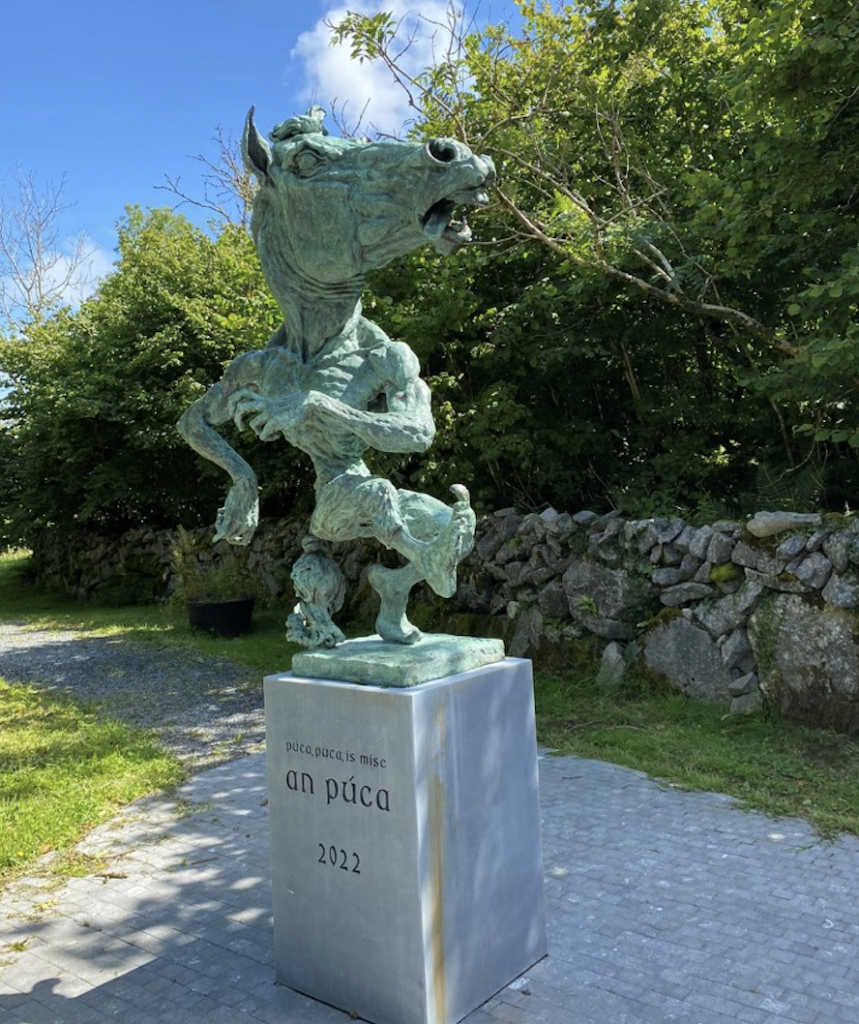 Púca at the Michael Cusack Centre in the Burren, Co Clare
In recent years there have been efforts to revitalise Cusack’s reputation. De Búrca, naturally, dismisses the depiction of Cusack as an ‘aggressive, morose, pugnacious, the worst for wear from alcohol by mid-afternoon’ buffoon, while Manus O’Riordan claims it was lamentable that ‘conventional wisdom’ views Cusack with ‘an unthinking reflex that simply concludes: “GAA bigot!”’ Even Gerald Goldberg, the Jewish former Lord Mayor of Cork, writing in 1982 on the centenary of Joyce’s birth, points out that the true antisemite of Ulysses was Garrett Deasy, who claimed that Ireland was unique in never having persecuted the Jews because ‘she never let them in.’
The Michael Cusack Heritage Centre wants to move away from this boorish image of Cusack. Tim Madden, who manages the museum with a small team of colleagues, describes it as ‘a national asset of intrinsic heritage value.’ He told me: ‘Visitors can experience aspects of our cultural, architectural, natural, sporting, archaeological, oral and mythological heritage first hand, while at the same time being immersed in the wondrous landscape of the Burren.’ A modern building welcomes visitors with a unique exhibition along with various ephemera of the man’s life and achievements, before visitors are invited down to the house where Cusack first saw light of day.
In the garden behind the cottage lies Aidan Harte’s controversial horse-style sculpture, An Púca, obtained by the Centre after being rejected by the residents of Ennistymon, County Clare, for being ‘hideous’ and ‘scary.’ Every October Bank Holiday weekend since 2022, three days (23–25 October 2026) are given over to hosting the Samhain (Halloween) Púca Storytelling Festival: ‘A vibrant annual celebration of folklore, myth and Irish cultural heritage,’ as Madden explains.
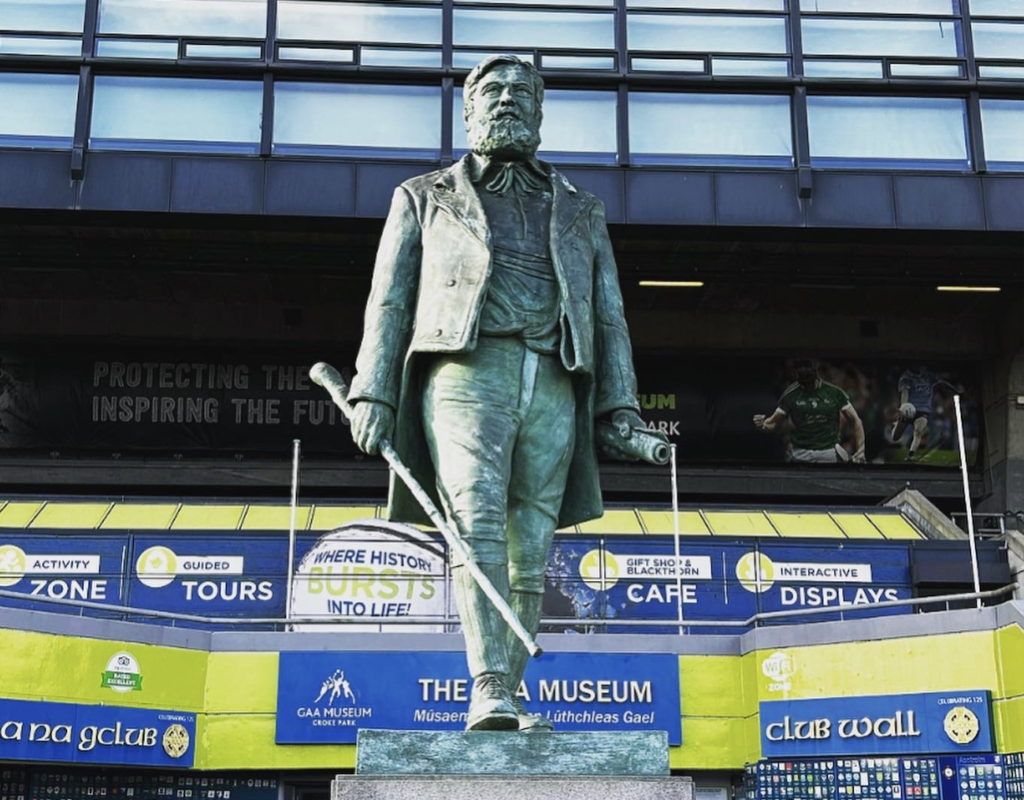 The Michael Cusack Monument at Croke Park Stadium (Pic: Fiona Fitzgerald for Fáilte Ireland)
The festival honours the ancient spirit of Samhain through storytelling, music, scholarship and community tradition, bringing together ‘renowned storytellers, performers, artists and scholars for an immersive and family-friendly programme rooted in Ireland’s living heritage,’ Madden continues. ‘Highlights include captivating performances by legendary storyteller Eddie Lenihan alongside interactive events for all ages.’
Proudly bilingual and fully inclusive, Madden adds: ‘Audiences will explore Samhain and Halloween through both academic insight and traditional customs, with events that celebrate folklore, ethnography, the Irish language and a strong sense of place. The festival continues to grow as a unique cultural gathering shaped by story, music, research and shared celebration.’
Madden also informs me that the centre gathers secondary school students on retreats through ‘an innovative, engaging and transformative wellbeing workshops programme.’ Students explore their ‘identity and values’ through themes titled: ‘Who Am I?’ and ‘Bend, Don’t Break.’ Into its sixth year, the programme has had over 3,000 students with aid from the Limerick & Clare Education and Training Board.
Such promotion of the virtues of sport is a clear nod to Cusack’s desire to extol the benefits of exercise. As the sporting academic Paul Rouse notes, Cusack believed in the power of sport to both physical and mental improvement, writing in Celtic Times in 1887: ‘No school or college should be without its gymnasium or its ball-alley and athletic grounds.’ Madden concludes that Cusack played an important role in Irish history: ‘It is now recognised that Cusack’s inspiration in founding the GAA was a sublime stroke of inspiration in 1884. No man did more to establish the organisation of Gaelic games, culture and lifelong participation.’
He adds that in addition to the GAA’s motto of ‘Where We All Belong’ the Cusack Centre is the place to come and explore: ‘Where it All Began.’
The Michael Cusack Heritage Centre is located at Poulaphuca, Carran, Co. Clare, V95 XT95, and is open Monday to Friday only, from 10:00 to 16:00 during the summer (closes at 14:00 in the winter). Prices are €8.00 per adult, €4.00 for children and €20.00 for a family of two adults and two children.
Information at: michaelcusack.ie
See More: GAA, Ireland, Michael Cusack
