



Though Aimée Madill now runs Phlox Books in East London, her story begins in Northern Ireland.
“I’m born and bred in Belfast,” she says, and all her family still live there.
Madill left Northern Ireland to study English at Trinity College Dublin before moving to London for a master’s at UCL.
What followed was a period of restless learning. Paris, New York, and eventually a return to London.
In Paris, she worked at the legendary Shakespeare and Company bookshop, staying for nearly two years to absorb everything she could.
“There’s no such thing as an internship for booksellers,” she says. “So I almost had to create one for myself: the good, the bad and the ugly.”
That immersion confirmed what she already suspected. She had no interest in the corporate end of the trade.
“The top of the tree in independent bookshops isn’t very tall,” she says. “Your option is to move into the commercial, the Waterstones, the Foyles, the Daunt Books, and I had no interest.”
Instead, she set herself a goal. Get the experience and open her own shop before she turns 30.
She succeeded, opening Phlox Books in 2017 at the age of 29.
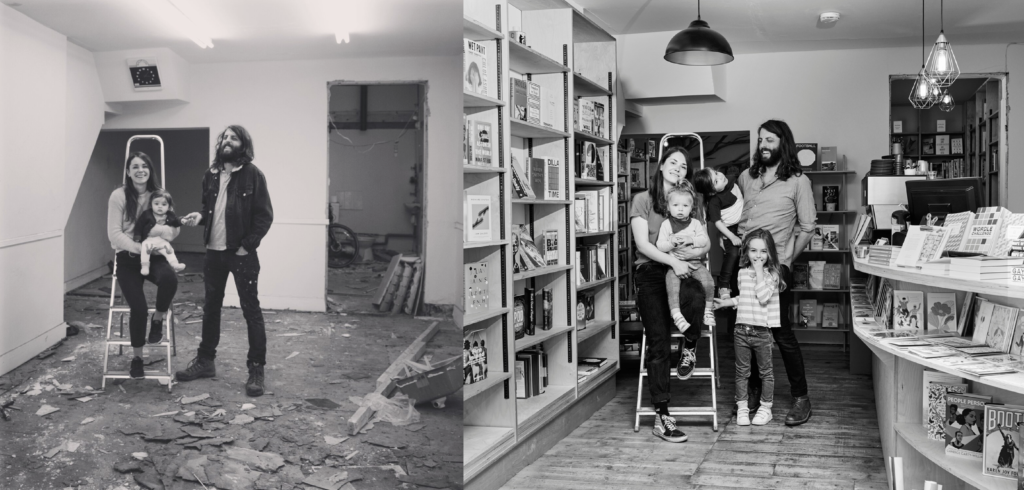 A before and after (Photo by Phlox Books)
The name Phlox carries its own history.
In the early 1980s, Madill’s parents opened a bookshop of the same name in Belfast. For its time, she says, it was radical.
“It was a sort of Scandi, early Conran. Ornaments, art books, furniture, décor, paper craft, all that sort of stuff.”
There was even a café serving cappuccinos and paninis, a novelty in early 80s Belfast. “That was wild,” she laughs.
The shop was right next to a police station on Donegal Pass and had three large glass windows.
“I get the impression that the windows went out many, many times,” she says.
Eventually, the pressure became too much, and her parents closed the business. All that remained was a single bookcase.
That bookcase now stands in Phlox Books in London, shipped over by her father. Madill also revived the original logo.
“New location, new generation, but it’s got the same roots and ethos.”
Books were always central to her life. “Growing up, reading was always a passion of mine. I’d maxed out the library by the time I was 10.”
“Schooling at that time in the North of Ireland, you were very much taught: get educated and get out.”
There was little sense then of a cultural industry you could build a living around, something she notes has changed dramatically in Belfast today.
Her reading tastes were shaped early by librarians who handed her Agatha Christie and P. G. Wodehouse, books she still thinks of as a comfort blanket.
Though many assumed she would end up in publishing or academia, she was drawn instead to the shop floor.
“The B to C of the bookshop was where I wanted to be,” she says. “I love the way books are consumed by people, but I also love the business side. The brand building, the bricks and mortar of it all.”
That philosophy underpins Phlox Books. Madill speaks passionately about what she calls the rarefication of bookshops.
Competing with Amazon on speed or price was never the point. “My job was to find the space that encouraged people to come and stay in the bookshop.”
When she opened, she had a four-month-old baby. “I could have gone to the pub with my child and put an iPad in front of them, or I could come to the bookshop and have a glass of wine with my friends.”
The shop was designed to be somewhere people would enjoy spending an evening in.
A central part of the Phlox experience, besides their coffee and wine menu, are the book recommendations, which Madill describes as both the most fascinating and frustrating part of bookselling.
Her staff, she insists, practise an underrated skill.
“It’s not just that they are well read; it’s that they know how to find books for other people.”
Rather than asking customers what they last read, they ask, “What’s the last book you want to feel like again?” Time, mood and emotional need are all factored in.
“It’s like a prescription,” she says. “When someone talks to me about what kind of book they want, it feels like a fruit machine going off in my head.”
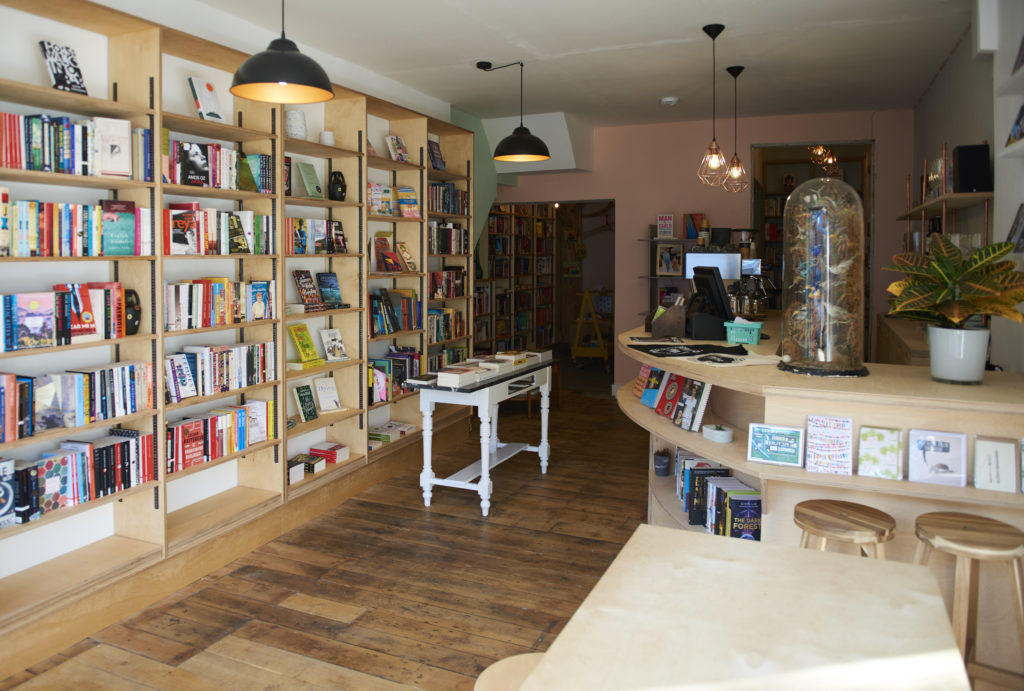 Proudly serving Books. Booze. Coffee since 2017 (Photo by Phlox Books)
Irish writing is still very close to her heart.
She has rituals like reading Joyce’s The Dead every Christmas Eve and enduring favourites like Elizabeth Bowen, Patrick Kavanagh and Seamus Heaney, whose lectures she attended while at Trinity.
She is particularly excited by the current talent coming out of Northern Ireland. Michael Magee’s Close to Home, she believes, “should be a seminal text for all young people.”
Of Aimée Walsh’s Exile, she says she could recognise unnamed Belfast clubs purely from the prose. “That’s how well written it is.”
Eight years on, and three children later, the business has evolved in ways she didn’t expect.
Rather than expanding to multiple shops, Phlox now does a lot of external work.
This includes building pop-up bookshops for festivals like Latitude and Wilderness and acting as the official booksellers for literary events like the Irish Writers’ Festival at the British Library.
Phlox also runs personalised book subscriptions, becoming such a hit that they were recently featured in the Guardian Gift Guide.
“The direction I thought I would have has completely changed,” she says. “But I love my contribution to the literary direction.”
Phlox, the plant name her parents chose decades ago, is said to symbolise hardiness, innovation and honesty.
In East London, with Belfast roots firmly intact, those values are still in bloom.
