



IRELAND’S reputation as a golfing country was built not in manicured resorts but along the ragged edge of the Atlantic, where fairways were threaded through dunes, as often as not guided by sheep paths, and players learnt to treat the wind as both adversary and accomplice.
Today, its most celebrated links attract golfers from across the world — and charge prices to match. But remote coastal courses, handsome inland parkland layouts to and friendly local clubs offer unforgettable rounds that can still cost less than your dinner.
Golf is usually regarded as Scotland’s gift to the world, although its precise origins remain disputed. The game may owe something to both Irish and Dutch traditions. One theory links it to shinty, the Scottish stick-and-ball which evolved from hurling.
Settlers from Ireland brought their language and culture to western Scotland during the early medieval period, and some historians believe players may eventually have begun striking balls across open ground towards distant targets.
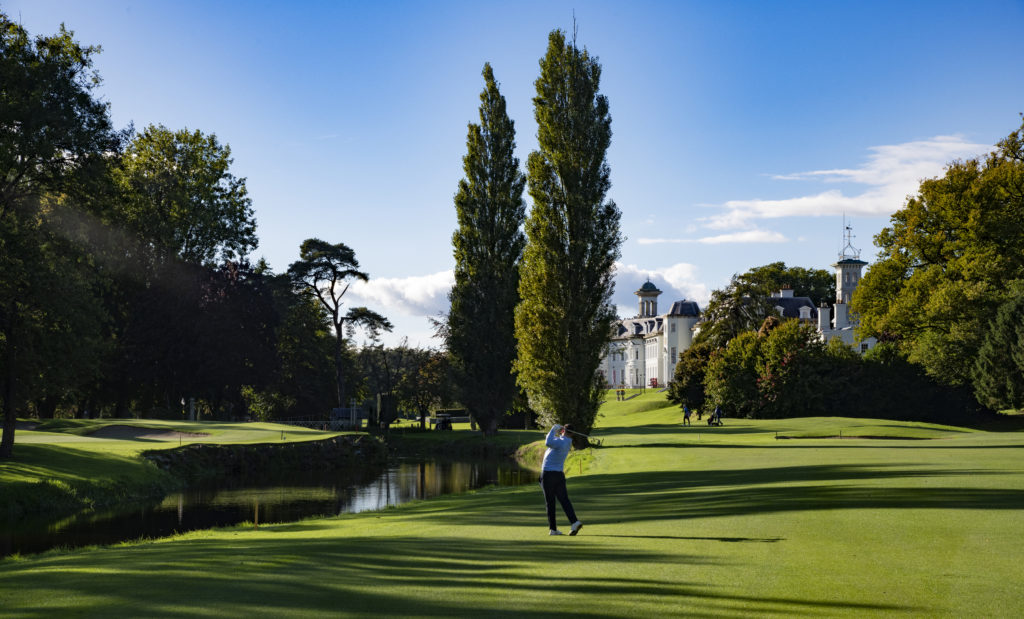 Golfers at the K Club in Kildare
Another possible influence was the Dutch game colf, in which players used a club to propel a ball towards a target, sometimes across fields or frozen waterways.
It was being played in the Netherlands by the late 13th century, at a time when Scotland had extensive trading links with the Low Countries. Kolf and, later, kolven developed from that Dutch tradition. So bang goes the theory that it was called golf because all the other four-letter words were already taken.
But we have to hand it to them: golf in its recognisably modern form developed in Scotland, and soon established itself as the only sport you play wearing a cardigan.
Royal County Down, Newcastle, Co. Down
Any discussion of Ireland’s finest courses inevitably begins at Royal County Down. Its Championship Course lies beside Newcastle, with the Mountains of Mourne rising behind it and Dundrum Bay opening out ahead.
The club was founded in 1889 after the railway helped transform Newcastle from a fishing village into a Victorian seaside resort. Old Tom Morris was invited to advise on the original course, reportedly for an expense of no more than £4. Subsequent work by George Combe and Harry Colt helped create the links encountered today.
The narrow fairways twist between dunes covered in heather and gorse. Blind shots and deep bunkers make local knowledge extremely valuable, while the wind can turn a perfectly respectable hole into something thoroughly intimidating. Even the bunkers have their own personality, fringed by long marram grass that gives them the appearance of untidy eyebrows.
To play at the Royal County Down course, you’ll need a low handicap and a deep pocket. A round can cost up to £450 — if you want to use a caddie, that’ll be quite a bit extra. Oh, and you’ll need to be properly dressed. Shorts, jeans and tracksuits for men are all out, and for women don’t even think about ‘short shorts, tee shirts without sleeves, or garments displaying logos’.
Royal County Down is consequently a once-in-a-lifetime experience for many visitors — but few who make the pilgrimage are likely to forget it. The bunkers are among the most severe and cunningly placed on any course in the world. And in case you don’t know: the definition of a bunker is a hole with just enough room for one angry man and his niblick. For Royal County Down, make that a very angry man.
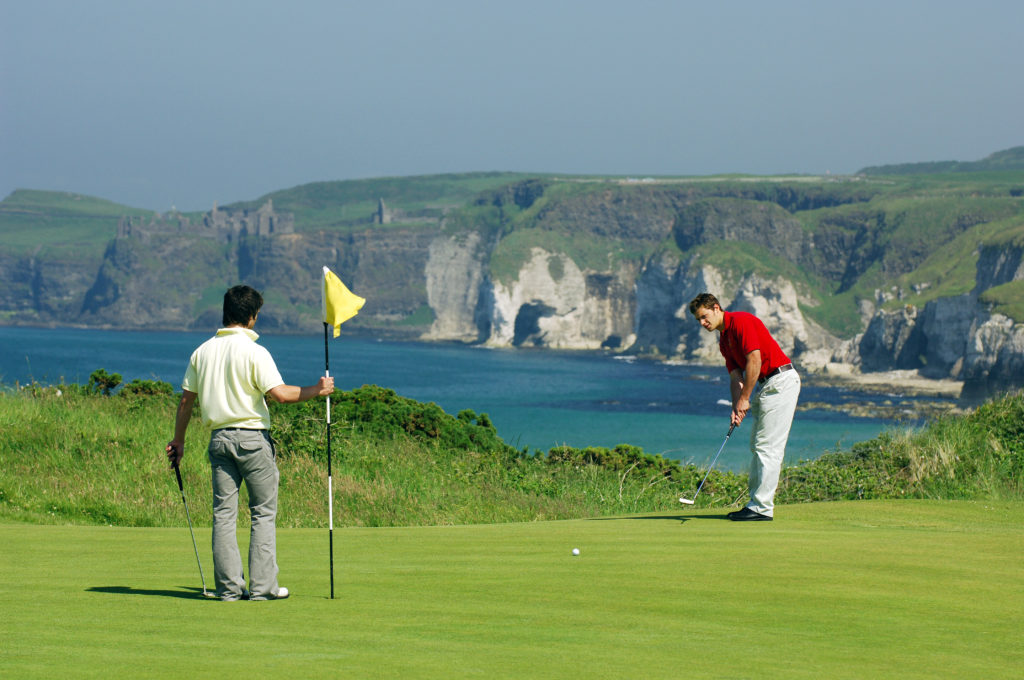 Royal Portrush Golf Course in Co. Antrim
Royal Portrush, Co. Antrim
The Dunluce Links occupies a triangle of enormous sandhills on the north Antrim coast. Harry Colt’s redesign, undertaken between 1929 and 1932, established the essential character of a course which offers views towards Donegal, the Skerries and, on a clear day, the Scottish islands.
Royal Portrush first hosted the Open Championship in 1951, when Max Faulkner won the Claret Jug. The tournament returned in 2019 and produced the result almost all of Ireland wanted: Shane Lowry winning his first major. When the Open came back again in 2025, Scottie Scheffler claimed the title.
The fairways at Portrush appear generous from some tees, only to narrow precisely where a good drive is expected to land. The fifth, White Rocks, runs towards the cliff edge, while the celebrated 16th, Calamity Corner, requires a daunting carry across a deep ravine.
This is one serious golf course.
Portmarnock Golf Club, Co. Dublin
Portmarnock links occupies a low peninsula north of Dublin. It has hosted the Irish Open 19 times, producing winners including Seve Ballesteros, Bernhard Langer, Ben Crenshaw and Ian Woosnam. It has also staged the Walker Cup and major amateur championships.
The course is often described as fair, although that should not be mistaken for easy. There are few tricks, blind drives or extraordinary bounces. Instead, its defence comes from superbly placed bunkers, changing wind directions and greens approached at awkward angles. Poor shots are punished; good ones are generally rewarded.
With Dublin Airport nearby, it is also among the most accessible of Ireland’s great links. You could leave Britain early morning and be on the first tee by lunchtime. But it won’t be a cheap day out — a round at Portmarnock costs €475. Oh, and the maximum handicap you’ll need is 28 for men and 36 for women.
Ballybunion, Co. Kerry
The opening holes of the Old Course provide only a partial indication of what lies ahead — and we’re not talking here about the graveyard that lies alongside the first hole. The links disappears into great folds of duneland, before rumpled fairways emerge beside the Atlantic.
The Old Course is now firmly on international golfing itineraries, and the cost reflects that standing. Its high-season visitor fee in 2026 is €450.
But worth it. On a blustery afternoon, when a low-running shot catches the correct slope and finds its way towards the flag, its reputation makes perfect sense.
That’s the thing about golf. No matter how mediocre a player you are, over 18 holes and, say, over a hundred shots, you’re bound to hit one perfect drive, one exemplary pitch, one unbelievable putt — one shot that makes it all worthwhile.
Lahinch Golf Club, Co. Clare
Golf was first played at Lahinch in April 1892. Old Tom Morris, a legendary name in golf design, subsequently laid out a new course among the sandhills, while Alister MacKenzie — later a designer of Augusta National — produced a major redesign in the 1920s.
Two holes inherited from Morris remain gloriously unconventional. At the fourth, Klondyke, the second shot must be struck over a high dune to a green which lurks unseen on the other side. The fifth, Dell, plays to another concealed green squeezed between dunes, with a marker indicating the day’s pin position.
Modern architecture tends to dislike blind shots, arguing that golfers ought to see the challenge in front of them. Lahinch replies, in effect, that a little mystery is part of the fun.
The rest of the Old Course supplies more than enough conventional quality to justify its lofty reputation. The wind off Liscannor Bay ensures that no two rounds are quite alike.
Lahinch is also unusual among elite courses in sitting directly beside a lively village. The 19th hole can therefore extend into several establishments without requiring a taxi.
Waterville Golf Links, Co. Kerry
Set on the Iveragh Peninsula between Ballinskelligs Bay and the surrounding mountains, Waterville possesses a particular sense of isolation.
The game was introduced to the area during the 19th century by workers involved in transatlantic communications. Formal golf was established by 1889, but the old layout fell dormant after changing technology reduced the importance of the cable station.
Its modern rebirth came in the 1970s, when Irish-born American businessman John Mulcahy helped develop a championship course designed by Eddie Hackett. Tom Fazio later carried out sympathetic improvements.
Waterville has attracted many leading golfers preparing for the Open Championship.
Payne Stewart developed an especially close relationship with the club and accepted its captaincy in 1998, the final golfing honour he received before his death the following year. A bronze statue overlooking the course remembers him.
Old Head Golf Links, Co. Cork
Old Head is the course to show someone who claims not to be interested in golf.
It occupies a narrow headland which extends for more than two miles into the Atlantic near Kinsale. Sheer cliffs fall away on either side, while the lighthouse marks ground whose history stretches far beyond the arrival of golf.
The course opened in the 1990s, making it young by Irish standards. Its creation involved brothers John and Patrick O’Connor, with several architects contributing to the finished layout.
Old Head is sometimes described as a luxury experience rather than a traditional Irish golf club, and there is some truth in that. The service, accommodation and sense of seclusion place it firmly at the expensive end of the market.
Yet it would be unfair to dismiss the golf as secondary to the scenery. Several holes run perilously close to the cliffs and require decisions about how much of the coastline to challenge. Wind can transform the course within minutes. Golf balls are replaceable; overconfidence may be rather more costly.
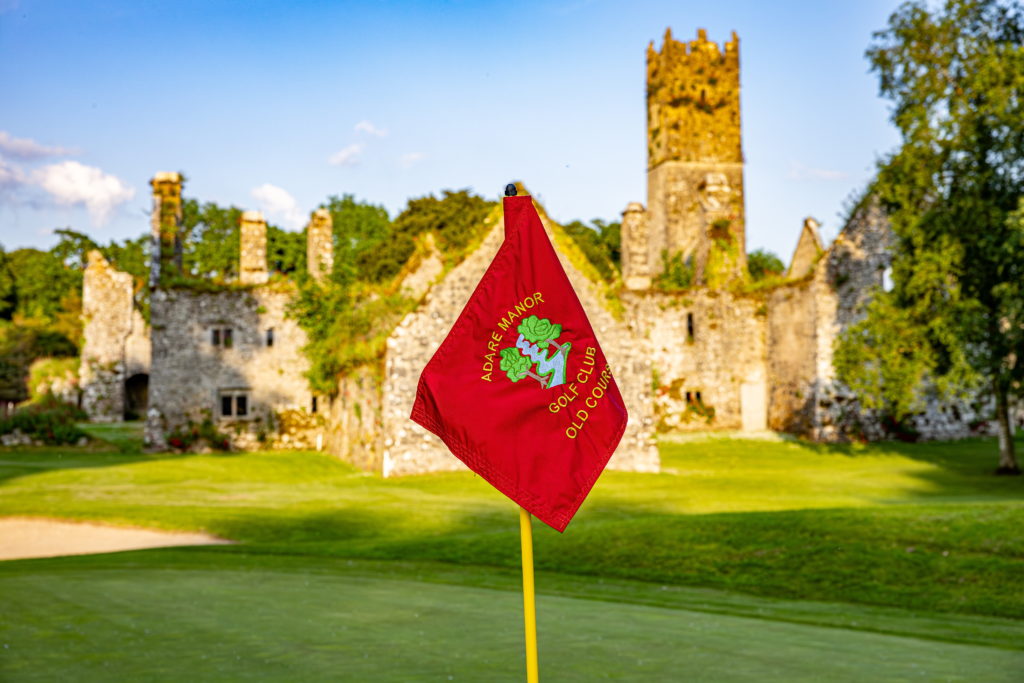 Adare Manor Golf Club
Adare Manor, Co. Limerick
Most of Ireland’s famous courses were shaped by sand, sea and more than a century of gradual change. Adare Manor represents something very different: a modern inland course reconstructed to stage golf’s biggest events.
American architect Tom Fazio redesigned the layout between 2016 and 2017. Extensive drainage, sand-capping and sophisticated green systems were installed to create exceptionally consistent playing conditions despite the Irish weather.
The course is set within a grand parkland estate, with mature trees, the River Maigue and the manor house replacing dunes and ocean as the visual accompaniment. It is immaculately presented, strategic and unapologetically luxurious.
In September 2027 it will host the Ryder Cup, bringing the contest back to Ireland for the first time since the K Club staged Europe’s victory in 2006.
The K Club, Straffan, Co. Kildare
Having once staged the Ryder Cup, this is a club to be reckoned with. Two courses boast flawless greens and meticulous course maintenance. However, just one wee word in your ear.
If your name is Hank or Jessie May and you’re reading this online from the comfort of your home in the USA, I’ve something to say to you. If you like parkland courses, this is the place for you. Forget about US parklands — the K Club is a fairway to heaven.
Carne Golf Links, Co. Mayo
Reaching Carne requires commitment. The course lies outside Belmullet on the Mullet Peninsula, far from the well-worn golfing circuit of the south-west.
Carne was the final design of Eddie Hackett, a big name in Irish golfing circles. He created or revised courses across the country. He worked with the existing landscape rather than imposing a design upon it, using natural sites for tees and greens and employing comparatively little earth-moving equipment.
The scale of the dunes is astonishing. Fairways climb, fall and twist between enormous sandy ridges, creating moments of exhilaration and occasional bewilderment. Carne now offers two principal combinations: the original Hackett routing and the Wild Atlantic Dunes course, which incorporates newer holes inspired by his early vision.
It is no longer cheap, but it remains less costly than Ireland’s most famous names.
Golfing tip: as this is on the west coast, wet weather isn’t unknown here. So quite often the most important club in the bag will be the umbrella.
County Sligo Golf Club, Rosses Point
This course combines great golf with one of the most recognisably Irish landscapes on this list.
Ben Bulben rises on one side, with Knocknarea and the traditional resting place of Queen Maeve visible on the other. From the elevated third tee, the panorama extends across mountains, sea and countryside associated with the poetry of WB Yeats.
The club was founded in 1894, while Harry Colt produced the basis of the present championship course in the late 1920s. It has been home to the West of Ireland Amateur Open since 1923, a competition closely connected with the development of many leading Irish players.
Rosses Point is less theatrical than Carne and less commercially celebrated than Ballybunion, but its design has enormous substance. Colt’s bunkering and angled greens reward strategic thinking, while the changing direction of the holes prevents the golfer becoming comfortable with the wind.
Cruit Island Golf Club, Co. Donegal
Cruit Island proves that a course does not require 18 holes, a famous architect or an enormous maintenance budget to become unforgettable.
Reached by a bridge from the Donegal mainland, it is a nine-hole links laid across rocky coastal ground. The holes are played twice from differing tees to produce an 18-hole round, but few golfers are likely to complain about seeing the scenery again.
The course is short by modern standards, yet length is largely irrelevant when the wind is blowing. Drives must be threaded between rocky outcrops, while approaches are played towards small greens with beaches, sea and offshore islands forming the backdrop.
Ballyheigue Castle Golf Club, Co. Kerry
Ballyheigue Castle is a nine-hole course laid out in mature woodland around the remains of an 18th-century castle. Its elevated position provides views over Ballyheigue Bay, Banna Strand and the surrounding north Kerry countryside.
The course opened in the 1990s and does not pretend to rival Ballybunion as a championship examination. Instead, it provides approachable, good-humoured golf in attractive surroundings.
The shorter format suits beginners, families or experienced players who simply want an enjoyable afternoon without turning it into an expedition.
Most strikingly, visitors currently pay €25 for nine holes or €40 to play the course twice.
That contrast captures something important. Ireland’s golf boom has brought investment, international visitors and global recognition, but it has also carried many famous courses beyond the reach of ordinary players.
Clubs such as Ballyheigue keep another tradition alive: golf as an accessible local recreation, followed by conversation in a clubhouse where nobody is especially interested in the size of your bank account.
Visitor fees and access arrangements vary according to season and should be confirmed directly with each club before travelling.
For more information on holidays in Ireland, visit ireland.com
Everything from irishpost.com and the print edition is available on the Irish Post App — plus more! Download it for Android or Apple IOS devices today.
