





“IF THE alpha male gorilla stands up and starts beating his chest,” the park ranger told our group, “nobody should respond by doing the same back to him.”
It was not quite the sort of travel advice you usually receive on holiday.
But then Rwanda’s Volcanoes National Park is not quite the sort of place where one has an ordinary day out.
My journey to see mountain gorillas in the wild began before sunrise in the northern Rwandan city of Ruhengeri.
After a short drive to the park registration centre and a briefing from armed guides, our group continued along rough mountain roads — what our driver Damascene cheerfully called an “African massage” — before setting off on foot into the forest.
Half an hour later we reached what I had travelled halfway across the world to see: a family of silverback mountain gorillas moving quietly through the thick vegetation.
Volcanoes National Park lies beneath the slopes of Mount Sabyinyo near the meeting point of Rwanda, Uganda and the Democratic Republic of the Congo.
Standing silently among the bamboo and forest growth, watching these enormous animals move calmly through their natural habitat, is an experience that feels both extraordinary and strangely peaceful.
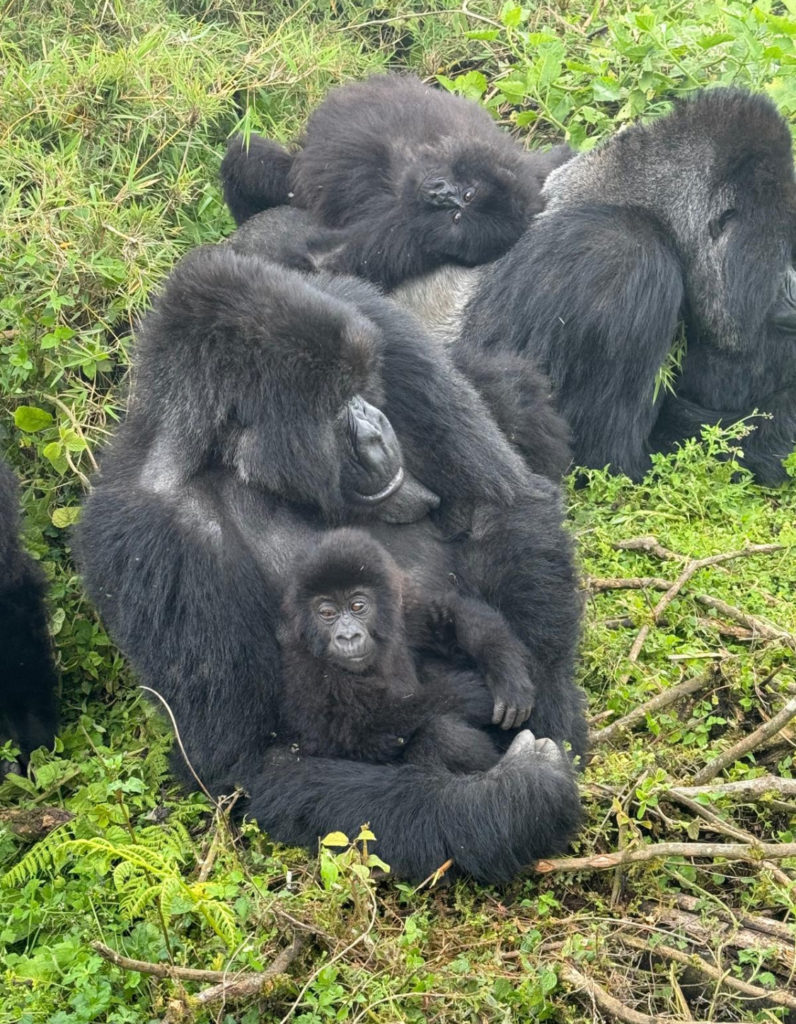 The family group
At one point a curious young gorilla pushed one member of our group gently aside as it passed.
A little later an adult female caught my eye as I took photographs, fixing me with a steady stare that grew steadily more intimidating. Remembering the ranger’s instructions, I quickly looked away.
Then the silverback rose.
For a moment he stood upright, beating his chest with a deep thudding sound that echoed through the trees before pushing his way through the dense undergrowth and settling again to chew bamboo in the morning mist.
There are few wild animals that allow humans to come this close. Certainly none of the other great apes possess the same confidence to treat people as little threat — neither attacking nor fleeing.
It is not only gorillas that draw visitors to this corner of Rwanda.
A popular additional excursion is an early morning visit to see the golden monkeys that inhabit the park. Slightly larger than Barbary macaques, these rare primates are lively, curious and entertaining to watch.
Animals, as the old saying goes, are unpredictable performers. But I was fortunate: despite travelling during the rainy season, the weather held and the park wardens had located a gorilla family within relatively easy walking distance.
The trek itself, though steep in places and occasionally interrupted by thorny branches or buffalo droppings, is manageable for most reasonably fit travellers.
It is not often we can genuinely claim to experience something “once in a lifetime”. Most pleasures in life are things we hope to repeat. But trekking gorillas in Rwanda comes close to that description.
The distance and expense alone mean many travellers will make the journey only once. Permits cost $1,500 per person and only ninety-six are issued each day.
During the rainy season, when I visited, conditions can be more challenging. Rain makes the jungle paths slippery and thunderstorms are common, although they usually arrive later in the day when most treks have finished.
Cheaper options exist in neighbouring Uganda and the Democratic Republic of the Congo.
Uganda’s gorilla parks are generally considered more physically demanding to reach, while the long drive from Entebbe can take up to ten hours. By contrast, Ruhengeri is about two hours from Kigali, making Rwanda’s treks relatively accessible.
No visitor to Rwanda can ignore the events that shaped the country’s recent history. The genocide of 1994, when hundreds of thousands of Tutsis and moderate Hutus were killed in just one hundred days, left deep scars.
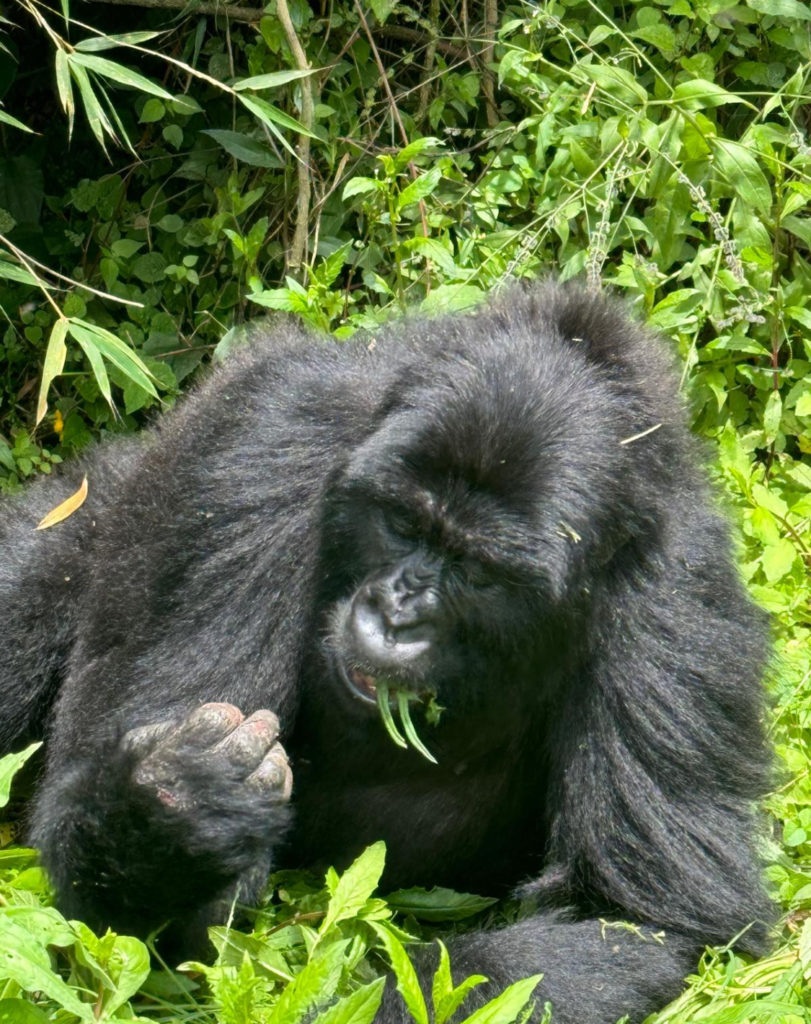 Time for a snack
Yet Rwanda today presents a very different picture from the images that once dominated international headlines.
President Paul Kagame’s government has focused strongly on rebuilding the country and developing tourism.
Around Volcanoes National Park, conservation has brought economic benefits to local communities.
Former poachers and villagers now run cultural initiatives such as the Gorilla Guardians Village, where visitors can learn about traditional customs.
About sixty miles south of Ruhengeri lies Kigali, Rwanda’s capital and the country’s main gateway.
The national airline, RwandAir, operates daily flights from Heathrow and Kigali has developed into an increasingly important hub for travel across Central and Southern Africa.
The city is also widely regarded as one of the cleanest capitals in the world. On the last Saturday of each month residents take part in a nationwide community clean-up known as Umuganda, sweeping streets and clearing rubbish.
Kigali offers a surprisingly varied food scene. American fast-food chains are rare, but Indian and Chinese restaurants are common in the city centre.
Near my hotel — the 2000 Downtown Kigali — I discovered the Pan-Afrikan Kitchen, a small and inexpensive restaurant serving excellent local dishes. One speciality worth trying is matoke, a green banana cooked either as a side dish or as part of a stew.
Kigali’s main visitor sites are inevitably connected to Rwanda’s modern history.
The Kigali Genocide Memorial offers a powerful and moving account of the events of 1994, commemorating the victims while documenting the causes and consequences of the violence.
Visitors can also see the Hôtel des Mille Collines, made famous by the film Hotel Rwanda, and the Belgian Peacekeepers Memorial.
Understanding that history helps explain the remarkable transformation Rwanda has undergone in the decades since.
Tourism is also expanding through sport. In a country where bicycles are commonly used to transport goods along steep hillsides, cycling has become part of everyday life.
The Tour du Rwanda, first held in 1988 and revived after the genocide, now attracts international competitors each year. Ireland’s Jesse Ewart finished third in the race in 2022.
For recreational cyclists, Rwanda’s well-maintained roads offer spectacular scenery across what is often called the “Land of a Thousand Hills”.
For visitors arriving in Sub-Saharan Africa for the first time, Rwanda is a relatively straightforward introduction. Visas are issued on arrival for $50, English is widely spoken and the country is generally safe for travellers.
Malaria is present, as in much of Central Africa, so preventative tablets and insect repellent are advisable. Unlike some other African destinations, yellow fever vaccination is only required if arriving from an infected country.
But for most travellers, Rwanda will always be remembered for that moment in the forest — when the silverback rises, beats his chest, and reminds you whose world you have briefly stepped into.
For more details: https://www.tourdurwanda.rw
