




FIRST, A confession: I have never liked cycling.
Even when I was a fit-as-a-fiddle teenager who ran like a hare and played football three times a week, a bike was always an alien beast on which I felt like a crumbling mess before I had travelled a couple of painful miles.
Maybe, as some experts have concluded, I’m one of those unfortunate people whose physiology has never been suited to the continuous pedalling mechanics and bent-over positioning needed in the saddle.
Yet e-biking has changed everything. In recent years, those little rechargeable motors have propelled me, like a nuclear-powered Eddy Merckx, up twisting hills in Luxembourg’s ‘Little Switzerland’ and through fearsome Atlantic gales in northern France. No more agonised muscle straining. Just scenery-gazing with a fixed smile – instead of struggling along with a tortured grimace – hour after blissful hour.
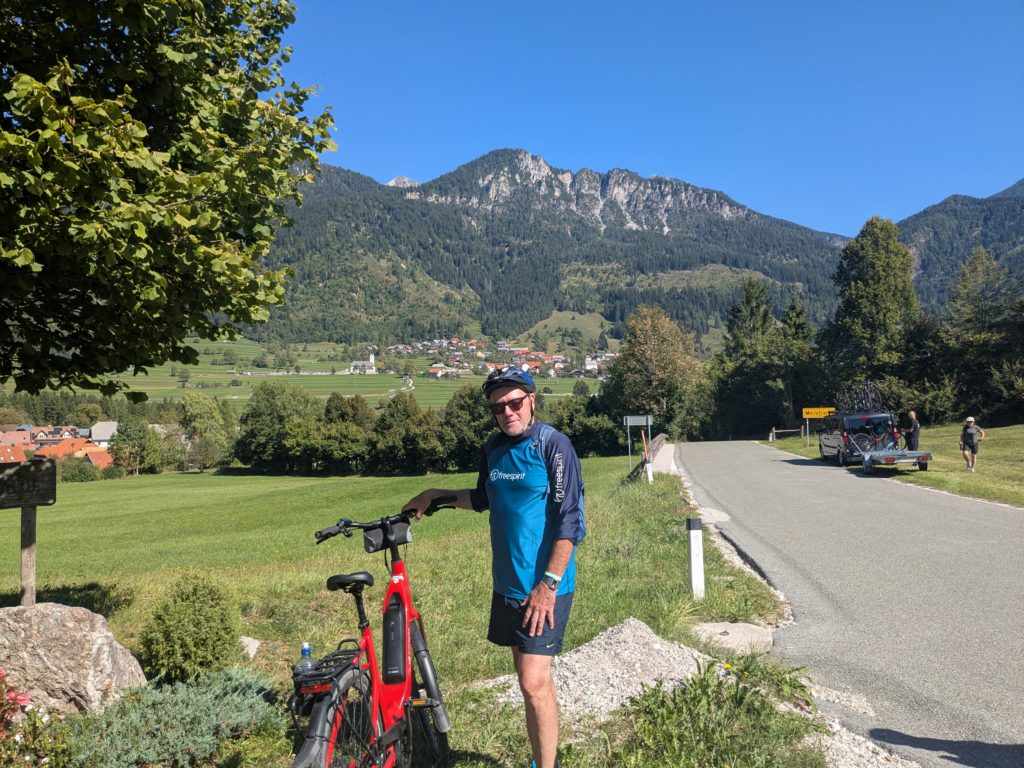 James with his e-bike during a well-earned rest stop
And that was the exciting prospect as I arrived at the very welcoming Ljubljana Airport for a whole week of electrically powered biking round a country about one-twelfth the size of the UK that felt as enthralling as the model village I had gawped at on holiday in Skegness as a child in short trousers in the 1960s.
Here was a relatively tiny land with a population about the size of Northern Ireland that, like a relaunched Barry McGuigan, punches well above its weight everywhere you look.
The last time I came close to a visit was in 1992, when I was a young journalist staying just over the border in the Croatian spa town of Lipik, which had been battered to rubble by the fierce fighting that accompanied the break-up of the old Yugoslavia.
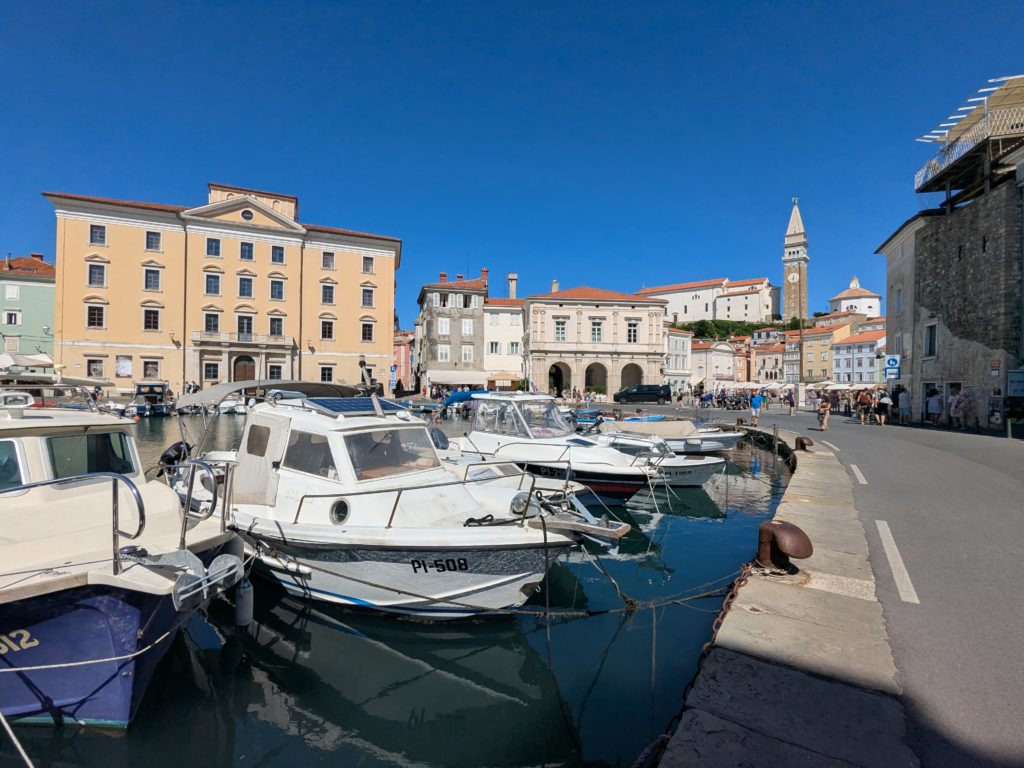 Harbourside in Piran, the medieval resort on the Adriatic
Slovenia had declared independence in June 1991. After the so-called Ten-Day War, it emerged from Yugoslavia’s break-up and set off on the road to today’s EU-centred democracy.
As I travelled over the next two years through the genocidal madness that ripped the heart out of Bosnia and Croatia – even surviving three visits to besieged ‘murder city’ Sarajevo – I often wondered how little Slovenia had escaped so much of the mayhem. I began to get a sense of the country when I met my airport driver.
Here was a widely travelled man in his sixties who spoke perfect English and had a deep understanding of the world and its politics. Our half-hour chat covered everything from basketball and symphony orchestras to Putin and Trump (coincidentally, Melania grew up in the country’s small industrial town of Sevnica, where the local bakers’ First Lady Cake is an apparent hit with tourists).
He was the epitome of one aspect of Slovenes that I soon came to appreciate: they like to compete and to win, and have welcomed strangers (many of them invaders) for centuries for all the goodies they bring. And why not? As several told me over the coming week, ‘visitors’ have left behind some great roads (the Romans), wonderful architecture (the Habsburgs), railways, bridges and mountain passes (Austro-Hungarian engineers).
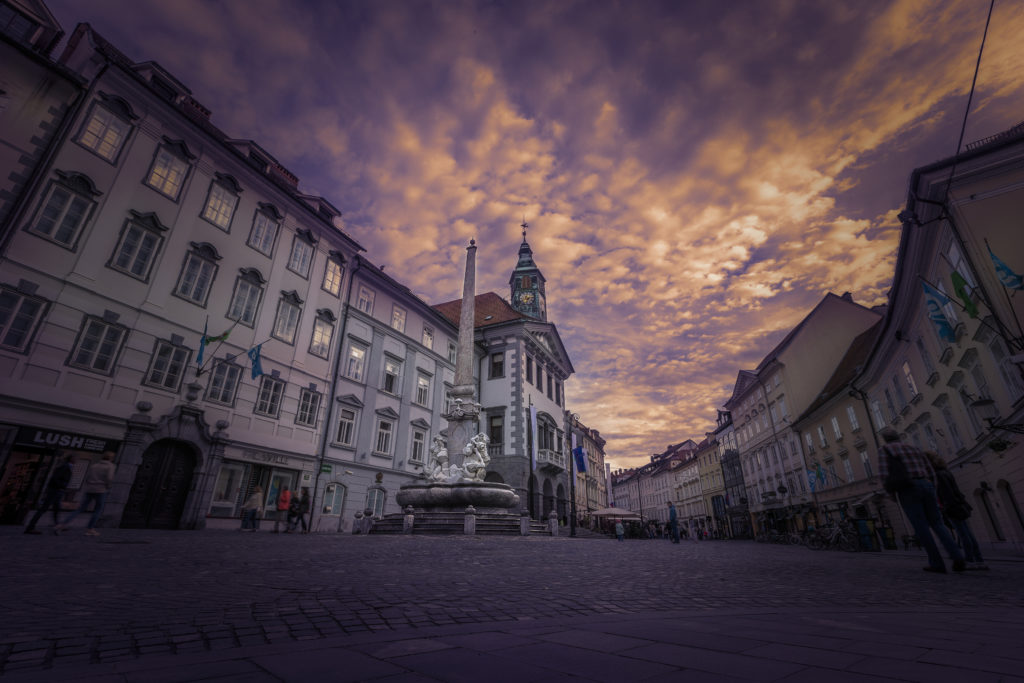 Autumn sky over the historic capital Ljubljana
Then there has been the legacy of amazing food, from fine Italian pasta to Balkan grilled meat and sausages, as well as those scrumptious Viennese cakes. As they like to say there with a smile: “Thank you and goodbye, oh you mighty conquerors.”
Today’s invaders are tourists, bringing currency instead of muskets, from Slovenia’s four neighbouring countries of Austria, Hungary, Italy and Croatia as well as, increasingly, from across the world.
My Intrepid Travel cycling group had come from Australia, New Zealand, the USA and the UK, keen on two-wheeled exploration of one of Europe’s greenest and most varied countries.
As a bunch of strangers (several were couples and most were retired professionals who, like me, were veteran travellers), we met at a Ljubljana hotel in an air of excited anticipation.
Ahead lay towering Alpine valleys, ancient villages and Tuscany-style vineyards, before we finished by bouncing through the cobbled alleyways of Piran, the pretty medieval resort on the country’s tiny 29-mile coastline, the Slovene Riviera, shining like a glistening pearl embedded between the mighty diamonds of Italy and Croatia.
Over the next week, two expert heroes guided our progress: group leaders Leon and Andro, an empathetic double act who nursed us through the complex business of moving bikes, luggage and ourselves from hotel to hotel and around some of the country’s most exceptional rides.
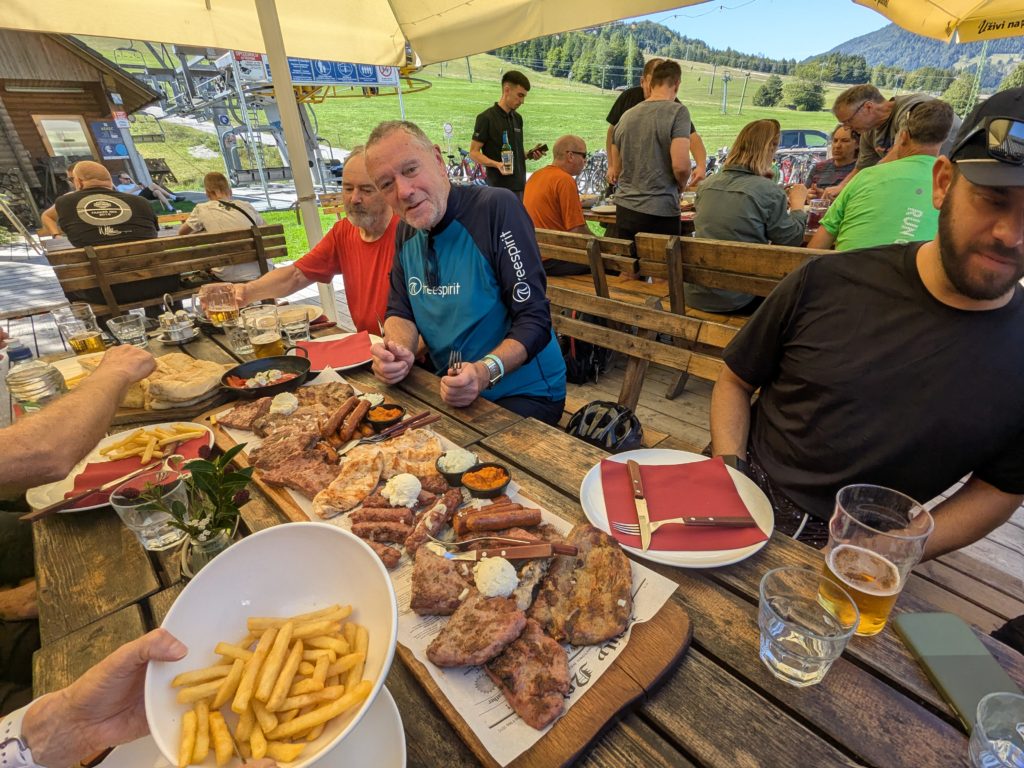 James is staggered by a huge Slovenian barbecue at the end of a day's ride
Leon, a super-fit cyclist and proud father from the Soča Valley, had an encyclopaedic knowledge of his homeland and a gentle manner that reassured even the least confident rider: me. Amiable Andro, from the Croatian capital, Zagreb, drove the support minibus, managed the trailer and bikes, and produced regular picnics like a magician.
With around half of the 16-strong group whizzing along at the press of a button and a few untaxing pedal swivels on our electric bikes, I admired the others labouring manfully on their human-powered machines. The latter were truly boosting their cardiovascular strength but missing much of the amazing scenery the rest of us were gawping at constantly.
First up, in the north-west, was Lake Bled, that emerald-green glacial expanse watched over by its clifftop medieval castle and tear-shaped island. The island is home to the Church of the Assumption, which draws countless visitors on traditional pletna wooden boats to clang its so-called ‘wishing bell’ – ‘a tourist trap’, one local told me.
In a week of memorable moments, I was quietly eating the fabled mushroom soup outside the 120-year-old ‘Mountaineer’s Inn’ nearby when the black ‘pub cat’ snarled and leapt off the front step towards a passing collie, which ran for its life. “He is defending his wife,” a waitress told me, pointing to the tawny old girl, still snoozing on the step. “He can’t be bothered with little dogs, but the big ones get it!” He’s Slovenian and, clearly, competitive!
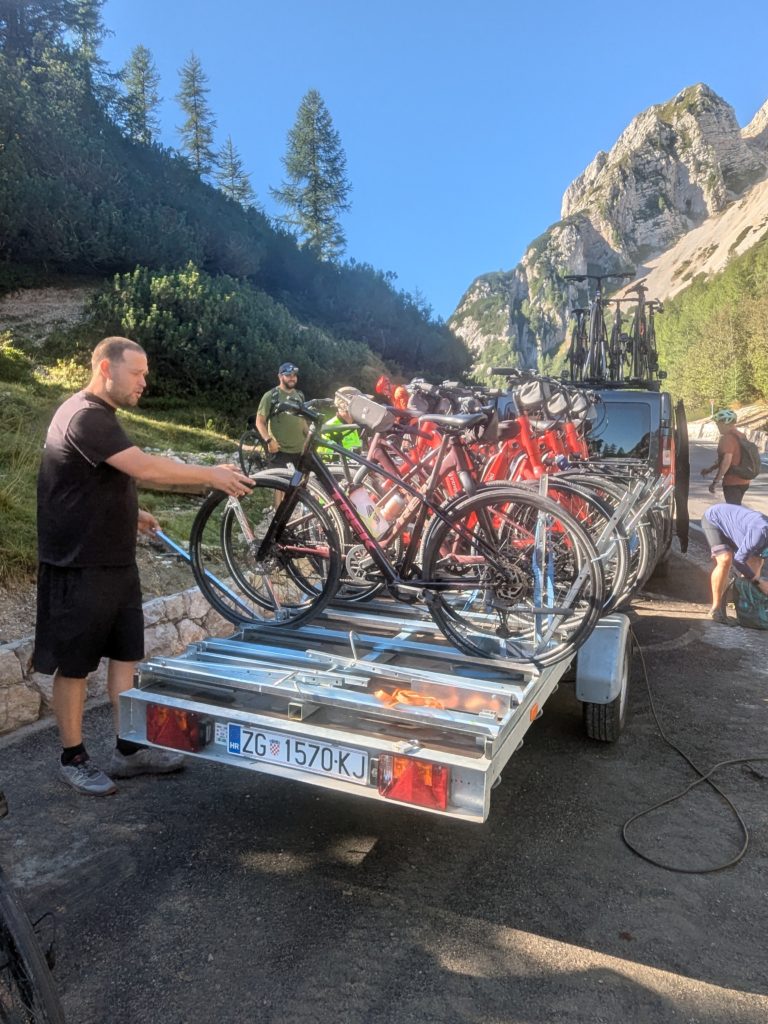 Andro stacks the bikes on his slick minibus trailer
The next day took us towards Kranjska Gora, best known as a ski resort but quiet, with green slopes in autumn. We travelled along peaceful roads through forests, ravines and flower-filled meadows beneath the country’s highest peaks in Triglav National Park.
Another memorable – yet on this occasion pitiful – moment came at Radovna, where we stopped to view the memorial and ruined building in the village where occupying Nazi troops burned down 12 houses in 1944, killing 24 people trapped inside (the youngest just seven months old and the oldest 81) in reprisal for local partisan activity.
And so our journey continued amid a kaleidoscope of sights (the River Soča’s startlingly emerald waters, the undulating vineyards of the Goriška Brda region), tastes (the pasta and prosciutto as we cycled briefly across the border into Italy) and emotions (the friendships that grew stronger daily).
The weather was our kind travelling companion, with heavy rain on just a single day, when cycling was replaced by a visit to the extraordinary Predjama Castle. There, according to legend, Slovenia’s version of Robin Hood, the rebellious 15th-century knight Erazem, held out against an imperial army before being killed by a cannon shot while using the castle toilet. Not an entirely happy ending.
After that came the huge Postojna Cave, an underground maze filled with a vast array of limestone tunnels as well as the country’s ‘baby dragon’, the olm, a pale and sightless salamander that can live for a century and go without food for a decade.
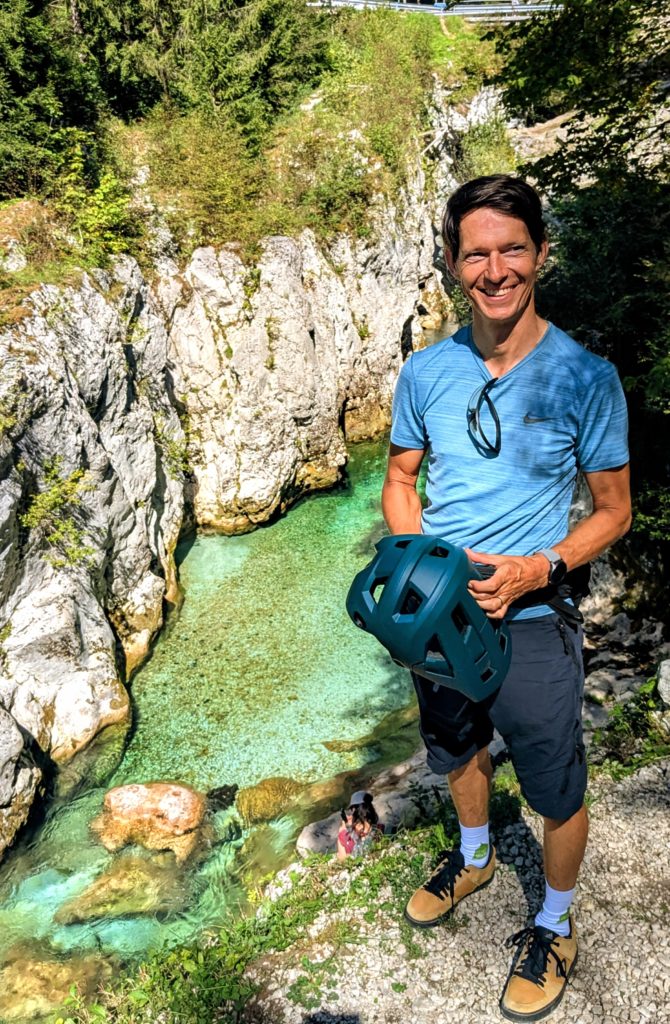 Guide Leon alongside his beloved River Soca
That is more than could be said for my group of international pedallers. By the time we sighted the Venetian bell tower of Piran, flanked by the deep-blue Adriatic, we had munched our way through oceans of glorious fish and seafood, meadows of meat and barbecued sausages, and lakes of fine local wines and craft beers.
And along the way, countless stick-thin racing cyclists had passed us with a wave, but our unspoken motto had not been one of competition among strangers. Instead, we were like a group of longtime pals, chatting constantly, sharing excitement and issues, and enjoying every moment.
Perhaps that was the lasting pleasure: at coffee stops, picnics, wrong turns and evening meals, a collection of people from around the globe had welded into a close-knit team.
Slovenia had certainly provided the mountains, history and scenery; Leon and Andro had kept the wheels turning. Yet it was the simple understanding that we were there for each other that made this much more than a cycling holiday and gave us all a story worth carrying home. Without the bikes, of course!
Factfile
Visit Intrepid Travel’s 8-day Cycle Slovenia tour (www.intrepidtravel.com/en/slovenia/cycle-slovenia-174760). Prices are from £2,360pp including accommodation, ground transport, bicycle hire, guided cycling with a support vehicle, services of a local leader and some meals and other activities. Book at www.intrepidtravel.com or call 0808 274 5111
For cut-price airport parking and hotels, try Holiday Extras: www.holidayextras.com or call 0800 316 5678.
Everything from irishpost.com and the print edition is available on the Irish Post App — plus more! Download it for Android or Apple IOS devices today
