



A SPECIAL film screening about the maverick Irishman Ronan O’Rahilly, founder of the celebrated pirate radio station Radio Caroline — who became known as the man who changed radio forever — comes to the Irish Cultural Centre in Hammersmith on Sunday, May 3 at 3pm.
A Pirate’s Tale tells the story of how Ronan O’Rahilly (grandson of the 1916 Irish rebel The O’Rahilly) came to park a boat full of radio DJs in international waters off the coast of Britain in 1964 and blow the BBC’s pop music monopoly wide open.
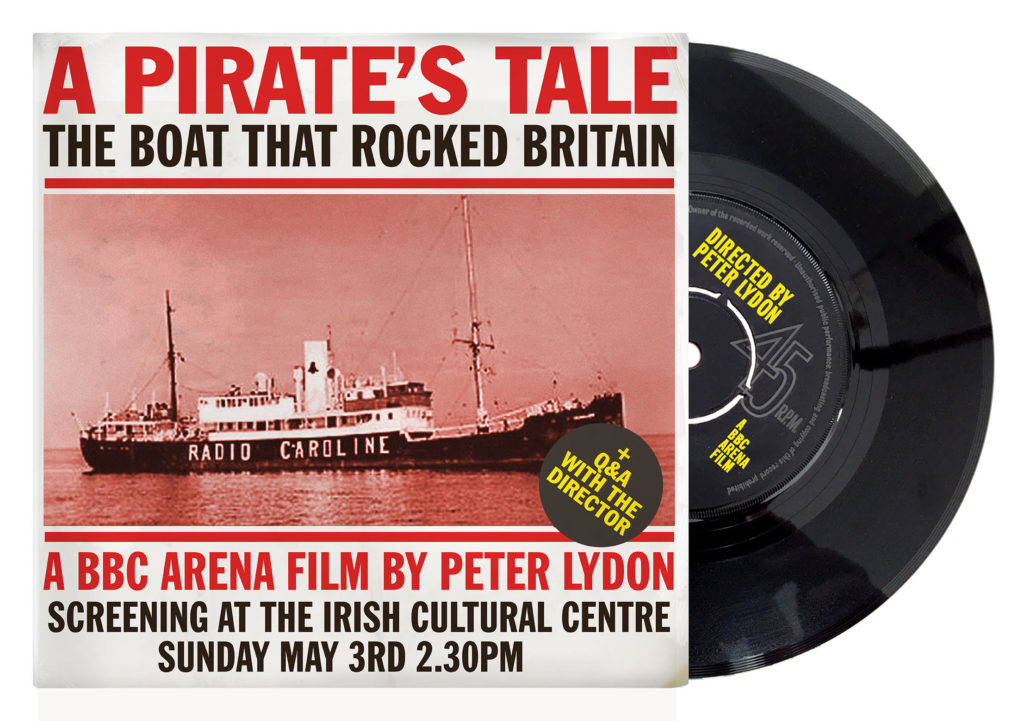
With the creation of the UK’s first pirate radio station on Easter Sunday 1964, O’Rahilly took on the British political and broadcasting establishments. At the time, the BBC was attempting to control the pop and rock music revolution by broadcasting just one hour of pop per week, on Alan Freeman’s Pick of the Pops. O’Rahilly, who managed Georgie Fame, discovered a loophole in strict radio licensing laws and said: “If a ship was parked off the coast, three miles out, the whole country would tune in and turn on.” And it did.
Overnight, Radio Caroline was reaching a music-starved audience of nearly 10 million across the British Isles, throughout Ireland and further afield. The station, playing the pop and rock artists of the day, broke the BBC’s monopoly on radio in the UK. It changed youth culture and launched the DJ careers of Tony Blackburn, Simon Dee, Johnnie Walker and Dave Lee Travis.
A Pirate’s Tale is a fascinating film featuring a great soundtrack from the 1960s, but what is perhaps even more striking is the impact Radio Caroline had on young people and youth culture in Ireland, both north and south. Before the station hit the airwaves, families mainly heard Irish traditional music on RTÉ via large Marconi wireless sets. However, in the early 1960s, with the rise of cheap, battery-operated transistor radios — essential for tuning into stations like Radio Caroline — young people across Ireland began listening day and night to the latest American singles and the new generation of vibrant DJs.
They tuned in in their millions, reshaping the Irish charts as records played on Radio Caroline regularly reached number one. The station also had a major influence on Ireland’s showband scene, which had previously focused on céilí bands and dance orchestras. In its wake, a new wave of showbands emerged, performing pop, American rock ’n’ roll and country music for a younger audience.
Radio Caroline had a particularly strong following in Northern Ireland. In December 1964, the station opened a record shop in Andersonstown, attended by DJ Simon Dee, who was greeted like a pop star by hundreds of young fans lining the streets. That same year, Radio Caroline opened a sales office on Molesworth Street in Dublin — nicknamed “Caroline House” — to handle high demand for advertising space.
The station’s roots, however, were firmly Irish. Not only was its founder a charismatic Irishman, but the original ship, MV Caroline, was fitted out at the Port of Greenore in County Louth by local workers — few of whom could have known the role it would go on to play in changing radio forever.
The screening of A Pirate’s Tale will be followed by a Q&A with the film’s director, Peter Lydon, who will be interviewed by Piers Thompson, DJ and co-founder of London’s independent station Portobello Radio.
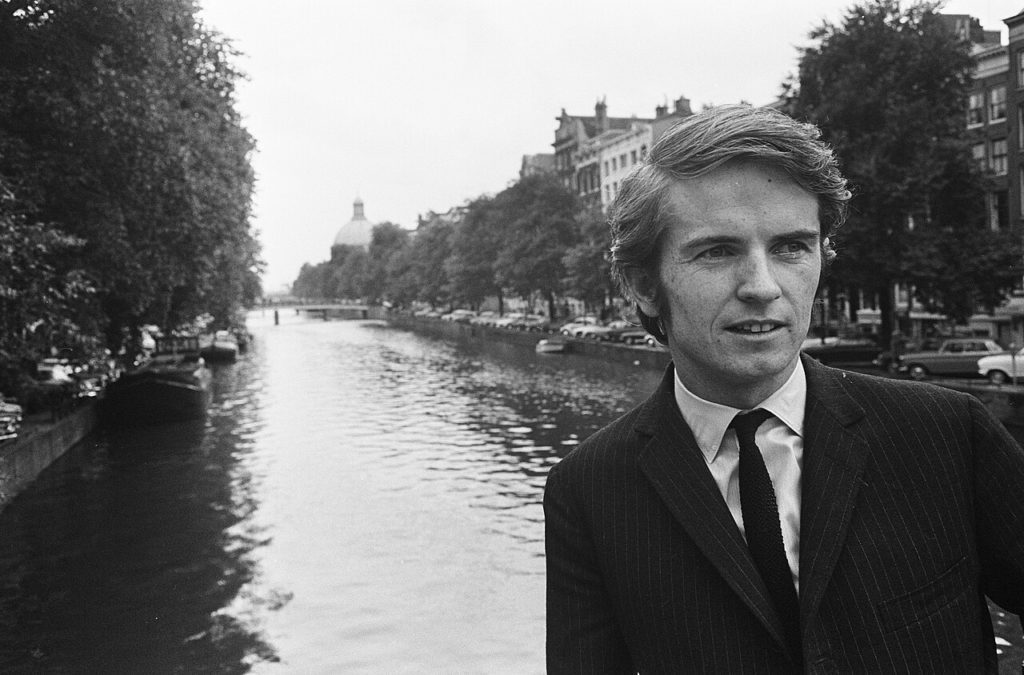 Ronan O'Rahilly in Amsterdam (Eric Koch for Anefo, CC-0, public domain dedication)
Pirate signal, Irish sound
While Radio Caroline was not an Irish music station, its impact on Irish artists was profound. At a time when broadcasters in both Britain and Ireland were slow to embrace new sounds, the pirate station gave crucial exposure to emerging acts — including The Dubliners, whose records received heavy airplay and broke into the UK charts. In doing so, Radio Caroline helped carry Irish folk beyond its traditional base, introducing it to new audiences across Britain and Europe. More broadly, the station’s anything-goes approach to music helped galvanise a generation of Irish musicians, proving that there was a mass audience for sounds that fell outside the mainstream.
Ronan O’Rahilly
Ronan O’Rahilly was born in Dublin in 1940 into a politically prominent Irish family. His grandfather was Michael Joseph O'Rahilly, a founding member of the Irish Volunteers who was killed during the Easter Rising. His father, Aodogán (or Aodhagán) O’Rahilly, was a well-known academic — a Celtic scholar and later Professor of Irish at University College Cork. The family combined republican heritage with intellectual influence, something that fed into Ronan’s independent streak.
The station was named after Caroline Kennedy. O’Rahilly was inspired by a widely circulated photograph of the young Caroline playing under her father’s desk in the White House — a symbol, he felt, of youthful disruption inside the political establishment. He saw Radio Caroline in similar terms: challenging the broadcasting status quo from the outside.
O’Rahilly died in April 2020 in Carlingford, on the Co, Louth coast, just a couple of mles from the port of Greenore, which his family owned until 2020. His home was fittingly within sight of the Irish Sea, where his most famous maritime venture had once broadcast to millions.
A Pirate’s Tale
Sunday, May 3, at 3pm
Irish Cultural Centre
5 Black's Rd, London W6 9DT
Tel: 020 8563 8232
irishculturalcentre.co.uk/
See More: Pirate Radio, Radio Caroline, Ronan O'Rahilly
