





TAOISEACH Micheál Martin has reflected on the impact of the Famine in Ireland as “one of the most profound and defining periods in our history”.
The National Famine Commemoration took place on May 17 at the Irish Workhouse Centre in Portumna, County Galway.
An annual event, it is held in remembrance of all those who suffered, died or was forced to emigrate due to An Gorta Mór.
The Taoiseach officiated at the event, which was hosted by the Minister for Culture, Communications and Sport and the Chair of the National Famine Commemoration Committee, Patrick O’Donovan.
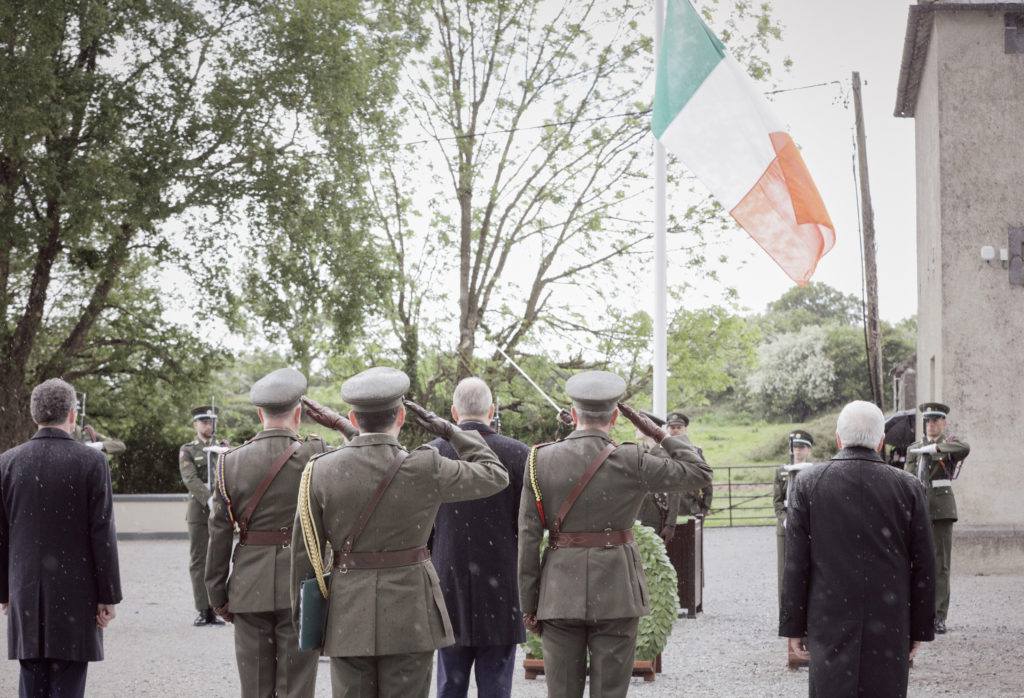 Taoiseach Micheál Martin, accompanied by the Culture Minister Patrick O’Donovan and Cathaoirleach of the County of Galway, Councillor David Collins, officiated at the National Famine Commemoration in Galway
The Most Reverend Luis Mariano Montemayor, Apostolic Nuncio and the Dean of the Diplomatic Corps, and the Cathaoirleach of the Galway County Council, Councillor David Collins, also took part in proceedings, which marked the first time the State Commemoration has taken place in Galway.
“In the recorded history of our island there is no more traumatic event than the Great Famine,” the Taoiseach told those gathered for the event.
“Its destructive intensity brought a scale of death and dispossession which is almost impossible to comprehend,” he added.
“After the worst was over, nothing would ever be the same again.
“We became a nation where emigration touched every family. To be Irish now meant to have deep connections thousands of miles away,” he explained.
“A relentless determination not to face the same helplessness became a defining Irish characteristic. It was not just politically radicalising; it changed the very fabric of our society and identity.
“So, it is important that we take time to gather and to reflect – to solemnly remember and to seek understanding.”
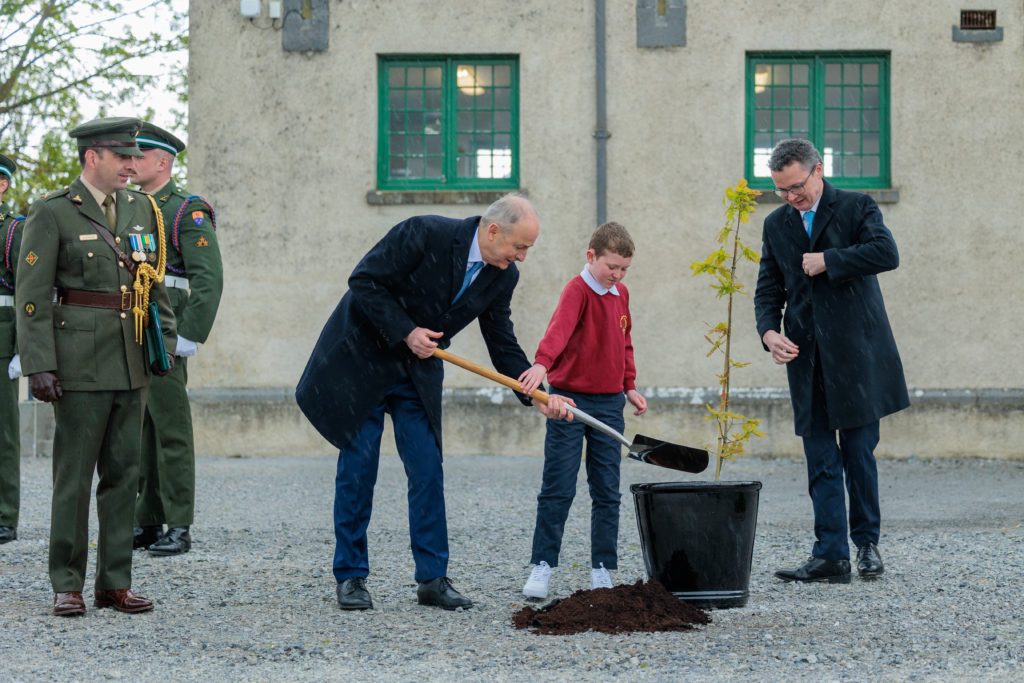 A tree was planted at the site during the commemoration
The event, held on May 17, included military honours and cultural and community elements before culminating in a solemn wreath-laying ceremony led by the Taoiseach.
Mr Martin admitted that the commemoration was not stir resentment over the past, but to ensure that the memories of those lost were “kept alive”.
“It is not the role of this or any generation to keep alive resentments for events far in the past,” he said.
“Yet it is our duty to keep alive even the most difficult memories."
First opened in 1852, as part of Ireland's Poor Law Union system, the Portumna Workhouse is widely regarded as one of the most complete surviving complexes of its kind.
They were introduced to alleviate the widespread poverty and devastation caused by the Famine.
The Portumna Workhouse was designed by George Wilkinson. It was built on a nine-acre site north of Portumna town to accommodate 600 inmates.
The workhouse system, which was modelled on a similar system in England, offered indoor relief to those unable to support themselves.
Inmates received food and shelter in exchange for labour, but conditions were deliberately harsh to discourage dependency.
Families entering the workhouse were segregated by gender and age, with only children aged under two allowed to remain with their mothers.
The site is now in use as a venue for lectures, exhibitions and cultural events.
Further events commemorating the Famine will continuing at the site, including theatre, music and exhibitions which will run until next month.
All events are free and booking is not required. For further information click here.
Everything from irishpost.com and the print edition is available on the Irish Post App — plus more! Download it for Android or Apple IOS devices today.
