



A MILKY sunrise is beginning to spread a faint golden glow across the ageing limestone front wall of the Alamo, America’s most iconic battle monument, as many of the citizens of the surrounding city enjoy a final hour of peaceful slumber.
It’s an image that burns indelibly into my senses as I consider the contrast between such tranquillity and the heroic and bloody life-and-death struggle which had taken place at this very spot, 190 years ago, in what is now modern San Antonio, the country’s sixth biggest city.
Here, birds sing in the dawn trees as I wander around the restored church and the site’s remaining long barrack building, trying to picture the desperate screams, cannon blasts and rifle fire that ensued as a small band of doomed men fought overwhelming odds to throw off the control of Mexico and create an independent Texas state.
And immediately, I wonder how many of the 1.6 million visitors who shuffle around the hallowed walls of this ‘cradle of Texas liberty’ realise that the Irish were at the heart of its story of courage and sacrifice in the fight that, ultimately, helped create that dream of freedom for Texas on the road to the creation of today’s USA.
In fact, at least 15 natives of the Old Country fought and died here and the ancient Franciscan mission’s garrison included large numbers of soldiers of Scots-Irish descent – a fact that has been largely buried beneath the mythology that owes more to actors Fess Parker and John Wayne’s 1950s Hollywood silver screen fiction than actual history.
Their depictions of this last stand for freedom and independence for Texas by fewer than 260 doomed defenders (Hollywood’s ‘Good’) against an army of thousands of Mexican soldiers (Hollywood’s ‘Bad’) led by (the admittedly, pretty evil) General Antonio López de Santa Anna sparked a popular vision of American masculinity and frontier grit, as well as an Anglo-Saxon and Protestant struggle against Mexican Catholics.
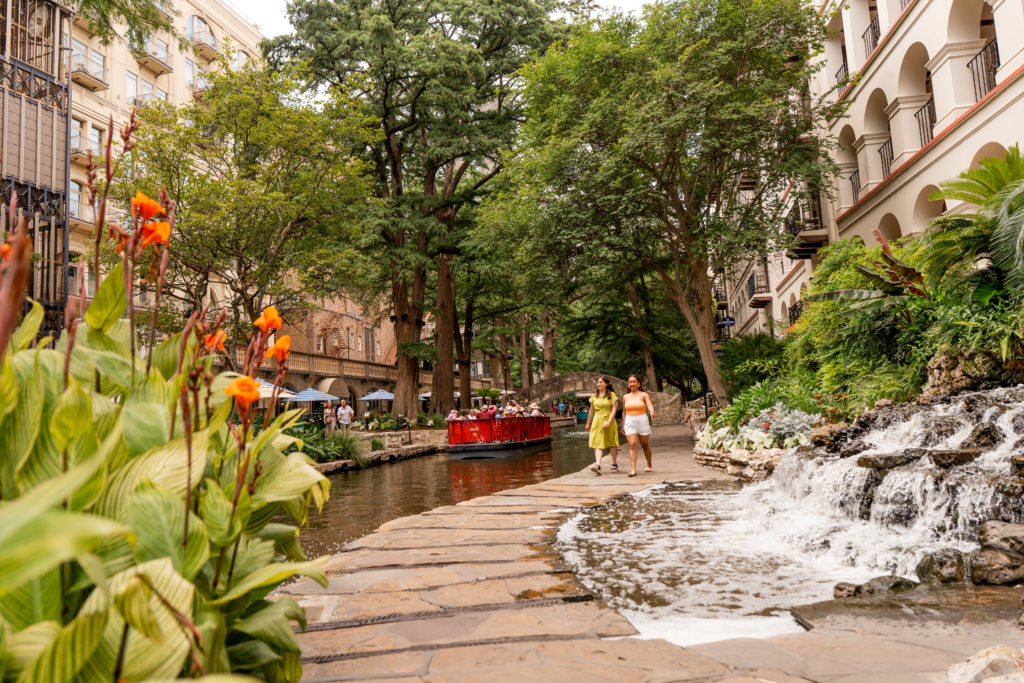 A fountain runs along San Antonio's famous River Walk
The truth is far more nuanced and complex, with the Irish at the forefront of it, an honour now commemorated by the presence of the Tricolour and a piece of Connemara marble permanently displayed inside the Alamo Church.
As leading US historian Dr Phillip Thomas Tucker points out, the struggle for liberty in Texas and at the Alamo in particular, ‘has long been viewed as a stirring Anglo-Saxon epic without any alleged “taint” of ethnicity.’
Yet many Irish immigrants and their descendants, who were drawn to Texas on the promise of the open frontier life and cheap land, became ‘the most diehard revolutionaries’ against the yoke of controlling Mexico.
Conversely, some even fought on the Mexican side against their fellow Irishmen, fired up by Catholic and anti-slavery values. But the Alamo showdown symbolises, as Tucker says, the ‘disproportionate contributions and sacrifices of Irish Texas patriots’ to the struggle for liberty and the birth of the state.
Thus, on St Patrick’s Day every year, the Harp and Shamrock Society of Texas and city officials hold a wreath-laying ceremony – complete with bagpipes and Irish singers – to salute those Alamo martyrs who had Emerald Isle roots.
But come to this vibrant city a little after that ceremony, in mid-April, and you’ll dive into a party of 2.5 million people, the San Antonio Fiesta, which turns the streets, bars, cafés and its many renowned restaurants into a joyous 11-day explosion of food, music, heritage and organised chaos.
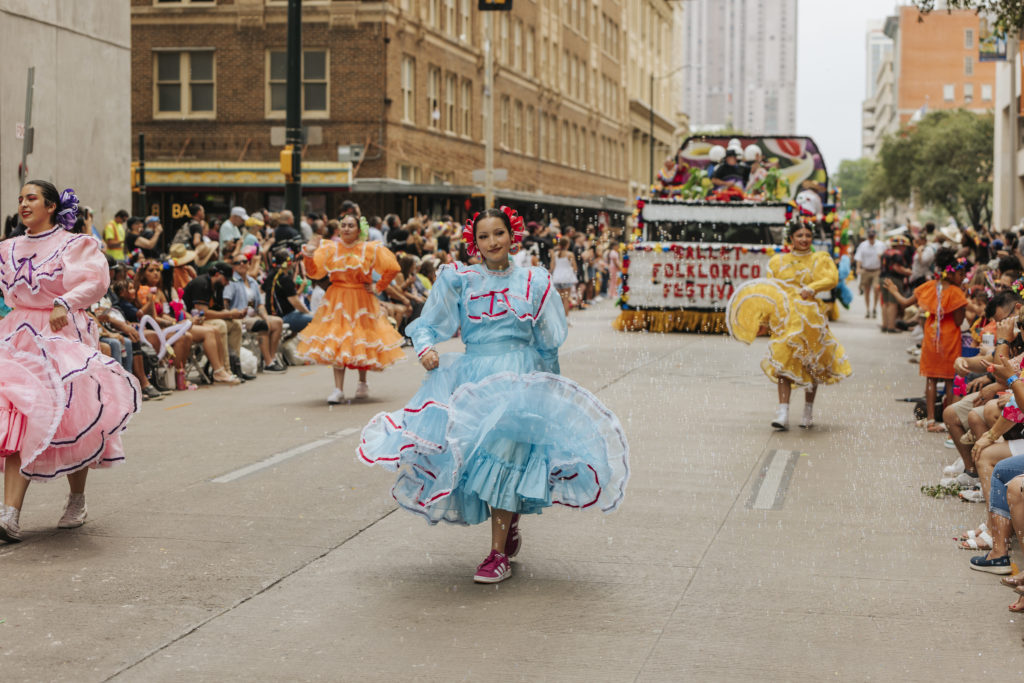 Dancers in the Fiesta Battle of Flowers parade
As a celebration, the size, noise and sheer good-natured fun would take some beating across the globe, as the city’s many cultures come together, from Hispanic to Mexican and Texan to Irish (of course).
In fact, I arranged to meet some of the latter down at The Cottage, a proper Irish pub on Broadway, owned by Phil Bentley from Manchester and his wife Gina, who grew up in Passage East, the pretty fishing village on Waterford Harbour, where the Guinness is cold and the regulars like nothing better than a big dish of Irish bangers and mash or corned beef and cabbage boxty.
There I was expecting to meet just a couple of people, but 10 turned up from the Harp and Shamrock Society and the Irish Cultural Society of San Antonio who regaled me with their enduring pride in their ancestral roots, as well as the many events, scholarships and charitable causes they support to help young people learn about Irish culture and history.
Later, at the Fiesta itself, it was clear that the ‘home fires’ were certainly burning. A typical example emerged as I toured the Irish pop-up bars at the Old San Antonio Fair where mother-of-three Helen McCafferty told me how her grandfather originally hailed from Donegal and her ‘clan’ of 48 had learned how to make traditional Irish egg nog which they all enjoyed every Christmas.
Of course, the Fiesta is for all-comers and was created in 1890 in honour of those who died at the Alamo and the subsequent Battle of San Jacinto, in which Santa Anna’s Mexican army was defeated and Texas went on to gain its independence.
Nowadays the crowds come for the party fun: mariachi trumpets blast out from doorways, country music anthems pour out of beer gardens and Tejano accordions serenade lovers along the city’s famous River Walk. There, along the San Antonio River, electric-powered barges take diners under Venice-style arched bridges and past buildings that shout Texas swagger while whispering historic Mexican and Spanish charm.
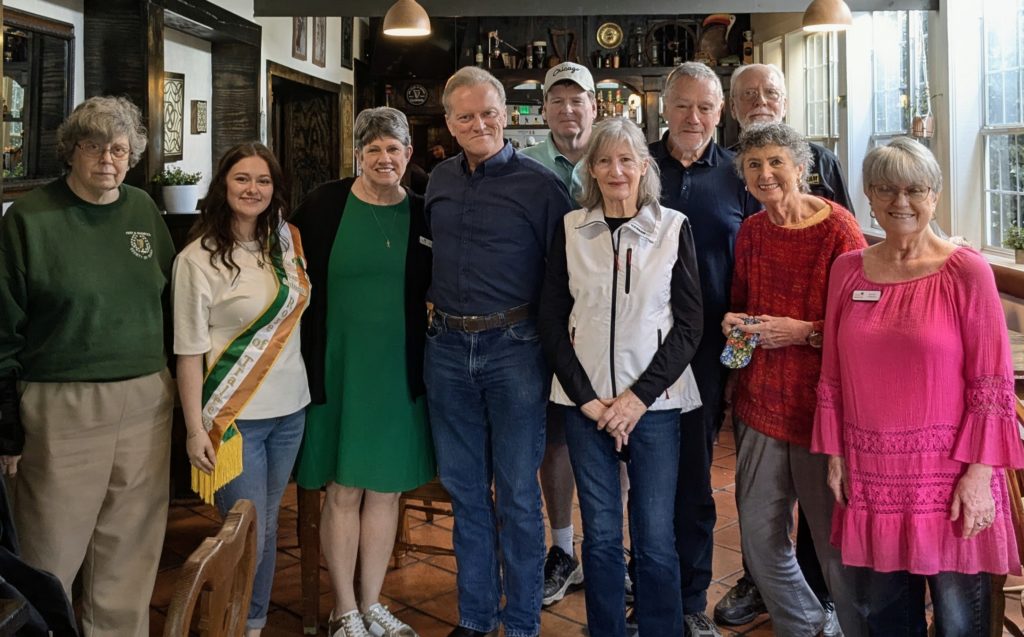 James, fourth from the right, with members of the Harp and Shamrock Society of Texas and the Irish Cultural Society of San Antonio
My energetic few days there whizzed by in a kaleidoscope of unforgettable scenes: the sun melting across the distant Hill Country from the top of the Tower of the Americas; the glitzy Coronation of the Queen of the Order of the Alamo at the wonderful Majestic Theatre; lunch of enormous plates of enchiladas, tamales and fajitas with impressively huge goblets of margaritas amid the colour explosion that is the legendary Mi Tierra Café y Panadería.
The vast size of the event is typified by the Battle of the Flowers Parade, in which scores of elaborately decorated floats take a couple of hours to pass by before I take my stadium seat for the Battle of the Bands, an equally huge and skilled demonstration of the city’s thousands of talented school musicians.
There are also fireworks, fun fair rides, a Western Art Museum and even a psychedelic adult art centre, Hopscotch (great fun).
Yet there is also tranquillity to be found with a trip to the UNESCO-listed Mission San José, bursting with Spanish colonial history, as well as the water-trickling sedateness of the Japanese Tea Garden.
And all the time there is that feeling of friendly chattiness that you might find in Galway, Cork or Belfast, in which locals clearly want you to have the best of times at an event that has its roots in tears and tragedy but now celebrates with joy and laughter.
Viva Fiesta, as they scream in San Antonio.
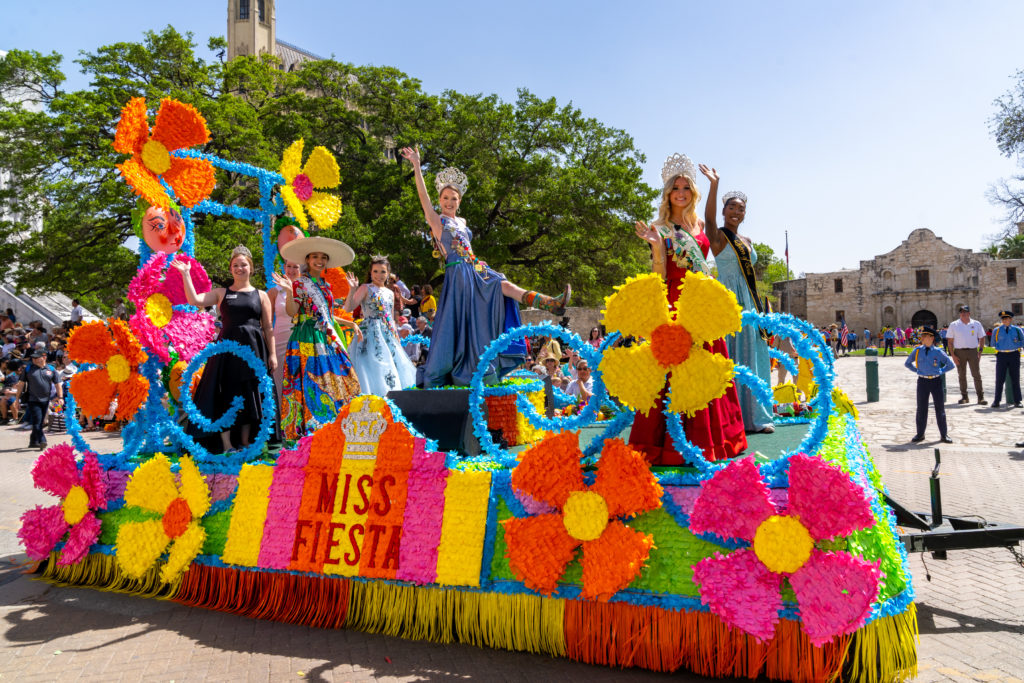 A burst of colour during the Fiesta Battle of Flowers parade
The San Antonio Fiesta raises over $200 million every year for charitable causes, including scholarships and support to improve lives in the community.
According to organisers, as many as 75,000 volunteers man the stalls and events without pay, sometimes across several generations of the same family.
As I walked out of my hotel during a light shower, an elderly man, a high-vis jacketed volunteer, came over to pass me an umbrella – something he had been doing for 42 years.
“You’re very welcome sir,” he said as he wandered off to find another visitor.
If you want to know more about the Irish at the Alamo, try Dr Phillip Thomas Tucker’s book, The Alamo’s Forgotten Defenders – The Remarkable Story of the Irish During the Texas Revolution.
After years of primary research, he has compiled a history which details the buried account of Irish involvement in the struggle which helped create modern America.
He reveals how at least 15 of the defenders were Irish-born, but many more were sons, grandsons and great-grandsons of Irish immigrants, both Catholic and Protestant.
Indeed, he says:
“The Irish were motivated primarily by their longtime desire for liberty (long denied to them by the English in their home country), the dream of becoming equal citizens of a new, independent republic, and the acquisition of abundant amounts of Texas land.
“The legacy of the Irish people battling for independence against a centralized government (England) for centuries played a forgotten role in inspiring the Irish in Texas to break away from the centralized government of Mexico in an armed revolt against a more powerful opponent.
“And, of course, the autocratic Mexican military strongman and dictator, General Santa Anna, reminded them of centuries of abusive English domination and rule in Ireland.”
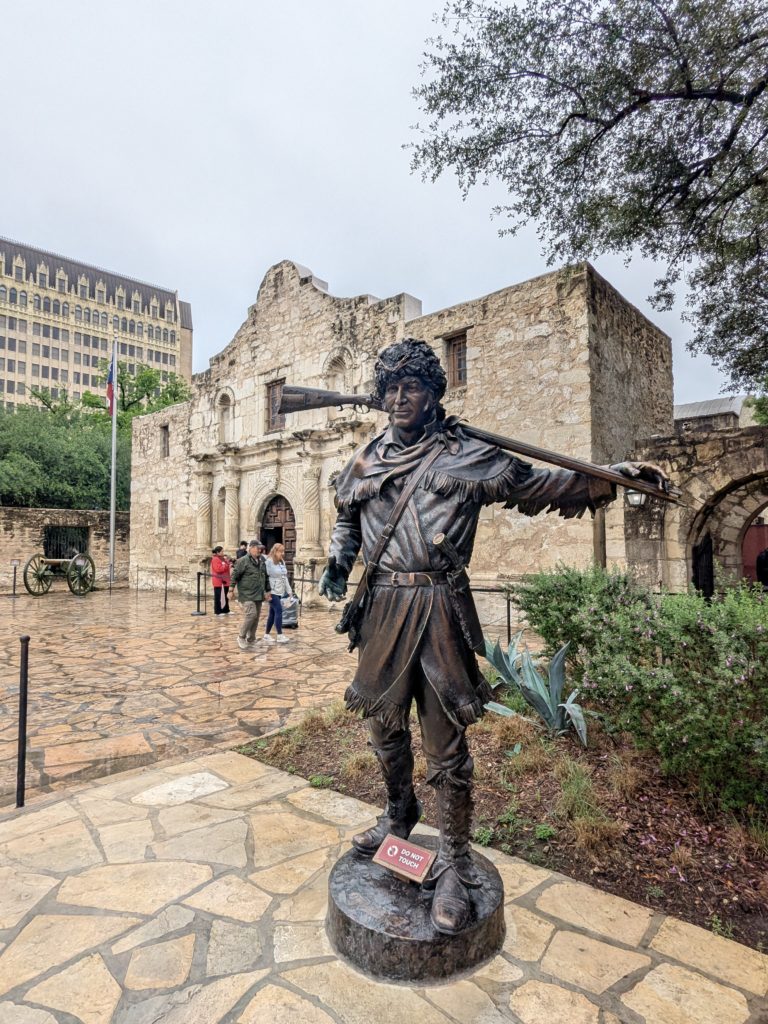 Davy Crockett's statue outside the Alamo
Among the most famous Irish-linked Alamo martyrs were commander and frontiersman Davy Crockett, who was proud of his Ulster Protestant ancestry; Major Robert Evans, born in County Derry, who was shot by Mexican soldiers as he bravely tried to ignite the Alamo gunpowder supply; and another Derryman, Sergeant William Ward, who died from sabre wounds while firing the main gate cannon.
The Alamo’s biggest superfan is British musician Phil Collins, who became fascinated with the battle through watching movies as a child and has collected hundreds of artefacts, a collection reported to be worth at least $40 million but probably priceless.
The former Genesis drummer donated more than 400 pieces to the State of Texas in 2014 and these are on show at the Alamo site in the Ralston Family Collections Centre.
Among them are frontiersman Davy Crockett’s fringed leather shot pouch and iconic Bowie knives.
They will be moved to a new $500 million Alamo Visitor Centre, currently under construction and due to open in Spring 2028, which will feature a 4D theatre and high-tech storytelling systems.
Factfile
If you are thinking of visiting Fiesta next year, check out details at Fiesta San Antonio.
For details on the city, visit Visit San Antonio.
British Airways flies regularly to New York and Atlanta, which connect with domestic flights to San Antonio.
Holiday Extras
For cut-price airport parking and hotels, try Holiday Extras.
