





POLITICS in Ireland in the early 1920s was defined by friendships and alliances fractured by the Anglo-Irish Treaty and the subsequent Civil War.
Comrades who had fought together parted company — often with lethal consequences — over the agreement signed at Downing Street on December 6, 1921.
Among them were Michael Collins and Austin Stack. My research for a new biography of Stack suggests that their rift owed as much to Collins’ condescending attitude towards colleagues whom he considered inferior or incompetent as to the Treaty divide.
They became close during 1917 and 1918, when Stack corresponded with Collins from prisons in England and Belfast. Collins used information from Stack — who led high-profile riots in Belfast Jail in 1918 — about prison conditions for propaganda purposes.
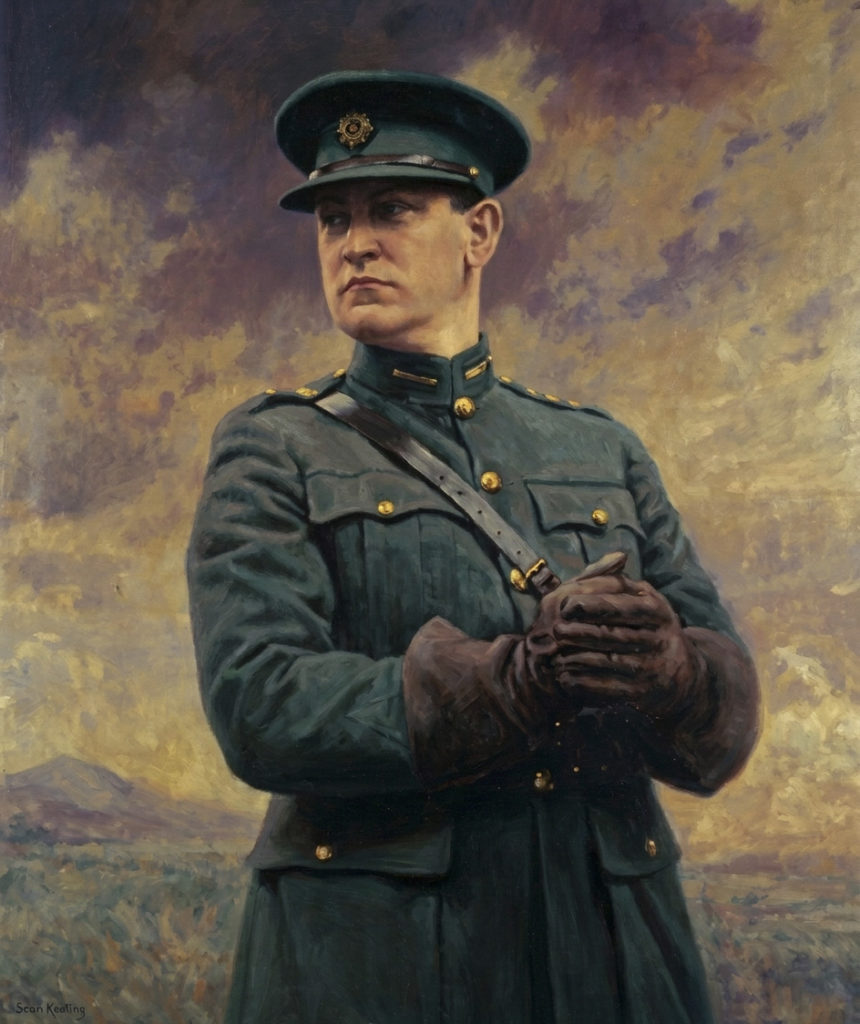 Michael Collins by Leo Whelan (Pic: OPW)
Collins consulted Stack on political and electoral strategy, confiding his doubts and isolation: ‘I wish to God there were more of the people out [of prison] whom one could discuss things with and in whom confidence could be reposed,’ he wrote in October 1918.
Days later, Collins wrote that he was ‘fed up today. It’s the first time for 8 years I’ve felt it necessary to stay in bed, which in addition to the physical disability makes me smart under a feeling of vicarious shame … I’m very, very impatient.’
In June 1919, he told Stack that ‘things are not going very smoothly … all sorts of miserable little undercurrents are working and the effect is anything but good’.
He was keen for Stack to be freed: ‘you’d be indispensable in Dublin … How I do hope you’ll be released.’
Collins helped plan the escape of Stack and other Irish prisoners from Strangeways Prison in Manchester in October 1919. He visited the jail and, according to one account, ‘daringly visited’ each inmate in his cell without being recognised.
In May, he had asked Stack for details of the ‘position, conditions, surveillance etc.’ They devised a ‘means of secret communication’ about the escape plans, with Collins signing his letters ‘Angela’.
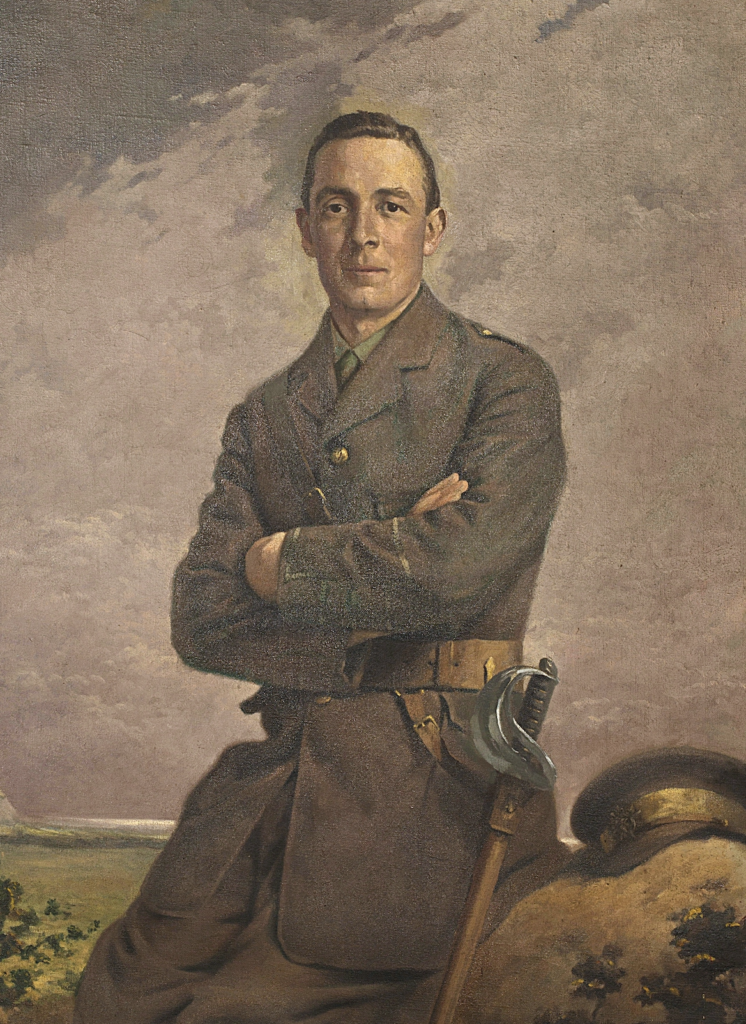 Austin Stack by Leo Whelan (Collection and image © Hugh Lane Gallery)
Weeks after the escape, Stack was smuggled into a Dublin safe house arranged by Collins. In November 1919, he took charge of Home Affairs in a Dáil government in which Collins was Minister for Finance.
Stack’s responsibilities included developing the Dáil courts, or republican courts: an alternative system of justice, supported by republican policing, intended to supplant the British legal system in Ireland.
His ministry first tested their friendship. Stack was criticised and sometimes vilified, often unfairly, for slow progress in establishing the courts, despite the enormous challenges involved.
Some considered him dogmatic and pedantic. Collins, frustrated by the pace of change, meddled in Stack’s business, as he did with other ministries, and offered strong opinions about perceived failures.
At one point, Collins threw a bundle of letters, which he said contained complaints about Home Affairs, across Stack’s desk, declaring: ‘Your department, Austin, is nothing but a bloody joke.’
Collins also blamed Stack for failing to coordinate and resource the Irish Republican Police properly.
Stack was infuriated when Collins told the Dáil in August 1921 that, during the War of Independence, there was ‘no proper effort made’ to keep the Dáil courts operational. The courts ‘broke down … the machinery was not held together. There was not enough work done locally or at Headquarters.’
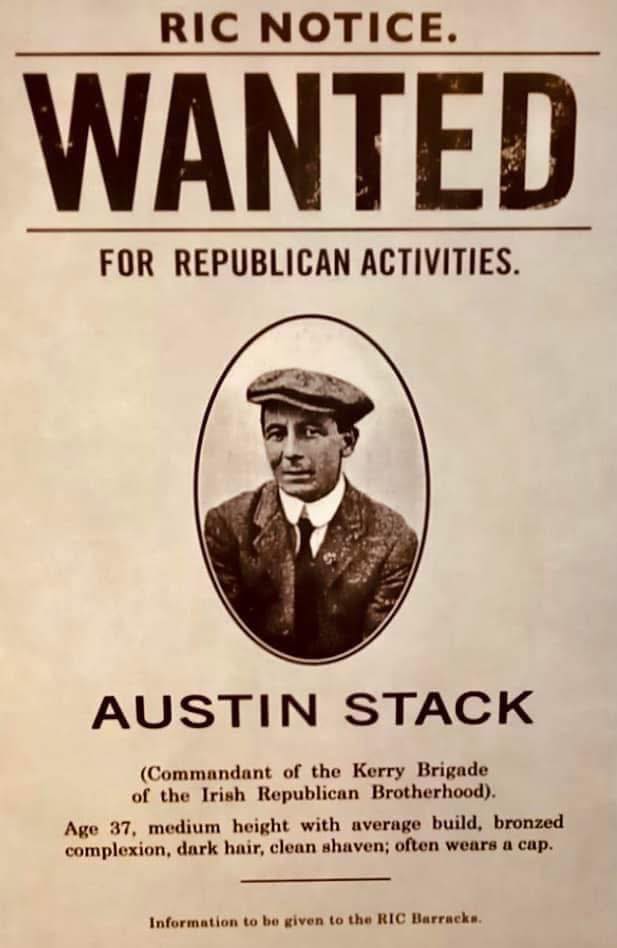 Poster circulated by the Royal Irish Constabulary c. 1916
Stack’s friend and colleague, J. J. O’Kelly, believed Collins was unnecessarily aggressive: ‘Michael Collins said something about Austin Stack’s department, one of the statements he was quite capable of making after a late night … He seemed to think Stack was a timid type of man that he could overawe.’
Their differences in personality and leadership style were exacerbated by the Treaty split. Collins was charismatic, abrasive and impatient, with a network of allies among the Volunteers and Sinn Féin.
Stack was deeply shy, sometimes timid and often self-effacing, more comfortable as a prison leader than as an administrator or public speaker.
Richard Mulcahy contended that these tensions revived Collins’ accusation that Stack’s leadership of the Kerry Volunteers before the Easter Rising had been shambolic.
Stack was long accused — usually unfairly — of mishandling Roger Casement’s arrival in Kerry on Good Friday in 1916 and the ill-fated mission to import guns for the rebellion. Collins considered Stack his inferior in such matters.
When Collins signed the Treaty, it was the final straw. Stack, who had accompanied Éamon de Valera to exploratory talks with the British government that summer, vehemently opposed its terms and felt betrayed.
The Treaty pushed him closer to de Valera. During the Dáil debates, Stack and Collins exchanged barbs and insults. Their relationship never recovered.
When Collins was killed at Béal na Bláth in August 1922, Stack expressed shock and lamented ‘our old friend, Mick’. Affection survived, but his political commitment remained:
‘He [Collins] did great work for Ireland up to the Truce – no man more. I am more than sorry, I am heartbroken. I fail to see how it is all to end. Perhaps others of us [will] go down. If it were to arise, I should gladly accept it for myself tomorrow but the Republican position must be saved if possible. The country must never be counted as having given up its independence.’
Whether they could ever have reconciled is impossible to know. Stack remained a republican in the Fenian tradition, unwilling to accept a settlement short of an Irish republic.
Their broken friendship was one of many personal ruptures that gave Ireland’s revolutionary divisions such deep and enduring consequences.
Unchanged and Unchangeable: Austin Stack and the Irish Revolution by Owen O’Shea is published by Merrion Press
Everything from irishpost.com and the print edition is available on the Irish Post App — plus more! Download it for Android or Apple IOS devices today.
See More: Austin Stack, Michael Collins
