





IF YOU WERE asked in a quiz where you’d find the Blue Stack Mountains, you’d probably say something like “West Virginia? Maybe Wyoming?” were you not acquainted with name.
But they are, in fact, amongst Ireland’s most northerly mountains, ranging roughly from Donegal Town northwards towards Letterkenny.
The highest point, Blue Stack itself — a “here I am, here I stand” sort of mountain — reaches some 2,219 feet.
They’re not that remote either. You could be sitting in a pub in Donegal Town, look out the window and say, “I fancy climbing that.” And then just walk there; it’s only five miles away.
Of course, you may want to stay put in the town, famous for its 15th-century castle, tweeds and traditional music.
Or you could do it the easy way and book yourself in at Harvey’s Point Country Hotel, which lies on the shores of Lough Eske, smack bang on the Ulster Way and the Bluestack Way.
The old boreen which makes up this part of the Ulster Way winds past the hotel, then follows the lough shore, taking you through ancient woodland and past quietly lapping water — if you’re lucky, you might just spot the 21st century.
Lough Eske, home to the increasingly rare char, a tasty species of salmon. Even scarcer freshwater oysters, reputedly containing pearls, lurk along the lough’s edges.
However, it’s illegal to fish for them, so this doesn’t represent a viable way of bankrolling your holiday.
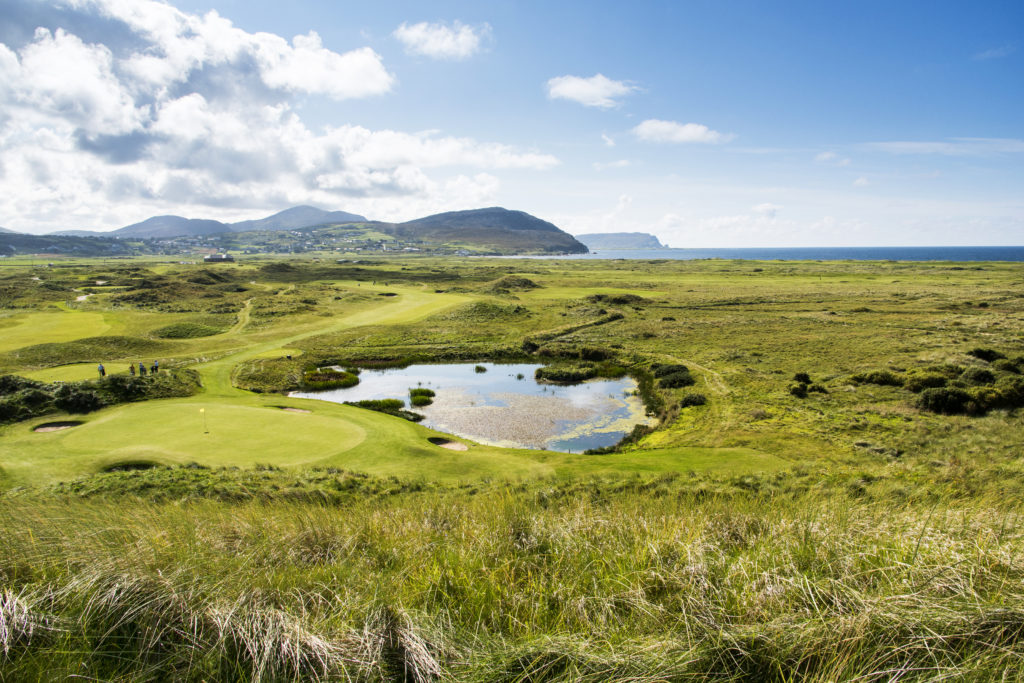 The Inishowen Peninsula, Co. Donegal
After standing a while looking at the islands floating in dreamlike quality and daydreaming about stumbling across a few pearls, it’s time to head into the uplands. A few stands of alien conifers — probably between thirty and forty years old — adorn the lower slopes of the Blue Stacks, but as the meadows fall away, you’re soon into limitless, rolling moorland leading to the mountains proper.
Most of Ireland would once have been covered with ash, alder, hazel and birch, but this woodland has long disappeared — and not just because of human intervention.
Listen to this, Fact Fans: research in Donegal has shown that eroded peat has been washing into mountain lakes for the last 3,000 years, causing the soil to erode and leaving it unable to support native woodland. So it isn’t all our fault!
Whatever the reason for Donegal’s magnificently surreal landscape, you’ll be struck by the almost wanton promiscuity of space, with moss-covered uplands stretching to the horizon.
As you head north from Lough Eske, the Ulster Way takes you to the east of Banagher Hill, with terrific views of the main peaks in the Blue Stacks, the Sligo mountains and Donegal Bay. This is Mother Nature in her wildest mood.
If the Blue Stacks have left you feeling that Donegal has, ahem, reached a peak, there’s good news. It’s only warming up.
Head west towards Slieve League (Sliabh Liag), where the cliffs rise more than 600 metres above the Atlantic. This is where the Old World comes to an abrupt end, with only three thousand miles and a million seabirds between you and New York.
Geology takes on a dizzying dimension here. Different hues in the metallic ores accumulate with washed-down clays and soils to produce a scene of elemental beauty.
The narrow ridge called One Man’s Pass is not even as nice as it sounds. I suspect the man in question had excellent balance and no imagination.
From up here, Donegal Bay and the Sligo mountains spread out before you; from a boat leaving Teelin, the cliffs look even more improbable.
You can recover your nerve at nearby Glencolmcille, then carry on to Malinbeg. Silver Strand lies tucked inside a horseshoe of cliffs, reached by a long flight of steps.
Donegal, however, has a habit of making you get back on the road just when you think you’ve seen the best of it. Glenveagh, at over 16,000 hectares, is the largest of Ireland’s five national parks. The park lies in the Derryveagh Mountains and takes its name from its central valley: Glenveagh, meaning “Glen of Birch”.
The steep sides of the glen hold the three-mile-long Lough Beagh, fully equipped with a lakeshore Victorian castle and immaculate gardens. The castle’s formal gardens contrast spectacularly with the surrounding mountains, woodland and moorland — home to one of the largest herds of red deer in Europe.
Out on the Fanad peninsula, the lighthouse stands between Lough Swilly and Mulroy Bay, with the Atlantic waiting beyond. There are tours if you want to hear about the people who kept its light burning.
Nearby Ballymastocker Beach is the place to take off your shoes and discover that Donegal sand can be wonderfully soft even when the breeze has other ideas.
And then there’s Malin Head, Ireland’s most northerly point. At Banba’s Crown stands a watchtower built in 1805, when people were keeping an eye out for Napoleon.
He never turned up, which must have made for some rather long shifts. Today you can watch the Atlantic instead, or walk towards the great cleft in the rock called Hell’s Hole. Stay on the safe paths: the sea makes quite enough of a spectacle without any help from you.
By this stage, you’ll have travelled from quiet lough shore to mountain, cliff and headland, and Donegal will still have places you haven’t seen. You could spend another week here. You probably should.
The Donegal poet William Allingham wrote: “I never came back to Ballyshannon after an absence, without thinking that it looked the oldest place I ever saw.”
Ballyshannon is just down the road from Harvey’s Point, and as you stand in this elemental and all but empty land stretching between Lough Eske and Eglish Valley, you’ll probably find yourself agreeing with Mr Allingham.
The place does seem inordinately old — even by Irish standards — and one of the most poignant, ethereal places you’ll ever come across.
Everything from irishpost.com and the print edition is available on the Irish Post App — plus more! Download it for Android or Apple IOS devices today.
See More: Blue Stack Mountains, Donegal, Letterkenny
